
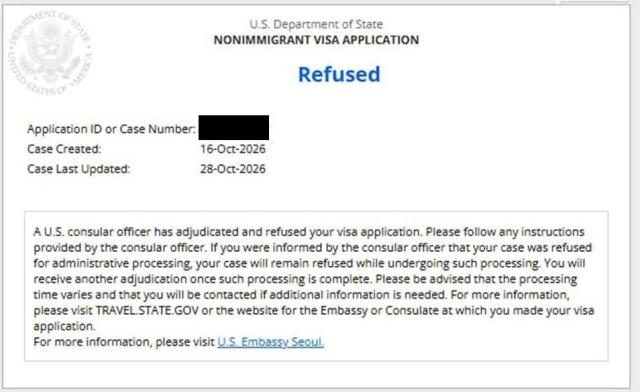
The controversy began on Wednesday when Rep. Jin Seong-joon of the ruling Democratic Party (DP), chairman of the National Assembly's National Defense Committee, disclosed that his application for an official A-2 visa had been marked "Refused" ahead of a planned visit to U.S. military commanders in Hawaii.
Jin was scheduled to lead a four-member parliamentary delegation to U.S. Indo-Pacific Command from Nov. 1 to 5 to discuss bilateral security cooperation and ways to strengthen the alliance.
According to Jin, meetings had already been arranged with senior U.S. military officials, including Adm. Samuel Paparo, commander of U.S. Indo-Pacific Command, and Adm. Stephen T. Koehler, commander of the U.S. Pacific Fleet.
The committee had also planned discussions with other American military commanders and representatives of Korean War veterans in Hawaii.
The reason for the visa refusal remains unclear. Jin was convicted of violating South Korea's National Security Act in 1991 and sentenced to three years in prison and a three-year suspension of qualifications. He was subsequently pardoned in 1995.
U.S. authorities have reportedly requested additional court documents concerning his conviction, including English translations. Jin previously visited the same U.S. military command in March 2014 while serving on the parliamentary defense committee.
The refusal does not necessarily mean that Jin has been permanently barred from entering the United States. The U.S. State Department's visa procedures allow certain applications classified as "Refused" to undergo further administrative processing and potentially be reconsidered.
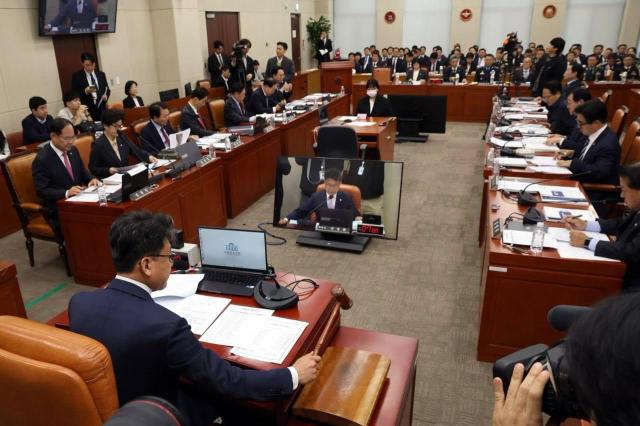
The U.S. State Department, responding to questions about the case, said visa applications are reviewed individually and declined to comment on Jin's specific circumstances.
"I strongly regret the United States' refusal to issue a visa to the chairman of the National Defense Committee of the National Assembly. Denying a visa to an elected representative of the South Korean people and the defense committee chairman of an allied nation's parliament disregards the standing of the National Assembly and undermines the mutual respect and trust that form the foundation of the bilateral alliance," Jin wrote on Facebook on Wednesday.
Jin argued that the decision went beyond restricting an individual's travel, saying it interfered with the National Assembly's official activities intended to strengthen bilateral security cooperation.
Rep. Jung Chung-rae, a former DP leader, also switched from the National Assembly's Foreign Affairs and Unification Committee's Americas delegation to its Europe delegation on Oct. 8 after delays in the issuance of his U.S. visa.
The two cases have prompted questions about whether the difficulties reflect individual immigration procedures or broader strains in relations between Seoul and Washington.
No evidence has been publicly established that either decision was intended as political retaliation.
Lawmakers from other U.S. allies have faced similar difficulties.
In July 2017, Khalil Eideh, a member of Australia's Victoria state parliament, was prevented from boarding a flight from Vancouver to Denver during an official study tour despite holding a U.S. A-2 visa, prompting Canberra to seek an explanation from Washington. In June 2025, French lawmaker Pouria Amirshahi was initially denied a U.S. visa for a trip to meet American legislators, despite support from France's foreign ministry. U.S. authorities subsequently reversed the decision, granting him a visa on June 20.

Cho said he would request that Washington expedite the applications during his visit for a Group of 20 foreign ministers' meeting in Atlanta, where he is also seeking talks with U.S. Secretary of State Marco Rubio.
The dispute comes amid other sensitive developments in bilateral security relations.
On Wednesday, the two governments agreed to postpone their annual Security Consultative Meeting (SCM), a ministerial-level defense dialogue, until early 2027. The defense chiefs instead plan to meet in Washington in December.
The delay has drawn attention to differences over the pace of transferring wartime operational control (OPCON) from Washington to Seoul, although South Korea's defense ministry has rejected suggestions that the revised meeting schedule signals a setback in the transfer process.
DP Rep. Heo Young emphasized that disagreements between the two countries should not be confused with a fundamental breakdown of the alliance.
"The South Korea-U.S. alliance was forged through a long history and trust built in blood. Depending on the issues at hand, countries may hold different positions as they prioritize their national interests and their people. We must respect and understand those differences," Heo told AJP.
"Those differences cannot undermine or change the fundamental trust, faith and future of the alliance," he added.
Patrick Cronin, the Hudson Institute's Asia-Pacific security chair, expressed concern over the treatment of an allied official while emphasizing the substantial benefits that closer cooperation offers both countries.
"Denying an allied official a visa is a serious breach of trust and should only happen under extraordinary conditions," Cronin told AJP.
"South Koreans and Americans have a tremendous opportunity move ahead with cooperation on shipbuilding, energy, semiconductors, critical minerals and secure supply chains that are fundamental to the economic, industrial, and national security interests of both countries," he added.
"The cases involving both Jung and Jin are clear evidence of recent friction between South Korea and the United States and the U.S. government's distrust of the Lee Jae Myung administration," Yoo Seong-min, a former four-term PPP lawmaker, told AJP.
Reform Party Rep. Cheon Ha-ram, who serves on the National Defense Committee and was scheduled to accompany Jin to Hawaii, expressed similar concerns.
"The fact that Jin, like former Democratic Party leader Jung, was denied a visa despite having previously received U.S. visas shows that Washington is dissatisfied with the foreign and security policies of the Lee Jae Myung administration and the DP," Cheon told AJP.
"It also suggests that the dissatisfaction has become so serious that the United States is no longer exercising restraint in expressing it," he added.
PPP Rep. Kim Gunn, a member of the Foreign Affairs and Unification Committee, also questioned the government's assessment of bilateral relations while calling for efforts to restore mutual confidence.
"There are several warning signs in the bilateral elations, yet the government keeps saying that there are no problems and that disagreements are being resolved smoothly," Kim told AJP.
"I am also concerned that some figures within the ruling camp are even making remarks that fail to recognize the value of the alliance," he added.
Another PPP lawmaker serving on the same committee, Kim Dae Sik, offered an even more critical assessment.
"The alliance is in an all-around crisis. The public is worried about whether the alliance is still functioning properly," Kim told AJP.
"What is Foreign Minister Cho Hyun accomplishing by going to the United States? Washington is not budging," he added.
Despite their differing assessments of the administration's handling of relations with Washington, the lawmakers' comments reflected a shared focus on the importance of trust within the alliance.
Whether Jin ultimately receives a visa remains unresolved, with Seoul maintaining that the review process is still open and Washington declining to disclose the grounds for its decision.
Copyright ⓒ Aju Press All rights reserved.
