
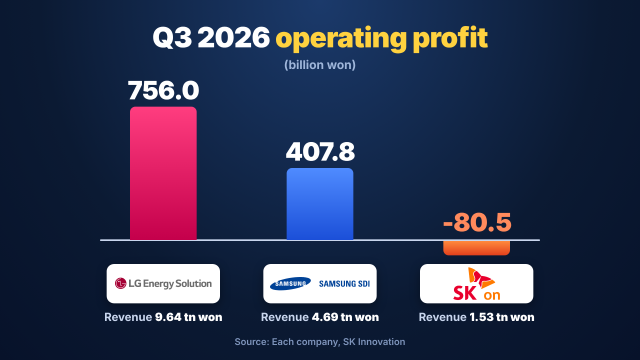
Samsung SDI on Thursday reported a third-quarter operating profit of 407.8 billion won (US$308 million), reversing a 591.3 billion won loss a year earlier.
The result, its largest in 12 quarters, came on climbing sales of energy storage systems (ESS) and battery backup units for AI data centers.
LG Energy Solution, the country's largest battery maker, posted record quarterly revenue of 9.64 trillion won, up 59 percent, in preliminary results released Oct. 8. Operating profit rose 25.7 percent to 756 billion won.
Stripped of 416.9 billion won in U.S. production tax credits, LG's operating profit came to 339.1 billion won, helped by rising ESS shipments in North America and compensation from some electric vehicle customers.
SK On, the battery unit of SK Innovation, was the only one of the three in the red. It swung to an operating loss of 80.5 billion won as battery sales fell and one-off gains from the previous quarter fell away.
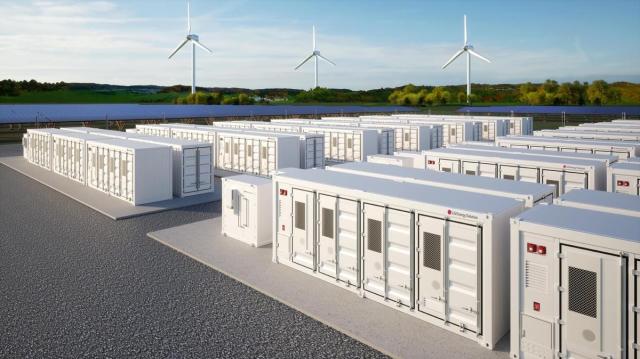
An ESS banks electricity in large arrays of batteries and releases it on demand, working as both a shock absorber and an insurance policy for data centers that cannot afford a second of downtime.
Global data center electricity consumption is set to more than double to about 945 terawatt-hours by 2030, according to the International Energy Agency.
South Korean manufacturers once dominated the field, holding about 70 percent of the global ESS market in 2017. A string of fires at storage sites in Korea then pushed them into retreat, and Chinese rivals moved in with cheaper lithium iron phosphate (LFP) cells.
Chinese companies still held 76 percent of North American ESS battery shipments in the first half of the year, according to SNE Research. North America took in 75.9 gigawatt-hours (GWh), about a sixth of global shipments.
The tides changed as U.S. President Donald Trump on Aug. 26 signed Executive Order 14420, declaring a national emergency over foreign-made power grid equipment. The order lets the Energy Department bar battery storage systems from foreign entities deemed a national security risk.
"Since the Trump administration tightened restrictions on China and pushed to reshape supply chains, interest in securing non-Chinese cells and stable suppliers has been rising, mainly among U.S. ESS operators and system integrators that had used Chinese cells," said Kim Young-kwang, SK On's head of financial management, on SK Innovation's earnings call.
South Korean battery makers have spent the electric vehicle slowdown retooling underused American EV lines to make LFP storage cells. LG Energy Solution now makes storage cells at five North American sites, aiming for more than 50 GWh of capacity by year-end.
Samsung SDI began mass-producing LFP storage cells in early October at StarPlus Energy, its Indiana joint venture with Stellantis. Its ESS orders this year topped 60 GWh through October, enough to run its storage lines in Indiana and Ulsan at full tilt through 2028.
SK On, a later entrant, is still converting lines at its Seosan plant in Korea and its Georgia factory, where cells are due to ship to U.S. firm NeoVolta from next year.
Samsung SDI said it has also signed leading global customers for cylindrical batteries used in humanoid robots and aerospace.
"Humanoids and aerospace are markets with very large growth potential over the mid to long term," Cho Han-je, Samsung SDI’s executive vice president for strategy and marketing, said on the call.
"By 2028, their share of revenue within our cylindrical battery business is expected to exceed 10 percent, contributing meaningfully to earnings."
The AI-driven ESS boom has also trickled down to other suppliers, including builders of ESS facilities. HD Hyundai Electric, a power equipment maker, booked record quarterly revenue of 1.18 trillion won in the third quarter.
"Our biggest concern right now is capacity. There are so many orders from the United States that profitability keeps climbing, with margins rising every quarter," an HD Hyundai Electric official said at an energy industry exhibition in Seoul this week.
"It is so much a seller's market that even if we add capacity, I don't think margins will fall," the official said.
The official said worries over a possible slowdown in AI investment had drawn frequent questions this quarter. "But that is not what our sales teams are feeling. There is still a lot left."
Talk of an AI bubble, and of chipmakers priced beyond their earnings, has hung over markets this month. Battery and power equipment makers share some of that unease, but are still adding lines and signing contracts that run years ahead.
Whatever becomes of the AI trade, the data centers already rising will still need to keep their lights on.
- Samsung SDI reported a third-quarter 2026 operating profit of 407.8 billion won on Oct. 29, its largest in 12 quarters, on higher sales of energy storage systems and battery backup units for AI data centers.
- LG Energy Solution posted record third-quarter 2026 revenue of 9.64 trillion won and operating profit of 756 billion won, while SK On swung to an operating loss of 80.5 billion won.
- Chinese companies held 76 percent of North American ESS battery shipments in the first half of 2026, according to SNE Research. U.S. Executive Order 14420, signed Aug. 26, 2026, lets the Energy Department restrict foreign-made grid battery storage.
- Samsung SDI said its ESS orders exceeded 60 GWh through October 2026, filling its Indiana and Ulsan lines through 2028. It expects humanoid and aerospace batteries to exceed 10 percent of its cylindrical battery revenue in 2028.
Copyright ⓒ Aju Press All rights reserved.
