SEOUL, October 30 (AJP) - Asked to imagine how artificial intelligence could go wrong in South Korea by 2036, ordinary citizens pointed not only to machines that break down but also to problems that arise when the technology works exactly as intended, according to a KAIST report announced Friday.
The report, "2036 AI Future Failure Scenarios," analyzed 429 scenarios from a nationwide idea contest that drew 732 participants. Only entries that met KAIST's Center for Ambitious Failure analysis criteria were included.
Participants used a method known as a premortem. Each assumed that a failure had already happened in 2036, a year when AI has become part of everyday life, then traced the causes backward to find choices that could still be changed today. The results were written up as one-page scenarios.
The report looked beyond malfunctions to what could go wrong when AI does what it is supposed to do. Contributors worried that leaning on AI would shrink people's own judgment and their chances to learn, and that when something went wrong, it would be unclear who was responsible.
From the submissions, the report built an "AI future risk map" covering eight domains, including education and learning, labor and expertise, and health and medical care, along with seven pathways to failure. It also examined conditions under which a single failure could grow into a wider social risk, such as the same error spreading in many places at once or heavy dependence on a handful of platforms.
The Center for Ambitious Failure (CAF) said the scenarios are not forecasts and do not estimate how likely any risk is. They record what people outside the AI field who have used generative AI services fear about the technology, and what human abilities, relationships and rights they want to protect. The center said their value lies in identifying questions that current technology, policy and institutions need to examine.
The report is one of two publications KAIST will present at its fourth Failure Conference, which runs from Nov. 4 to 13 on its Daejeon campus under the theme "Future and Failure." CAF was founded in 2021 to ease the fear of failure among members of the KAIST community and first held the conference in 2023.
KAIST President Bae Choong-sik said a university should be a place that respects and learns from "not only successful results but also the trial and error that comes with taking on a challenge."
The conference opens at 6 p.m. on Nov. 4 with the Failed Project Bragging Contest, organized with the student group ICISTS. KAIST students decorate booths with photos and videos to share setbacks from their studies, research and daily lives, and the audience votes for winners in five categories. Only students present, but members of the public can walk the booths and talk with them.
On Nov. 6 at 3 p.m., three winners of this year's failure essay contest will discuss their ongoing struggles with research and career plans. Seo Yong-seok, a professor at KAIST's Moon Soul Graduate School of Future Strategy, will follow with a lecture on why failure matters to people as AI grows smarter.
Throughout the conference, the lobby of the Creative Learning Building will host an exhibition of the citizens' 2036 scenarios and the risk map, alongside "Failure Photovoice," a display of photos and writing in which students recorded failures from daily life.
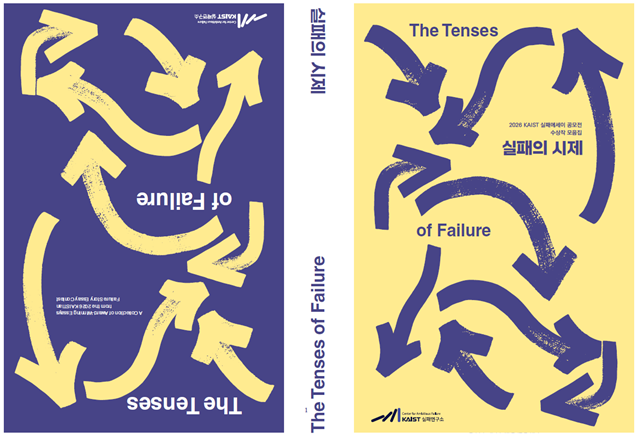
The second publication, "The Tense of Failure," collects the 16 winning entries from the 2026 essay contest. Several deal with failures that have not happened yet but already shape present choices.
Wang Seong-pil, a doctoral student at the Graduate School of Culture Technology, wrote about interdisciplinary research linking literature, statistical physics and AI that was repeatedly returned by journals unable to find reviewers for it. He asks whether growing better at avoiding rejection can be called success. Kim Yun-jeong, a doctoral student in the School of Electrical Engineering, describes switching from physics to electrical engineering in pursuit of quantum computing, and compares the detours to a layover on a trip that could have been a direct flight.
All conference programs are open to the public, and registration for the seminar is being taken online. Both publications will be posted as e-books on the center's website, caf.kaist.ac.kr.

Copyright ⓒ Aju Press All rights reserved.