SEOUL, Oct. 30 (AJP) - Wall Street's concerns over Alphabet's heavy spending on artificial intelligence (AI) infrastructure spread to South Korean and Japanese chipmakers that supply the tech giant, sending the KOSPI down 3.5 percent on Friday.
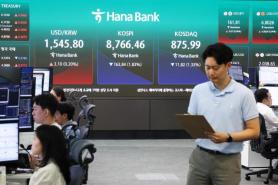
In Seoul, the benchmark KOSPI fell 209.62 points or 3.48 percent to close at 5,730.74.
The main index dropped as much as 5.7 percent during the session, hitting a low of 5,599.4. The Korea Exchange triggered a five-minute suspension of program sell orders, known as a sidecar, after KOSPI 200 futures fell by more than 5 percent for one minute.
It was this year's 28th sell-side sidecar and the first since October 15, when the KOSPI plunged 7.6 percent.
Foreign investors sold a net 1.51 trillion won (US$1.13 billion) worth of KOSPI-listed shares, ending a three-session buying streak. SK hynix fell 7.1 percent, while Samsung Electronics dropped 3.0 percent.
In Japan, the Nikkei 225 also declined 2.1 percent as chip-related stocks came under pressure.
The decline came after Alphabet shares plunged 12.6 percent in New York overnight, marking their biggest one-day drop since the company went public in 2004. The company reported negative free cash flow of $9.07 billion in the third quarter, raising concerns among investors about whether major technology companies can sustain their heavy spending on AI infrastructure and memory chips supplied by South Korean manufacturers.
Individual investors absorbed the foreign selling with net purchases of 682.8 billion won ($511.8 million). Institutions, net sellers for much of the session, finished 576.1 billion won ($431.8 million) on the buy side.
SK hynix closed at 1,418,000 won ($1,062.81). Samsung Electronics ended at 225,000 won ($168.64), losing less than half as much as its rival.
SK hynix had rallied earlier in the week after its quarterly results and a 60 trillion won ($44.97 billion) shareholder return plan.
Decliners outnumbered gainers 680 to 204. Among the country's 10 largest companies by market value, only Samsung Biologics and LG Energy Solution finished above Thursday's close.
Samsung Biologics rose 5.7 percent to 1,444,000 won ($1,082.30). LG Energy Solution added 1.0 percent to 359,500 won ($269.45).
The tech-heavy KOSDAQ fell harder, sliding 3.8 percent to 724.4.
The South won strengthened to 1,334.2 per dollar from 1,340.5, despite the foreign outflow.
In Tokyo, the Nikkei 225 fell 1,369.36 points to 63,290.1. Intel's plunge of more than 20 percent in after-hours trading and disappointing results from Amazon added to the Alphabet hit.
Substrate maker Ibiden, which counts Intel as a major customer, touched its daily trading limit. Advantest, Tokyo Electron and Kioxia also dropped sharply.
In Seoul, fellow substrate maker Samsung Electro-Mechanics lost 7.5 percent to 1,196,000 won ($896.42). It was the steepest drop of the day among South Korea's 10 largest stocks.
The KOSPI ends October down 16.2 percent.
Alphabet maintained its 2026 capital spending forecast of $195 billion to $205 billion, suggesting that orders for South Korean memory chipmakers remain steady for now. However, continued investor concerns over heavy spending could eventually pressure major technology companies to scale back their investments, potentially affecting demand for memory chips.
AJP Takeaways
- South Korean and Japanese chip stocks fell after Alphabet shares lost 12.6 percent in New York. The KOSPI dropped 3.5 percent and the Nikkei 225 fell 2.1 percent.
- Foreign investors sold a net 1.51 trillion won ($1.13 billion) of KOSPI shares, ending a three-session buying run. Individuals and institutions were net buyers.
- SK hynix fell 7.1 percent against 3.0 percent for Samsung Electronics, and the KOSPI closed October down 16.2 percent.
Copyright ⓒ Aju Press All rights reserved.