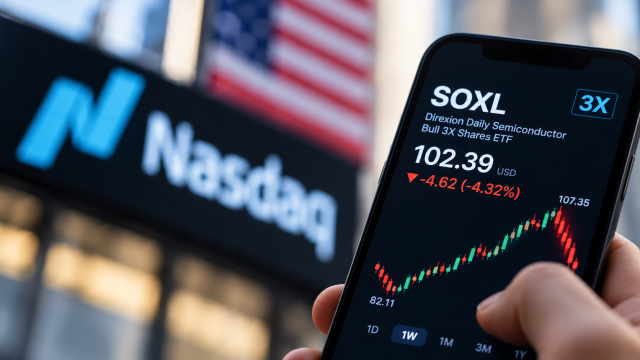
South Korean investors have poured more money into U.S. stocks this month than in any other month this year, with two-thirds of their net purchases going into a triple-leveraged semiconductor exchange-traded fund (ETF). The buying frenzy comes despite wild swings in chip stocks, doubts over artificial intelligence (AI) investment returns and currency risks that could wipe out their gains.
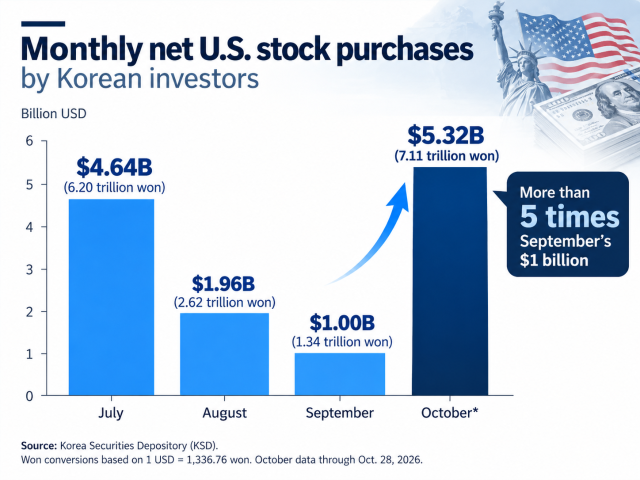
South Korean investors bought a net US$5.32 billion in U.S. stocks from Oct. 1 to 28, more than five times September's $1 billion and the highest monthly total so far this year, according to Korea Securities Depository (KSD) data. Net purchases had fallen steadily from $4.64 billion in July to $1.96 billion in August and $1 billion in September before rebounding sharply this month.
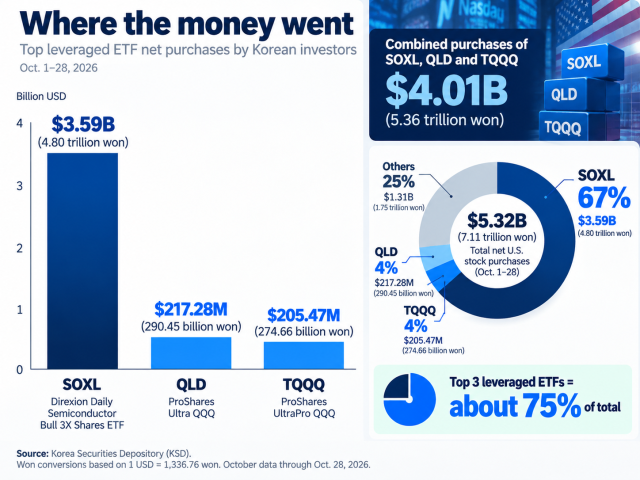
The Direxion Daily Semiconductor Bull 3X Shares ETF (SOXL) attracted $3.59 billion in net purchases, accounting for about 67 percent of all Korean net buying of U.S. stocks during the period.
SOXL seeks to deliver three times the daily return of the NYSE Semiconductor Index, which tracks major semiconductor companies. A 2 percent gain in the index would translate into a roughly 6 percent gain for the fund in a single day, before fees and expenses. The same leverage works against investors when chip stocks fall.
The appetite for leveraged investments extended beyond semiconductors. Korean investors purchased a net $217.28 million of ProShares Ultra QQQ (QLD), which targets twice the Nasdaq-100's daily return, and $205.47 million of ProShares UltraPro QQQ (TQQQ), which targets three times the return.
Together, the three leveraged ETFs attracted $4.01 billion, roughly three-quarters of Korea's net U.S. stock purchases.
Yang Jun-sok, an economics professor at the Catholic University of Korea, attributed the rush partly to Korean investors' longstanding appetite for high-risk investments.
"Korean investors have always had a strong appetite for risky investments," Yang said. "Even looking back 10 years, investment in derivatives and cryptocurrencies was relatively high compared with other countries."
A global survey by UK-based consumer research firm GlobalWebIndex (GWI), published in 2025, found that 12 percent of South Korean internet users aged 16 and older owned cryptocurrency, more than twice Japan's 4.9 percent. The figure also exceeded 8.1 percent in Britain and 11.4 percent in the United States.
Yang said the desire to make large gains quickly helps explain why Korean investors are drawn to triple-leveraged products.
Recent market swings, however, have exposed the risks of that strategy. SOXL plunged 20.47 percent on Oct. 22, when the Philadelphia Semiconductor Index, a widely followed industry benchmark, fell 6.72 percent.
The fund then rebounded from $82.11 on Oct. 22 to $107.35 on Oct. 28, a gain of about 31 percent, only to fall another 4.62 percent to $102.39 on Thursday.
The risk also extends beyond sharp daily losses. SOXL resets its leverage every trading day, meaning longer-term returns can differ sharply from three times the index's cumulative performance.
For example, if the underlying index falls 10 percent one day and rises 11.1 percent the next, it returns roughly to its starting point. A three-times leveraged fund would instead lose 30 percent on the first day and recover only 33.3 percent on the second, leaving investors down about 6.7 percent even before fees and expenses.
Such swings can leave investors with losses even when the underlying index recovers.
Yang questioned whether investors were truly unaware of the risks, pointing to the longstanding popularity of leveraged ETFs among South Korean investors. The country also requires training before individuals can trade certain high-risk products.
"Some may not have fully understood the risks," he said. "But investors going so far as to buy triple-leveraged products overseas can hardly claim they didn't know what they were getting into."
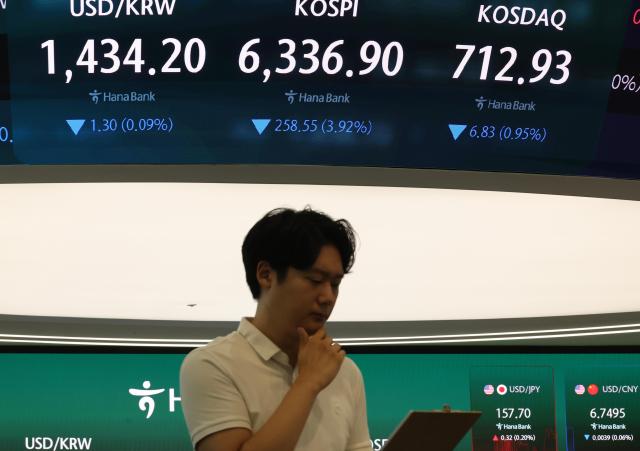
The won strengthened to 1,335.60 per dollar on Friday. A stronger won makes dollar-denominated stocks cheaper to buy, but it can also reduce the value of those investments when investors convert their proceeds back into Korean currency.
Yang said yet the stronger won could be another reason for the surge in U.S. stock purchases, as new investors can buy dollar assets at a lower cost than when the won was weaker.
"For those who have already invested in the U.S., gains can be offset by a stronger won," he said. "But for people buying now, a stronger won makes U.S. investments cheaper."
He said the prospect of currency losses could also push some investors toward leveraged products in pursuit of higher returns.
"When exchange-rate movements offset investment gains, investors may look for even higher returns to compensate," he said.
A Korean investor who earns a 10 percent return on a U.S. ETF in dollar terms, for example, would see that gain shrink to about 4.5 percent in won terms if the dollar weakened 5 percent against the won over the same period.
If the ETF falls while the won strengthens, the two losses can compound.
Beyond the risks of leverage and currency movements, investors also face uncertainty over whether the AI boom can generate enough profits to sustain the spending behind the chip rally.
Google parent Alphabet reported negative free cash flow of $9.07 billion in the third quarter, after spending $51.36 billion on capital investment, largely driven by AI infrastructure. Its shares plunged 12.6 percent the following day as investors questioned whether the spending would pay off.
The cost of financing the AI expansion is also mounting. Five major U.S. technology companies - Alphabet, Amazon, Meta, Microsoft and Oracle - raised a combined $326 billion through stock and bond issuance in 2026 through late October, more than three times the amount raised in 2025, according to S&P Global Market Intelligence.
Yang drew a contrast between U.S. technology companies investing heavily in future AI growth and Korean chipmakers already earning profits from supplying them.
"American AI companies are investing heavily in the future, and some are borrowing enormous amounts of money to do so," Yang said. "Korean semiconductor companies, on the other hand, are already selling actual products and making profits."
SK hynix is a case in point. The South Korean memory-chip maker reported a record 83.33 trillion won in third-quarter operating profit on revenue of 104.62 trillion won, driven by strong demand for high-bandwidth memory and other advanced chips used in AI systems.
The company also said long-term supply agreements covered more than half of its planned production capacity for 2027 and 2028, giving it greater visibility over future demand.
Even with orders secured years ahead, however, Korean chipmakers remain exposed to the spending decisions of their U.S. customers.
"If U.S. AI investments fail to generate sufficient returns, companies could scale back spending, with the impact eventually rippling through to Korean chipmakers," Yang warned.
The uncertainty over U.S. AI investment adds another layer of risk to the gamble on a chip rebound. If U.S. AI spending slows, chip demand could weaken, while sharp swings in leveraged ETFs and currency losses could leave investors with less than they expected.

Copyright ⓒ Aju Press All rights reserved.