

AJP Factbox: Skin care drives Korea’s foreign patient boom
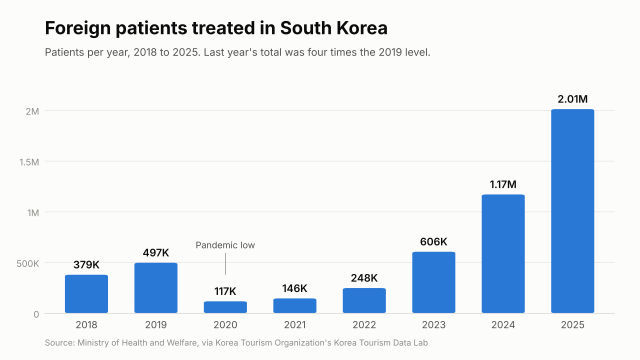
SEOUL, November 02 (AJP) - South Korea's state tourism agency is using big data to learn who travels to the country for medical treatment and how they spend, as foreign patient numbers climb to four times pre-pandemic levels.
Foreign patients treated in South Korea totaled 2,011,822 last year, up 71.9 percent from 2024, according to the Ministry of Health and Welfare. The figure marked the third consecutive annual record and the first above 2 million since the ministry began counting in 2009. In 2019, before the pandemic, the count stood at 497,464.
The Korea Tourism Organization (KTO) said Monday that it will present recent findings at a seminar on Nov. 26 at the COEX ASEM Ballroom in Seoul. Drawing on tourism big data, the agency will lay out the main characteristics of foreign medical tourists, where they go in the country and what they spend on.
A panel of medical tourism experts will then discuss the sector's growth opportunities and the problems it faces. Registration is open to the public through Nov. 12 on KTO's Korea Tourism Data Lab website.
The government treats medical tourism as a high-value industry because patients spend far more than ordinary visitors. The Korea Institute for Industrial Economics and Trade estimated that foreign patients and their companions spent 12.5 trillion won ($9.3 billion) in South Korea last year, producing 22.8 trillion won in total economic impact.
Most come for skin treatment, with dermatology accounting for 62.9 percent of foreign patients last year, followed by plastic surgery at 11.2 percent and internal medicine at 9.2 percent.
The ministry attributed the surge to visa-free entry for Chinese tour groups, a value-added tax refund on cosmetic procedures for foreign tourists, and the global spread of K-pop and K-beauty. The tax refund expired on Dec. 31, 2025, and bills to revive it are pending in the National Assembly.
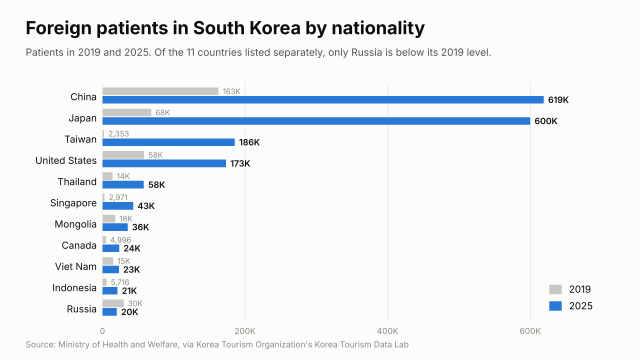
China regained the top spot last year with 618,973 patients, or 30.8 percent of the total, overtaking Japan, which had led in 2023 and 2024. Japan followed with 600,009, and the two neighbors together accounted for 60.6 percent of all foreign patients, up from 46.5 percent in 2019.
Taiwan sent 185,715 patients last year, up from 2,353 in 2019. Patients from the United States reached a record 173,363, a rise of 70.4 percent from 2024.
Patients from Russia went the other way, numbering 20,262 last year, still below the 29,897 recorded in 2019.
Seoul handled 87.2 percent of foreign patients last year, and 87.7 percent were treated at small clinics rather than hospitals.
KTO has begun preparing a longer-term plan for the sector. In September, the agency put out to tender a market survey of inbound medical tourism along with a mid- to long-term business strategy.
Kim Young-mi, who heads KTO's Tourism AI Innovation Division, said the industry needs to read market changes accurately through data "and connect this to tangible results in the field."
The Ministry of Justice has eased entry for patients as well, raising the number of hospitals and agencies designated as top medical tourism facilitators to 112 from Oct. 1. Patients who book through them can receive electronic visas within three days of applying.
Medical spending by foreign visitors, which includes pharmacy purchases, has kept rising this year, topping 200 billion won every month since March, according to the Korea Tourism Data Lab. From January to September, the total reached 1.84 trillion won, up 57.9 percent from the same period in 2025.

Copyright ⓒ Aju Press All rights reserved.
