
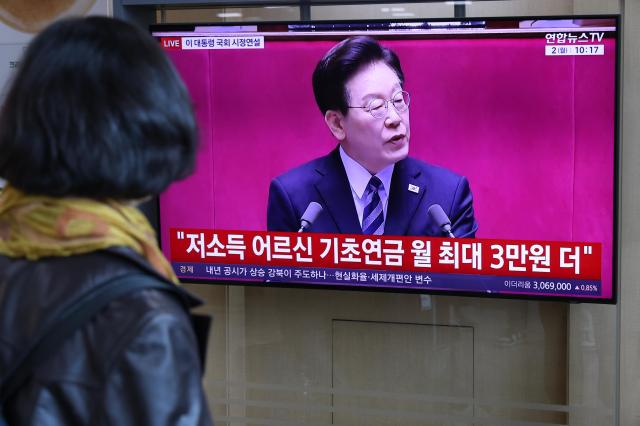
SEOUL, November 02 (AJP) - President Lee Jae Myung on Monday pitched South Korea’s largest-ever budget of 820.9 trillion won ($612.8 billion) for 2027 to accelerate the transition to artificial intelligence (AI) and modernize defense, channeling this year’s extraordinary chip windfall into stronger long-term growth.
“We will invest boldly in AI and future growth engines to raise the growth potential that forms the fundamental strength of our economy,” Lee said in a parliamentary address as the National Assembly began reviewing the spending proposal ahead of the Dec. 2 passage deadline.
The proposed budget represents a 12.8 percent increase from this year’s 727.9 trillion won. Lee described it as a budget to secure South Korea’s place among leading nations and ensure that national growth translates into gains for individual citizens.
His pitch centers on using additional tax revenue to prepare the economy for the future while spreading the benefits of a semiconductor boom that has delivered extraordinary corporate profits but uneven improvements in living standards.
Lee said the proposed Future Response Fund would serve as “an innovative fiscal stabilization mechanism to respond to fluctuations in tax revenue.”
“We will concentrate the additional tax revenue secured through the people’s collective efforts on four pillars: young people, future growth engines, regional development, and education and talent,” he said.
The president outlined three principles behind the proposal: invest boldly while eliminating waste, prioritize direct spending over tax breaks, and give regions outside the capital preferential support to promote balanced development. All spending programs had been reviewed from the ground up, he said.
A central pillar is 21.3 trillion won in AI investment, including three major national projects involving semiconductors, physical AI and AI data centers.
The government plans to allocate 2 trillion won to expanding semiconductor production infrastructure, 500 billion won to demonstrations of physical AI technologies and 4.7 trillion won to developing South Korea’s own AI models.
Physical AI enables intelligent systems to interact with the physical world through applications such as industrial robots, autonomous machines and AI-powered manufacturing. Research and development spending would rise by 4 trillion won to a record 39.5 trillion won, including 13.8 trillion won for 10 strategic technology sectors.
Lee also pledged to accelerate the energy transition, with 2.8 trillion won for renewable energy, including community solar projects that generate income for residents. Electric vehicle subsidies would cover a record 430,000 vehicles.
Defense expansion is another standout feature of the 2027 spending plan, with the budget rising 8.2 percent to 73.3 trillion won as the Lee administration seeks to complete the transfer of wartime operational control (OPCON) from the United States to South Korea within his five-year term.
Lee pledged to accelerate the acquisition of advanced weapons systems, including nuclear-powered submarines and domestically developed KF-21 fighter jets, while strengthening capabilities needed for the transfer of wartime operational control (OPCON) from the United States to South Korea.
The military would expand its use of AI, robotics and drones to respond to emerging threats and a shrinking pool of recruits. The government also aims to raise monthly compensation for junior military officers and noncommissioned officers to around 3 million won ($2,240).
Beyond technology and defense, Lee acknowledged that South Korea’s economic achievements had not improved living standards for everyone. Inequality and polarization persist, while regional economies have been slow to recover.
“We must move beyond the outdated dichotomy of growth versus distribution and present a new formula for growth,” he said. He called for a shift from gains concentrated among a limited number of companies, regions and social groups toward “growth for everyone.”
The proposal earmarks 33 trillion won for balanced regional development and locally driven growth. Government agencies would begin relocating from the Seoul metropolitan area to other regions next year.
The rural basic income program would expand to 35 counties, alongside increased support for regional medical services and higher education.
Youth-related spending would total 43.3 trillion won, covering housing, employment and education. Other priorities include 11.6 trillion won for culture, sports and tourism and a new 1.4 trillion won resource security fund to strengthen access to critical minerals and overseas supply chains.
The Future Response Fund, to be financed largely by additional tax revenue from the semiconductor boom, has emerged as a point of political contention.
The main opposition People Power Party has questioned its fiscal implications and urged the government to use more of the windfall to reduce national debt. The ruling Democratic Party argues that long-term investment is necessary to sustain growth.
Lee said South Korea was approaching $1 trillion in annual exports and was expected to surpass $40,000 in per capita gross national income. Such milestones would mean little, however, unless ordinary citizens felt improvements in their lives.
“The key is execution and speed,” he said, urging bipartisan cooperation to pass the budget on time.
Copyright ⓒ Aju Press All rights reserved.
