
SEOUL, November 02 (AJP) —South Korean investors could receive cash the next business day after selling shares under a new settlement system planned for 2028, a day sooner than under the current system.
Buyers would also have to pay a day earlier. Those who fail to cover a cash shortfall could face an earlier forced sale of their shares by brokerages seeking to recover the unpaid amount.
The Korea Exchange (KRX) on Monday outlined plans to move from the current T+2 settlement cycle to T+1, shortening the interval between a trade and the exchange of cash and securities from two business days to one. The change would cover stocks, exchange-traded funds (ETFs) and exchange-traded notes (ETNs).
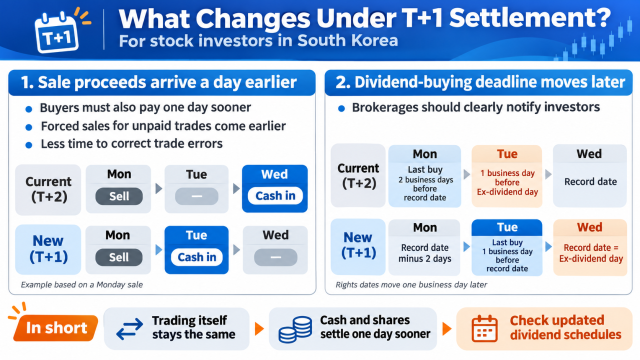
An investor selling shares on Monday currently receives the proceeds on Wednesday. Under the proposed system, the money would arrive on Tuesday, assuming no market holidays.
For investors who buy shares without enough cash in their accounts, the payment deadline would move forward by one business day. Failure to pay could trigger a forced sale on the second business day after the trade, rather than the third under the current system.
The shorter cycle would also give investors an extra day to buy shares and qualify for dividends and other shareholder rights. Purchases could be made one business day before the record date, compared with two business days under the existing framework.
The overhaul is intended to reduce the value of trades awaiting settlement and the risk that either side fails to meet its obligations. It could also lower margin requirements for brokerages and accelerate automation in trade processing.
South Korea has operated a T+2 settlement framework since 1972. The two-day window gives financial institutions time to verify transactions, correct errors, arrange funding and complete transfers.
Doing that work in a single day would require substantial changes to systems and operations at brokerages, custodians and clearing institutions. Overseas investors face the additional challenge of arranging currency conversions across time zones.
The KRX and Korea Securities Depository (KSD) aim to complete infrastructure upgrades by October 2027. Financial institutions and overseas investors are expected to finish their own preparations by the first quarter of 2028, followed by at least six months of joint testing before a planned transition later that year.
The launch date remains unsettled, however, as overseas institutions seek enough time to adapt.
In a survey of 32 overseas brokerages, custodians and investors, 17 said they needed at least 18 months to prepare. Twenty-seven respondents, or 84.4 percent, preferred a launch in the second half of 2028 or later.
Time-zone differences would leave foreign investors with a narrower window to confirm trades, convert currencies and obtain settlement approvals. Some institutions may need additional staff for overnight operations.
The shift would bring South Korea into line with a growing number of major markets. The United States adopted T+1 settlement in May 2024, while the European Union and Britain are targeting October 2027. Hong Kong plans to follow in the second half of 2028.
Ahead of the overhaul, South Korean brokerages are introducing loans that allow investors to access stock-sale proceeds before settlement, at lower interest rates than existing products.
Mirae Asset Securities was scheduled to begin offering the loans Monday, followed by Kiwoom Securities on November 20. Other brokerages are expected to join later.
The KRX said it would finalize the transition date after consulting financial authorities, domestic and overseas financial institutions and investors. Maintaining reliable settlement with minimal failures would remain a priority.

Copyright ⓒ Aju Press All rights reserved.
