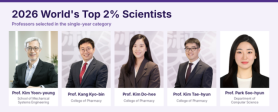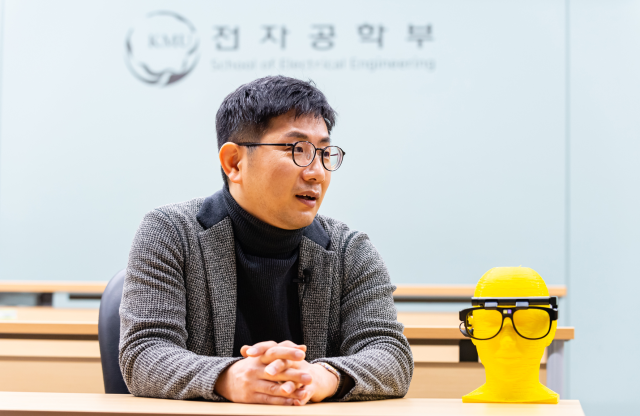
SEOUL, November 02 (AJP) - A Kookmin University engineer whose research helps chipmakers predict how long a semiconductor will last made the 2026 edition of the World's Top 2% Scientists list, compiled by Stanford University and the academic publisher Elsevier.
The list draws on Elsevier's Scopus research database and ranks scientists by citation-based measures of research impact, selecting the top 2 percent in each field. Kim Dae-hwan, a professor in Kookmin's School of Electrical Engineering, has published 484 papers in international journals and at major conferences, and his work has been cited 7,926 times, according to Scopus figures as of October, the university said Monday.
Kim's field is oxide semiconductors, in particular indium gallium zinc oxide, or IGZO, a material already used in display screens and now being developed for next-generation memory chips. He studies the physics of how transistors made from it behave.
His best-known contribution is a set of electrical and optical techniques for measuring the distribution of tiny defects inside the material, which engineers call the density of states in the band gap. Kim built device analysis and simulation models on those measurements, giving engineers a way to estimate a chip's lifespan and stability at the design stage rather than after it is built.
More recently, Kim has extended his research into chips for artificial intelligence and into circadian rhythm and sleep healthcare. He studies the reliability of oxide semiconductor transistors used in stacked circuits, display driving and 4F2 DRAM, a layout that packs memory cells into the smallest area current designs allow.
His lab is also working on transistors stacked directly on top of memory chips, memory devices that operate at the extremely low temperatures quantum computers require, and stacked memristors that speed up AI training and inference.
A memristor stores and processes data in the same place, much as synapses connect nerve cells in the human brain. Because data no longer has to shuttle between separate memory and processing units, the university said the approach could cut the power AI computing consumes and feed into the development of low-power chips. Kim is building these devices from oxide semiconductors.
From 2016 to 2022, Kim led the Circadian ICT Research Center, funded by the Ministry of Science and ICT. His team developed a technology that estimates a person's melatonin rhythm from heart signals alone, a sensor that detects light pollution, and Melight, a device that adjusts blue light by time of day. Blue light affects how much melatonin, the hormone that regulates sleep, the body releases.
Those technologies are being turned into personalized lighting and sleep management services by CirKadian, the first subsidiary of Kookmin's technology holding company. The university said they could help shift workers and people with sleep problems manage their health.
Kim said he was honored by the selection and credited the faculty and students of his SiLK lab, his co-researchers and industry partners.
"I believe research that digs all the way into the principles of semiconductor devices ultimately leads to technology that changes people's lives," he said.
He said he plans to deepen his work on AI chips and next-generation memory, and to refine technology that reads circadian rhythms with semiconductor sensors and adjusts them with light "so that anyone can stay healthy in everyday life."
Kookmin said Kim's research ties into KMU Vision 2035: EDGE, the university's long-term development plan, which names advanced materials and semiconductors, AI+X and biotechnology among eight fields it has chosen to specialize in.

Copyright ⓒ Aju Press All rights reserved.