
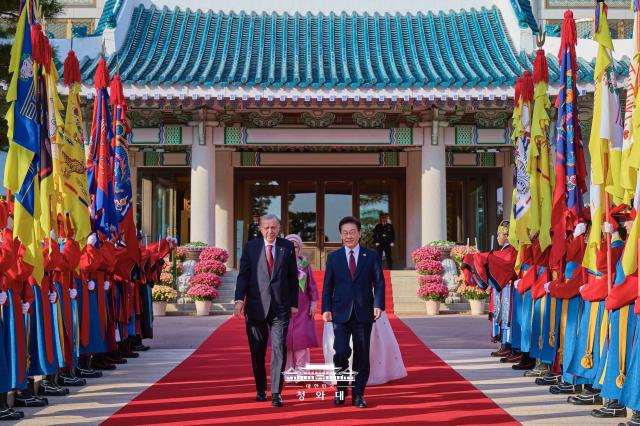
SEOUL, November 03 (AJP) - South Korea and Türkiye agreed Tuesday to back Korean companies' bid for Türkiye's next nuclear power plant with a dedicated financing framework and to explore joint entry into third-country defense markets, during a state visit to Seoul by Turkish President Recep Tayyip Erdoğan.
The two governments adopted four memorandums of understanding (MOUs) on energy, nuclear project financing, natural resources and mining, and science and technology after President Erdoğan held summit talks with President Lee Jae Myung at Cheong Wa Dae. The two countries' investment promotion agencies signed a fifth MOU separately.
Trade between the two countries reached $10.7 billion last year, the highest since diplomatic ties were established, according to Lee. A free trade agreement between them took effect in 2013.
"Türkiye has taken its place in the hearts of our people as 'kan kardeş,' brothers who share blood," Lee said at a joint press announcement after the talks, paying tribute to Turkish soldiers who fought in the Korean War.
Nuclear power led the economic agenda. The Export-Import Bank of Korea signed an MOU on nuclear project financing with Türkiye Nükleer Enerji A.Ş., the state company responsible for developing Türkiye's new nuclear plants. Hwang Ki-yeon, the bank's president, and Necati Yamaç, the company's chief executive, signed the agreement.
Under the deal, the two institutions will set up a system for exchanging strategic information on projects that involve Korean companies. They will also work together to review whether financial support is feasible and to identify potential financing opportunities.
Cheong Wa Dae said that putting a financing channel in place early would improve Korean companies' chances of winning nuclear contracts in Türkiye.
Türkiye plans to build its second nuclear power plant in Sinop, on its Black Sea coast. Korea Electric Power Corp. and the Turkish state nuclear company signed a cooperation agreement on the project last November, when Lee visited Ankara.
Lee said work under that agreement, including site evaluation and a joint working group, was "proceeding smoothly." He said the new financing agreement would support Korean companies' participation in Türkiye's new nuclear power projects.
On defense, the two countries held a joint committee on defense industry and logistics in July. At that meeting, they agreed to look for new areas of cooperation building on the Altay tank program, Türkiye's domestically developed main battle tank, which was built with technical support from Hyundai Rotem and fitted with a South Korean engine and transmission. In September, they signed a letter of intent on cooperation in naval vessels.
"We will continue to expand cooperation and seek joint entry into third countries," Lee said.
He also acknowledged friction in trade. Lee pledged to resolve the trade imbalance, import restrictions and customs delays "one by one, so that companies of both countries can operate in a more stable environment."
The energy MOU was signed by Kim Sung-whan, South Korea's minister of climate, energy and environment, and Alparslan Bayraktar, Türkiye's minister of energy and natural resources. It covers joint research to accelerate the energy transition and wider exchanges of policy and technology in renewable energy, power grids and nuclear power.
The agreement also creates a Korea-Türkiye Energy Transition Forum to identify specific projects. Lee said the forum would broaden cooperation in clean energy, hydrogen and renewable energy.
Bayraktar also signed the natural resources and mining MOU with Kim Jung-kwan, South Korea's minister of trade, industry and resources. The two sides will share information on critical minerals and rare earth deposits, form a strategic partnership in advanced rare earth materials, and cooperate on digitalizing mine operations.
Rare earths are used in the permanent magnets that drive electric vehicle motors and wind turbines. Cheong Wa Dae said the agreement would open a government-level channel on resources and lay the groundwork for technology and investment cooperation aimed at diversifying critical mineral supply chains.
Deputy Prime Minister and Science Minister Bae Kyung-hoon signed the science, technology and innovation MOU with Turkish Foreign Minister Hakan Fidan. It covers joint research and exchanges of researchers and information in six fields, including artificial intelligence, biotechnology, advanced telecommunications and advanced materials. Lee said the two countries would also hold their first joint committee on science and technology.
In biotechnology, Lee pointed to SK Plasma's role in Türkiye's program to become self-sufficient in blood-derived medicines. The company is helping build a plasma fractionation plant, which separates donated blood plasma into treatments such as albumin and immunoglobulin, and Lee pledged to keep the project on schedule.
The fifth agreement was signed by Kang Kyung-sung, president of the Korea Trade-Investment Promotion Agency, and A. Burak Dağlıoğlu, president of the Investment and Finance Office of the Presidency of Türkiye. The two agencies will exchange economic data and information on investment conditions, including joint ventures, mergers and acquisitions, and greenfield and brownfield projects. They will also help arrange high-level government and business visits.
Cheong Wa Dae said the channel would expand two-way investment and strengthen support for Korean companies entering Türkiye.
The two leaders also discussed security. Lee said Türkiye reaffirmed its consistent support for Seoul's North Korea policy and agreed to cooperate on establishing peace on the Korean Peninsula.
The two sides exchanged views on the war in Ukraine and the situation in the Middle East. They agreed to stay in close contact to support peaceful resolution of conflicts and the restoration of regional stability. As middle powers committed to a rules-based international order, they will also widen coordination at the United Nations and the Group of 20, Lee said.
Lee later hosted a state dinner for President Erdoğan at Yeongbingwan, the state guest house at Cheong Wa Dae. Business leaders including Hyundai Motor Group Executive Chair Chung Eui-sun, POSCO Group Chairman Chang In-hwa and Hyundai Rotem CEO Lee Yong-bae attended. The menu was planned around both countries' food cultures and included halal galbi kebab with smoked eggplant and grilled Deodeok, a mountain root, and bibimbap made with native Korean rice.
Lee noted that President Erdoğan often quotes poetry. He then cited a line from "Visitor" by Korean poet Chung Hyun-jong, which says that when someone comes to visit, their past, present and future come with them.
"I believe President Erdoğan's visit symbolizes the meeting of our two countries' past, present and the future we will open together," Lee said. He added that next year marks the 70th anniversary of diplomatic relations.
In his reply, President Erdoğan recalled Türkiye's role in the Korean War. "Seventy-six years ago, our brave soldiers sacrificed themselves for the freedom and independence of the Republic of Korea, and relations between our two countries grew into a blood alliance," he said.
Türkiye sent 21,212 troops to the 1950-53 war, and 741 of them were killed, according to South Korea's Ministry of National Defense.
Copyright ⓒ Aju Press All rights reserved.
