
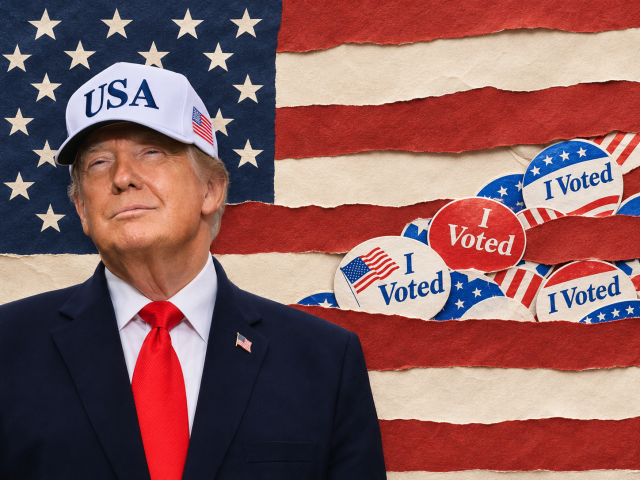
Voters want a life they can afford and a government they can hold to account. The blue wave emerging from the U.S. midterm elections carries that message well beyond Washington.
For South Korea, the warning is especially close to home: an economy riding the artificial intelligence boom depends heavily on investment decisions in a country whose voters are questioning who pays for growth.
Democrats have won control of the Senate and are on course to retake the House of Representatives. The scale of the rebuke to President Donald Trump became clear even before the final congressional balance was settled. Voters who gave Republicans control of Washington two years ago are moving to limit that power.
The temptation is to read the result as an ideological conversion. A more persuasive reading is that voters are demanding relief from everyday costs and protection against a government that has grown arrogant and insulated from their concerns.
A national voter survey conducted by SSRS for major U.S. news organizations puts those demands together. Roughly nine in 10 respondents said living costs were a crucial or major factor in their congressional vote. About seven in 10 said Congress was not doing enough to check the president. Anxiety about the grocery bill and anxiety about the exercise of power were part of the same electoral judgment.
A household cannot separate economic policy from the way decisions are made. Tariffs reach the checkout counter. War reaches the fuel pump. Decisions about health coverage reach the family budget. When leaders dismiss those consequences, the ability to challenge them becomes an economic concern as well as a democratic right.
Recent elections in Israel and Brazil offer different versions of that demand for limits.
Israel’s election left Benjamin Netanyahu’s bloc with 53 seats in the 120-seat parliament, short of a majority. The opposition won 48 and Arab-led parties 19. This was no straightforward victory for the left. Security failures, wartime accountability and unequal military-service obligations were central divisions. The result denied any one bloc the power to govern alone.
Brazil re-elected Luiz Inácio Lula da Silva with 51.79 percent of the vote while returning a strongly conservative Congress. The presidency and legislature carried competing mandates. Lula’s victory preserved his social-policy agenda, but it did not give him an unrestricted mandate to carry it out. Markets delivered their own verdict: Brazilian stocks and the real plunged as investors unwound bets on a right-wing victory and reassessed the country’s fiscal outlook.
These outcomes do not establish a single motive shared by millions of voters. Israel’s security reckoning cannot be reduced to inflation, nor Brazil’s divided government to a deliberate national bargain.
But together they suggest a useful lesson: electoral support is conditional. Voters can seek economic protection while withholding political dominance. They can want stronger leadership and stronger restraints on the leader.
As journalist Chuck Todd put it: “We may like to think politics is a battle of ideas and that the best idea wins out. But that’s not true in most elections. Most elections are about the worst ideas losing, not the best ideas winning.”
For many voters, support for Democrats appears to have been driven by anger at Republicans and Trump, without necessarily amounting to confidence in the alternative.
Balance alone will not lower prices. Divided government can produce paralysis, and coalition bargaining can protect entrenched interests. Its value depends on whether it forces negotiation over people’s needs. A veto is useful when it prevents abuse; it becomes an obstacle when it merely prevents government.
For Korea, the U.S. vote adds an uncomfortable economic dimension to that political lesson.
Wednesday’s Seoul trading showed how quickly American politics can unsettle Korean prosperity. In a market heavily dependent on AI-related stocks, investors’ immediate concern was the sustainability and predictability of the AI investment boom.
As of 2 p.m., SK hynix and Samsung Electronics were down 3 percent and 2.5 percent, respectively. The KOSPI fell 1.53 percent amid foreign selling. The dollar weakened to 1,340.9 won, while the 10-year government bond yield dropped 6.8 basis points to 3.934 percent.
The gains in government bonds should be read with care. Falling yields may reflect lower growth expectations, changing interest-rate assumptions or demand for safety. A stronger won can reflect a weaker dollar rather than greater confidence in Korea. Different assets can respond to the same political development for different reasons.
The chip selloff, however, exposed a particular vulnerability. Korea supplies the memory behind the AI investment boom, but much of the spending that sustains expectations for its leading companies is decided abroad.
An American debate over electricity bills, tax concessions or data-center permits can quickly become a Korean debate over earnings and export growth. This is where the electoral and economic stories meet.
A community asked to accommodate a vast server complex will want to know whether its electricity bill will rise, whether water supplies are secure and whether the promised jobs justify public support. Investors may see a construction delay. Residents may see an overdue negotiation over costs.
Democratic control of Congress would increase scrutiny, but it would not automatically halt AI investment. Trump would retain executive authority and his veto. State and local decisions over permits, utilities and incentives may have a more immediate effect on individual projects. Korea needs to follow those decisions as closely as the congressional seat count.
Nor does the world’s AI demand begin and end in America. China remains a major investor despite restrictions on access to advanced U.S. technology. Europe is building capacity despite energy, infrastructure and regulatory constraints. The International Energy Agency identifies the United States, China and Europe as the largest regions for data-center electricity demand.
Still, alternative markets cannot be assumed to replace an interruption in U.S. spending quickly or on equivalent commercial terms. Export controls complicate access to China. Russia’s war and international restrictions limit its usefulness as an alternative.
Europe’s investment constraints make rapid substitution difficult. Korea’s exposure is to a concentration of accessible demand, as well as to the technology itself.
The response should be to broaden the foundations of the boom. Korea needs more customers and more applications for AI across its own economy. Productivity gains in smaller manufacturers, logistics and services would give the technology a domestic purpose beyond supplying foreign server farms. Investment plans should also withstand slower construction and more demanding customers.
Above all, policymakers should resist equating semiconductor earnings with household prosperity. Export records can coexist with insecure work and unaffordable housing. A stock-market rally cannot settle questions about living standards any more than an election victory can settle questions about the proper use of power.
The lesson of the blue wave is that voters retain the right to revise the terms on which they are governed. The lesson for Korea is that this right also shapes the markets on which its growth depends.
A durable AI economy will have to earn public consent by making daily life better. The household bill will remain a more exacting test than the next earnings report.
*The author is the managing editor of AJP.
Copyright ⓒ Aju Press All rights reserved.
