
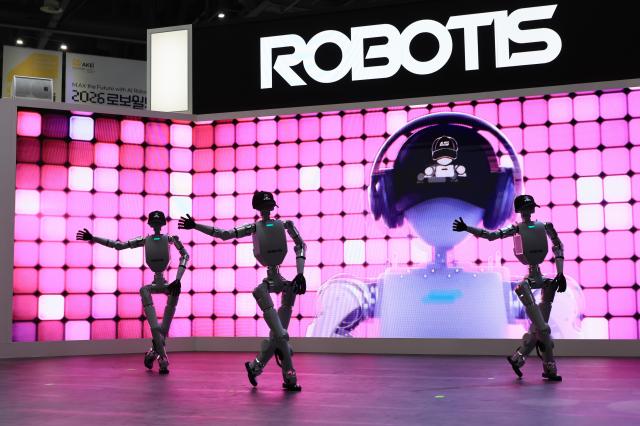
Three Unitree G1 humanoids danced in step to "Abracadabra" by K-pop group Brown Eyed Girls, while a Unitree robot dog wandered between booths. Service robots with holographic displays and small screens rolled through the aisles.
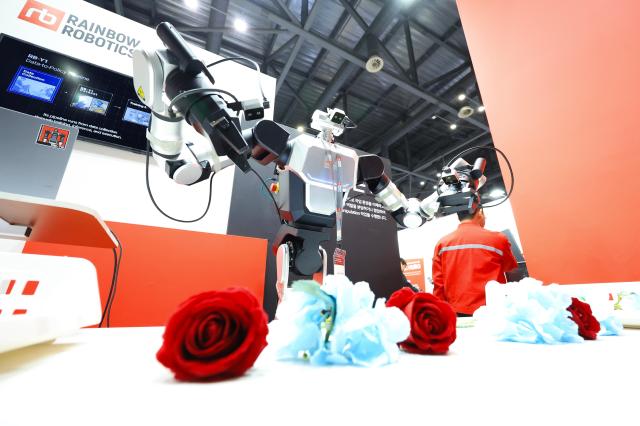
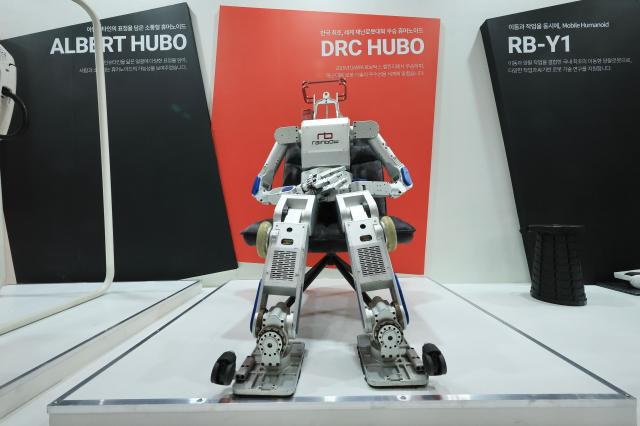
At Rainbow Robotics' booth, HUBO, the Einstein-faced Albert HUBO and the DARPA-winning DRC-HUBO were displayed side by side. A few steps away, their descendant, the RB-Y1, sorted flowers.
Korea's largest robot show opened Wednesday at KINTEX in Goyang, northwest of Seoul, with 402 companies occupying 1,198 booths, according to the Ministry of Trade, Industry and Resources.
KAIST professor Oh Jun-ho's lab unveiled HUBO in 2004. Rainbow was incorporated in 2011 when the lab began selling the robot, said Sean Jee, head of brand growth strategy and general manager at Rainbow.
Team KAIST's DRC-HUBO won the DARPA Robotics Challenge in 2015. Rainbow is now a Samsung Electronics subsidiary.
Reducers are gears that help control a robot's speed and torque. Rainbow builds some in-house and is developing the rest, though it still buys some from Korean and Japanese suppliers, Jee said.
Making parts in-house lowers costs and speeds up repairs. A single broken robot awaiting an imported component can hold up an entire production line.
"Dancing robots keep coming out, but working is a completely different problem," Jee said. "Walking on two legs is the same. What happens if it falls?"
Rainbow has sold nearly 200 units of its RB-Y1 mobile humanoid worldwide, Jee said. The company aims to secure safety certification for the next-generation RB-Y2 and begin mass production by next summer.
Rainbow plans to focus on manufacturing until about 2030, while testing robots with farm machinery maker Daedong, Samsung Medical Center and the Daejeon bakery chain Sungsimdang.
A few aisles away, Korean robots were dancing, too. Robotis' AI Sapiens humanoids performed in black caps printed with a cartoon humanoid. At the neighboring Aei Robot booth, the company's pet robot EDIE put on a gentler show.
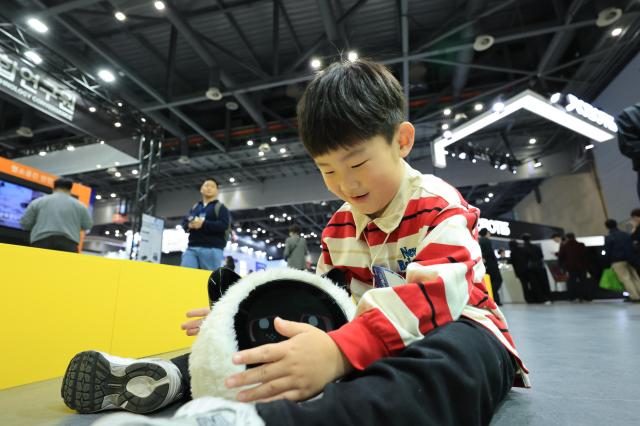
Covered in a soft, fleece-like shell and warmed to feel like a real animal, EDIE leaned into a petting hand the way a dog does when its ears are scratched. One unit in Aei Robot's mock playroom had been set to "shy," one of five personality options. It kept backing away from a giggling child as the mother snapped photos.
"Walking for a moment and walking all day were completely different problems," said Kim Ui-jin of Aei Robot's R&D team.
South Korea has 1,220 industrial robots per 10,000 manufacturing workers, the world's highest density, according to 2024 data from the International Federation of Robotics.
Those factories offer a testing ground, but also a reminder of how much robots still have to learn. Aei Robot is building a system to collect workplace data and train its robots to adapt to changing conditions. Even the same factory presents different conditions by night and by day, Kim said.
Robots that tumble and flip demonstrate what their hardware can do, he said. Turning that capability into a dependable worker requires more.
"We see everything inside, including the software and the AI model, as one product. We sell the finished product."
AJP Takeaways
- Robo World 2026 opened Nov. 4 at KINTEX in Goyang with 402 companies in 1,198 booths, according to South Korea’s Ministry of Trade, Industry and Resources.
- Rainbow Robotics makes almost all of its parts in-house except some reducers, and aims to mass-produce its next-generation Y2 by summer 2027.
- Aei Robot is building a data pipeline to train its ALICE humanoids for work in South Korean factories, which had 1,220 industrial robots per 10,000 manufacturing workers in 2024, the world’s highest, according to the International Federation of Robotics.
Copyright ⓒ Aju Press All rights reserved.
