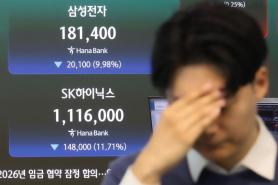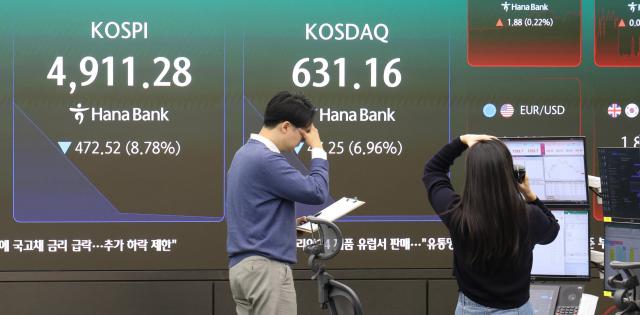
The won closed daytime trading at 1,357.8 per dollar, 15.7 won weaker than the previous session and its weakest daytime close since Sept. 28, as the benchmark KOSPI plunged 6.02 percent to 5,059.65, its lowest close since Jan. 26, while the KOSDAQ fell 5.04 percent to 644.25.
The simultaneous decline in stocks and the currency raises concerns that the turmoil could extend beyond equity valuations to foreign capital flows, import costs and corporate financing conditions, even as falling government bond yields offer some relief in benchmark borrowing rates.
The KOSPI briefly plunged to 4,911.28, its lowest intraday level since Jan. 27, triggering a 20-minute circuit breaker before recovering some losses. The index has lost 10.98 percent over two sessions and now stands about 44.5 percent below its record closing high of 9,114.55 on June 22.
Foreign investors sold a net 2.80 trillion won (about US$2.06 billion) worth of KOSPI shares Friday, while institutions and retail investors bought approximately 1.77 trillion won and 567 billion won, respectively.
The persistent foreign selling has intensified pressure on the currency, although stock sales do not automatically translate into immediate dollar purchases. The extent to which investors convert their proceeds into dollars and repatriate them will be critical in determining whether the won faces further depreciation.
Government bond yields, meanwhile, fell sharply across maturities, reflecting a contrasting adjustment in the domestic debt market.
As of around 3:30 p.m., the three-year government bond yield stood at 3.609 percent, down 6.2 basis points, while the benchmark 10-year yield fell 4.7 basis points to 3.845 percent. The 30-year yield declined by the same margin to 3.956 percent.
The figures approached levels last seen in late April and May, although final closing yields had yet to be released.
Lower government bond yields can signal stronger demand for safer assets or expectations of weaker growth and lower interest rates. They do not necessarily indicate improving financing conditions for companies, particularly if corporate credit spreads widen or lenders become more cautious.
The divergence between government bond yields and the won also presents a challenge for monetary policy. A prolonged decline in the currency could raise import costs and add to inflationary pressures, potentially limiting the Bank of Korea's (BOK) room to respond to weaker growth or financial market stress.
The turmoil followed a Wall Street rout overnight, when the Nasdaq Composite fell 5.52 percent and the Philadelphia Semiconductor Index plunged 12.25 percent amid concerns that tighter U.S. artificial intelligence policies could delay data center investment.
Those concerns have raised questions about the durability of the artificial intelligence (AI) investment cycle supporting South Korea's semiconductor exports, although a broad cancellation of existing investment commitments has not been established.
The market reaction contrasts with South Korea's strong external trade performance. The country recorded a record $61.46 billion current account surplus in September, supported by semiconductor exports, while authorities expect annual shipments to exceed $1 trillion this year.
Strong export earnings, however, do not necessarily shield the won from short-term portfolio outflows. Foreign investors' reassessment of future semiconductor demand could weigh on Korean equities and the currency even while current export receipts remain robust.
Earlier in the day, authorities said securities firms will be temporarily exempted from the 140 percent collateral rule on margin loans for three months from Nov. 9, to keep forced selling from worsening the stock slump.
The measure could ease immediate liquidation pressure and reduce the risk of cascading stock sales, but it does not directly address foreign exchange demand, overseas portfolio outflows or uncertainty over the global AI investment outlook.
Nor would lower government bond yields alone guarantee easier funding for businesses if investor risk aversion spreads to corporate debt markets. A sustained widening of credit spreads could offset the benefit of falling benchmark rates and eventually weigh on corporate investment.
The next test for the won will be whether foreign equity selling persists and how much of the proceeds are converted into dollars. Exporters' dollar sales could help offset the pressure, although their timing and scale remain uncertain.
Investors will also be watching movements in other Asian currencies, U.S. Treasury yields and major technology companies' capital spending plans to assess whether the latest selloff represents a temporary repricing or a more persistent deterioration in South Korea's financial conditions.

Copyright ⓒ Aju Press All rights reserved.