
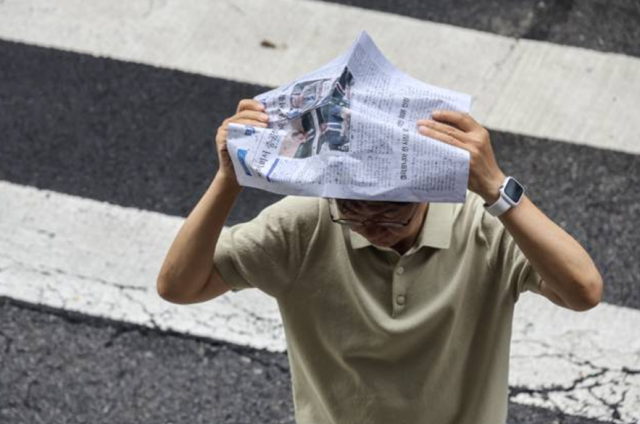
SEOUL, November 9 (AJP) — “It's been real, it's been fun, but it hasn't been real fun” serves as a swan song for South Korean mom-and-pop stock investors heading for the exit.
Jang, who works in Seoul’s trendy Seongsu-dong district and declined to give his full name, said he was done after watching Samsung Electronics and SK hynix spiral downward. The two chipmakers account for 80 percent of his savings.
For investors who jumped on the bandwagon during June’s fear-of-missing-out frenzy, the KOSPI’s race toward 10,000 now feels like a midsummer night’s dream. The awakening has been brutal, with the benchmark struggling to defend 5,000 with institutional support.
On Naver’s stock discussion boards, the party has given way to sarcasm and defeatism.
“KOSPI at 10,000? What a laugh it belongs at 2,000 where it used to be.”
“I can't tell if this is a stock market or a casino.”
Another investor expressed disbelief that 5,000 had become the line to defend.
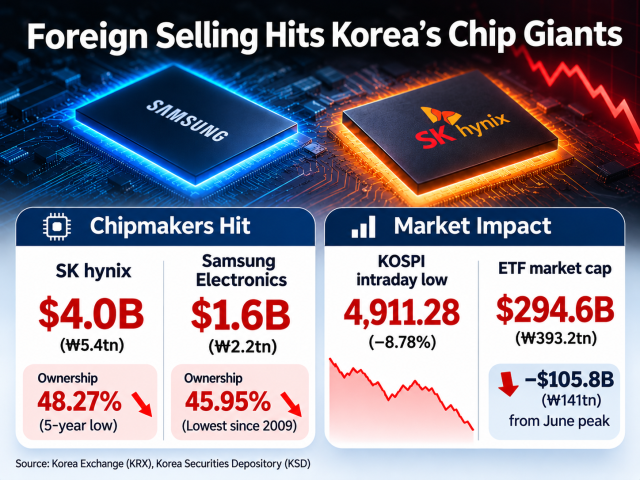
Foreign investors sold a net 10.38 trillion won ($7.66 billion) worth of KOSPI shares last week. About 7.6 trillion won, or roughly 73 percent, was concentrated in Samsung Electronics and SK hynix.
The benchmark ended November 6 at 5,059.69, down 11.71 percent from the previous Friday’s close, which also marked the end of October and 45 percent off its June peak.
The KOSPI nevertheless remained about 20 percent above its 2025 closing level, ahead of roughly 14 percent for Japan’s Nikkei 225 and about 7 percent each for the S&P 500 and Dow Jones Industrial Average.
For investors who bought near the peak, those year-to-date gains offer little consolation. Their losses reflect where they entered a market whose earlier ascent had been extraordinary.
SK hynix bore the brunt of last week’s foreign selling, with net sales of about 5.4 trillion won, followed by Samsung Electronics at 2.2 trillion won. Foreign ownership fell to 48.27 percent at SK hynix, its lowest in about five years, and 45.95 percent at Samsung, the lowest since July 2009.
The damage extended to exchange-traded funds (ETFs), which give investors exposure to baskets of securities through a single listed product. The combined market value of Korea’s 1,184 listed ETFs fell to about 393.2 trillion won on November 6, roughly 141 trillion won below June’s peak of 534.6 trillion won.
Investor deposits — money held in brokerage accounts and available for investment — stood at about 88.5 trillion won on November 5, down from summer levels above 100 trillion won.
Yet not all retail investors have given up on stocks, or even chips. Some have shifted their attention to the United States.
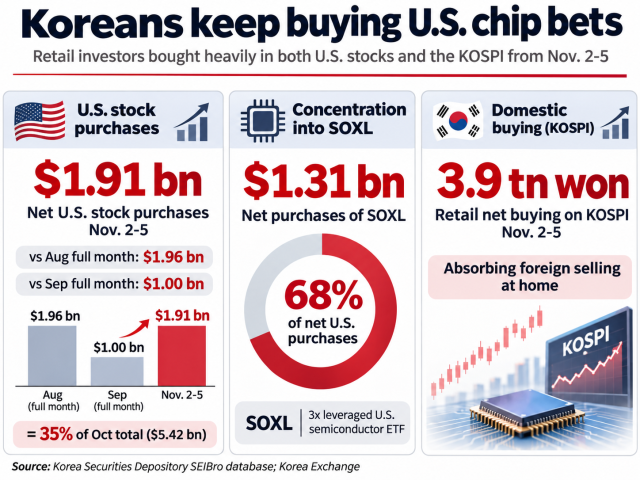
Korean individual investors bought a net $1.91 billion worth of U.S. shares from November 2 to 5, according to Korea Securities Depository’s SEIBro database.
That nearly matched August’s entire monthly net purchases of $1.96 billion and was almost twice September’s $1 billion. In just four days, purchases reached about 35 percent of October’s roughly $5.42 billion total.
Retail investors also bought a net 3.9 trillion won on the KOSPI over the same period, continuing to absorb foreign selling at home while committing substantial sums abroad.
Much of the money heading to the United States went straight back into the industry causing the anxiety.
SOXL, a leveraged ETF targeting three times the daily return of a U.S. semiconductor index, attracted about $1.31 billion in net purchases. That represented roughly 68 percent of Korean investors’ net U.S. stock purchases over the period.
The shift suggests that some investors are changing markets while doubling down on a semiconductor recovery.
Last week’s U.S. election results added a political shock to existing doubts about the profitability of AI spending and the pace of data center construction.
Democrats captured both houses of Congress and made sweeping gains in state elections. Their victories in the Texas and Georgia governor races broke Republican control in two important data center markets, although neither state came under unified Democratic control. Texas Governor-elect Gina Hinojosa campaigned against energy-hungry data center expansion.
For Korean chipmakers, the concern is that tougher scrutiny of power consumption, household electricity costs and public incentives could slow the projects underpinning memory demand.
Then came another unsettling development for the chip industry.
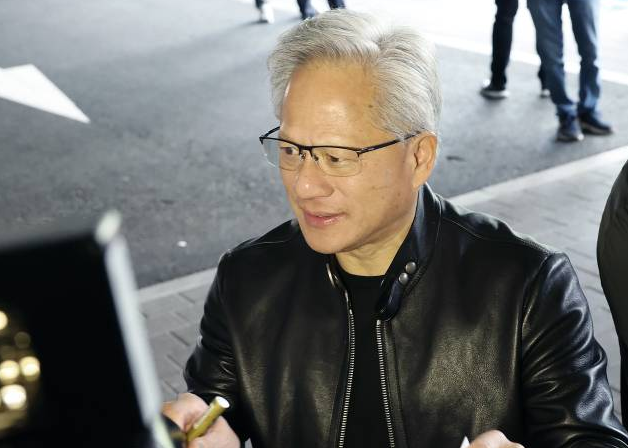
Nvidia announced Sunday that its board had launched an independent investigation following reports that chief executive Jensen Huang had been targeted by a foreign intelligence effort. Huang separately acknowledged an extramarital affair. The company said it had no reason to believe its secrets or U.S. national security had been compromised and expressed confidence in his leadership.
Seoul has sought to contain the immediate market damage by relaxing margin-loan collateral requirements.
Under the previous rule, investors borrowing 100 million won to buy shares generally had to maintain collateral worth at least 140 million won. If falling prices pushed that value below the threshold, they could be required to provide more cash or securities or face forced sales.
The government has suspended the 140 percent requirement through January 31, 2027, allowing brokerages to lower their thresholds or delay liquidations.
The exemption does not automatically stop forced selling. Relief depends on each brokerage’s policies and the borrower’s circumstances.
Mirae Asset Securities has lowered its standard requirement from 140 percent to 130 percent. Korea Investment & Securities and Kiwoom Securities are allowing eligible customers to apply for temporary delays in forced sales.
“It's a temporary measure, not something that can drive a lasting market recovery,” said Kim Dae-jong, a professor of business administration at Sejong University.
Kim warned that the impact would remain limited if foreign selling continued and concerns about the semiconductor industry persisted.
“Ultimately, we need stronger corporate earnings and foreign investment to return,” he said.
The selloff has also reopened the debate over whether Korean stocks have become too cheap to ignore.
The KOSPI’s 12-month forward price-to-earnings ratio fell to 3.54 times, its lowest since 2001, according to Daishin Securities. Its forward price-to-book ratio also fell below one, meaning the market was valuing companies at less than their projected net assets.
“I see this as an undershoot, where share prices fall below what the companies are fundamentally worth, driven largely by U.S. policy uncertainty and foreign fund withdrawals,” Kim said.
Still, those valuations depend on earnings forecasts surviving the uncertainty over AI investment.
“We need to verify that semiconductor companies can sustain their earnings forecasts,” he said. “A low PER alone does not necessarily mean stocks are undervalued.”
U.S. inflation figures will provide another test this week. October’s consumer price index is due Tuesday, followed by the producer price index Friday.
Forecasts point to a monthly CPI increase of 0.3 percent, down from 0.6 percent in September. Core inflation, excluding food and energy, is expected to ease to 0.2 percent from 0.3 percent.
Softer readings could ease concerns about interest rates and financing costs for AI infrastructure. An upside surprise could renew pressure on technology shares.
Kim expects the KOSPI to remain volatile between 5,000 and 6,000 in the near term. A return above 6,000 would depend on easing U.S. inflation, solid AI-related earnings and a slowdown in foreign selling.
“We should not assume this sharp selloff signals the beginning of a long-term market downturn,” he said.

Copyright ⓒ Aju Press All rights reserved.