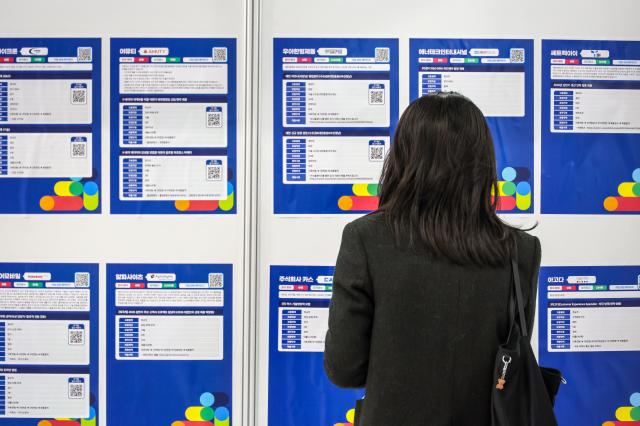
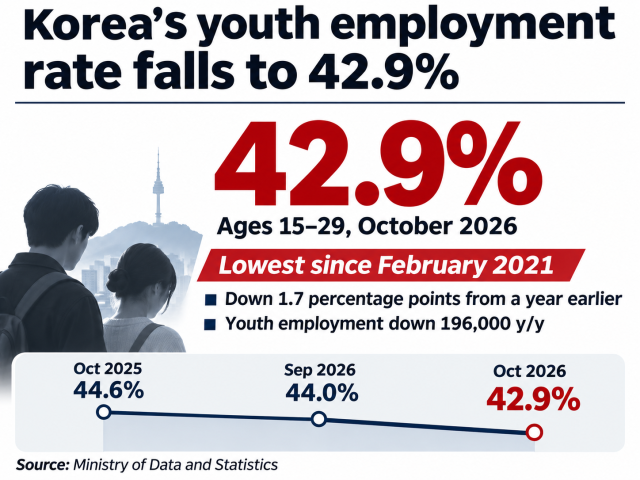
SEOUL, November 11 (AJP) — South Korea’s under-30 employment rate slipped for the 30th consecutive month to 42.9 percent, a level last seen during the pandemic in February 2021, government data showed Wednesday.
The number of employed people aged 15 to 29 fell by 196,000 from a year earlier to 3.325 million in October, marking the 48th consecutive month of year-on-year decline, according to the Ministry of Data and Statistics.
Their employment rate dropped 1.7 percentage points from a year earlier. It was also the lowest October reading since 2020, when the rate stood at 42.3 percent.
The deterioration was concentrated among people in their 20s, whose employment fell by 203,000 from a year earlier, exceeding the 188,000 decline in their population.
Among those aged 20 to 24, the employment rate plunged 3.6 percentage points to 40.0 percent, while the labor force participation rate fell 4.2 percentage points to 41.9 percent.
At a briefing Wednesday, Bin Hyun-jun, a director general at the ministry, said shrinking youth populations could not fully explain the employment weakness. He pointed to companies’ growing preference for experienced workers and rolling recruitment over traditional entry-level hiring.
The weakness persisted under the broader definition of youth introduced in September. Employment among people aged 15 to 34 declined by 131,000, while their employment rate fell 0.6 percentage point to 55.4 percent.
For those aged 15 to 29, the unemployment rate nevertheless edged down 0.1 percentage point to 5.2 percent, even as their labor force participation rate dropped 1.9 percentage points to 45.2 percent.
A broader measure of youth labor underutilization, which captures some jobseekers and workers not fully reflected in the headline unemployment rate, rose 0.4 percentage point to 15.1 percent.
The contrasting figures suggest that lower unemployment does not necessarily signal better hiring prospects when fewer young people are participating in the labor market.
The broader employment picture remained positive but uneven.
South Korea added 139,000 jobs from a year earlier, bringing total employment to 29.179 million. The increase compared with a gain of 113,000 in September.
Older workers continued to account for much of the net increase. Employment among people aged 65 and above rose by 255,000, while the number of employed people aged 15 to 64 declined by 117,000.
Employment among people in their 30s rose by 128,000, while those in their 40s lost 32,000 jobs.
Manufacturing employment fell by 7,000, reversing a gain of 16,000 in September that had ended a 26-month contraction. The renewed decline underscored the uneven spillover from South Korea’s export-led industrial recovery.
The ministry said employment gains in chemicals, fabricated metals and other transportation equipment were offset by declines in textiles, automobiles and apparel.
Accommodation and food services shed 137,000 jobs, the steepest decline since February 2021. The contraction widened from 97,000 in September and 61,000 in August.
Bin attributed part of the weakness to a high comparison base created by last year’s consumption voucher program, while also pointing to subdued activity in the sector.
Construction employment declined by 42,000, while agriculture, forestry and fisheries lost 101,000 jobs.
By contrast, health and social welfare services added 249,000 jobs. Transportation and storage gained 48,000, while business support services added 37,000.
The number of permanent employees increased by 287,000, but temporary workers fell by 107,000 and daily workers declined by 53,000.
The overall employment rate for people aged 15 and older slipped 0.1 percentage point to 63.3 percent, while the rate for those aged 15 to 64 rose 0.3 percentage point to 70.4 percent.
The headline unemployment rate fell 0.2 percentage point to 2.0 percent. The seasonally adjusted rate declined to 2.5 percent from 2.6 percent in September.
The number of people classified as “resting” outside the labor force fell by 69,000 to 2.511 million, including a decline of 38,000 among those aged 15 to 29.
Yet weaker youth participation, renewed manufacturing job losses and employment gains concentrated among older workers suggest the recovery has yet to broaden across generations and industries.

Copyright ⓒ Aju Press All rights reserved.