
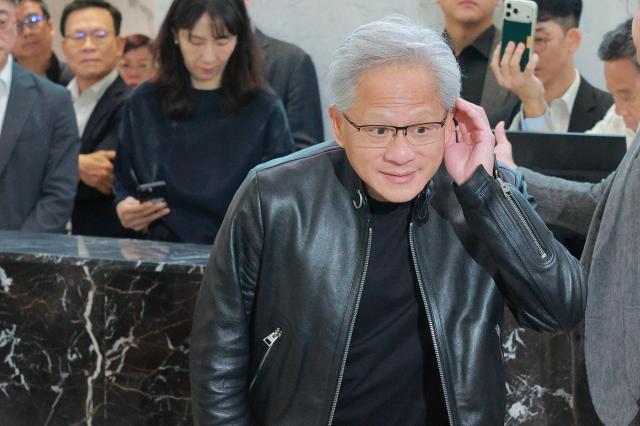
In Taiwan, disbelief has greeted the controversy surrounding one of its most celebrated emigrants.
Beijing has rejected the espionage allegations as a romantic affair becomes a national security issue ahead of an expected Trump-Xi meeting on the sidelines of APEC in Shenzhen next week.
South Korea, the primary supplier of memory chips powering Nvidia's AI empire, is absorbing a double blow — the U.S. midterm results and the eruption of the scandal.
Huang's confession compounded the pressure on Seoul's chip-heavy KOSPI, which has lost more than 12 percent since the Democratic election victories raised concerns about tighter curbs on data center construction in Republican strongholds such as Texas and Georgia.
"I owe my family and all of you an apology," Nvidia's founder and chief executive wrote to employees on Nov. 8, admitting he had been unfaithful to his wife.
Nvidia's board opened an independent investigation the same day into reports that he had been the target of a foreign intelligence effort.
The reports center on Alice Huang, no relation, a former executive at Megaspeed, a Singapore-based buyer of Nvidia chips. U.S. officials believe she was recruited by China's Ministry of State Security, the New York Times and the Financial Times reported.
No criminal charges against either have been reported, and Nvidia's board said it had "no reason to believe" that company secrets or U.S. national security had been compromised.
The fallout reached Seoul before Nvidia's latest gathering here.
Madison Huang, his daughter and a senior director at the company, canceled her trip to Nvidia AI Day Seoul a day before she was due to arrive. A planned meeting with Deputy Prime Minister and Science Minister Bae Kyung-hoon was also called off.
For Korea, the stakes extend well beyond a canceled visit. With its chips, data centers, cars and robots increasingly wired into one foreign company, the question is how much of that relationship runs through one man.
The business-as-usual facade was maintained. Launching AI Day at Seoul's COEX on Monday sans the Huangs, Nvidia screened a film that moved through Korea's chips, cars and ships before cutting to a StarCraft match under the caption: "This is the beginning of our friendship with Korea."
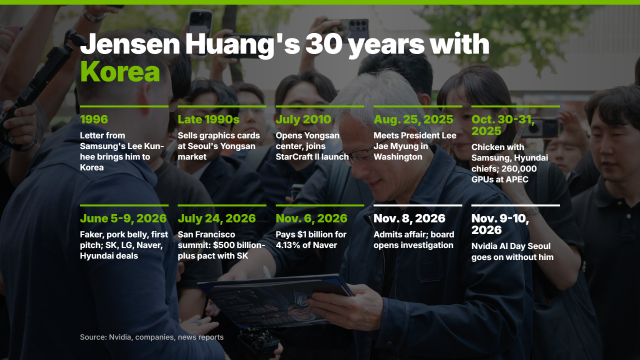
In 1996, three years after Huang co-founded Nvidia, a letter arrived from someone he had never met: Samsung Chairman Lee Kun-hee. Lee wanted to connect Korean homes to broadband, build an industry around video games and stage a gaming Olympics.
"In 1996, I received a letter from Korea," Huang recalled at a GeForce Gamer Festival in Seoul on Oct. 30, 2025, explaining what brought him to the country for the first time. Beside him stood Lee's son, Samsung Electronics Chairman Lee Jae-yong.
Huang arrived in a country about to fall for StarCraft. Released in 1998, the game helped fuel the proliferation of internet cafes known as PC bangs, which numbered about 20,000 by the early 2000s.
Many of their computers were assembled in Seoul's Yongsan Electronics Market, where Huang walked the aisles handing out business cards and pitching graphics cards.
The processors built to render games later became engines of the AI boom. The salesman from Yongsan now leads the company at the center of it.
Nvidia designs its chips but owns no fabrication plants. Samsung Electronics and SK hynix supply the high-bandwidth memory that sits alongside its AI processors, making Korea essential to the hardware behind its computing power.
The relationship also runs in the other direction.
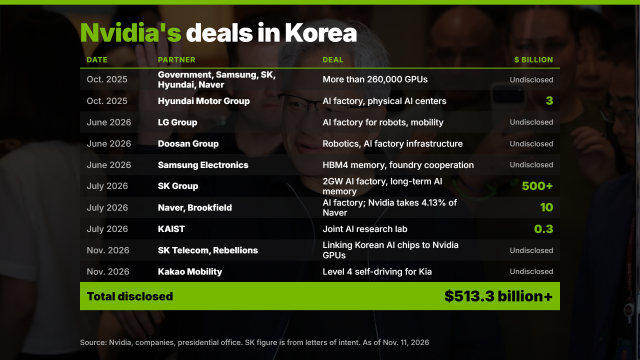
A day after Huang shared fried chicken and beer with Lee Jae-yong and Hyundai Motor Group Executive Chair Chung Euisun in Seoul last year, Nvidia announced plans to supply more than 260,000 graphics processing units to the Korean government, Samsung, SK, Hyundai and Naver.
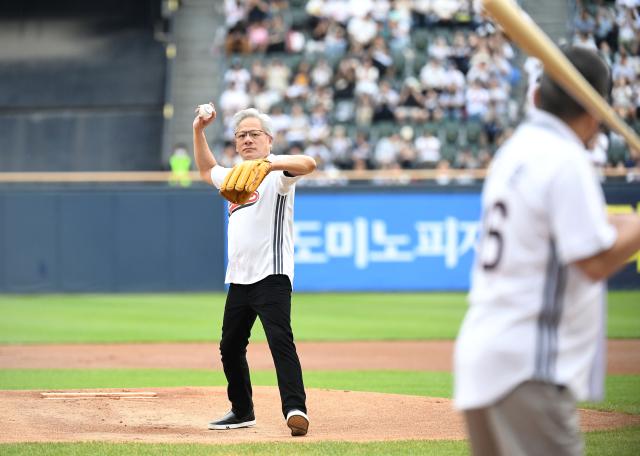
He returned in June for grilled pork belly with SK Group Chairman Chey Tae-won, LG Group Chairman Koo Kwang-mo and Naver founder Lee Hae-jin.
"Korea is in a very unique position in the world of physical AI," he told reporters in Seoul on June 8, describing a country equipped to support all five layers of the AI industry.
The ambitions grew after he left. In July, SK Group and Nvidia signed letters of intent for an initiative they valued at more than $500 billion, spanning AI infrastructure and next-generation memory. Naver also unveiled plans for a $10 billion AI factory with Nvidia and Brookfield.
On Nov. 6, Nvidia completed a $1 billion investment for a 4.13 percent stake in Naver.
These ties now extend through equity ownership, procurement and engineering programs. Some projects remain statements of intent, but the relationship has acquired a structure beyond Huang's personal diplomacy.
The government buys its Nvidia GPUs through server vendors rather than directly from Nvidia, Ryu Je-myung, second vice minister of science and ICT, told a National Assembly budget committee on Nov. 9. He said he expected contracted deliveries to remain on schedule.
Nvidia Korea, led by Jeong So-young, ran the two-day event as planned.
Jeong told a physical AI forum in Seoul last month that Korea could assume a role in the supply chain for robots and other physical AI systems comparable to Taiwan's position in data centers.
That prospect rests on Korea's manufacturing base and Nvidia's technology. Realizing it will require years of cooperation across companies.
For now, Huang remains at the helm. Nvidia said he would continue as chief executive during the investigation, while its board expressed confidence in "Jensen and his leadership team."
The independent directors on Tuesday retained Joon H. Kim, a former acting U.S. attorney in Manhattan, and his firm, Wachtell, Lipton, Rosen & Katz, to conduct the inquiry.
The scrutiny is widening. President Donald Trump said the FBI was also examining the matter, and a shareholder has filed a proposed class action in federal court in San Jose, California.
House Foreign Affairs Committee Chairman Brian Mast said he was prepared to subpoena Huang if he did not respond by Wednesday to a request for a closed-door briefing.
For Korea, the uncertainty centers on the man who has made a complex industrial partnership feel personal.
Huang, 63, has led Nvidia since its founding in 1993, and the board has not publicly named a successor. His appearances in Korea have carried a familiarity rarely associated with the head of a foreign technology supplier: handing out fried chicken outside a Gangnam restaurant and snacks labeled "HBM Chips" in Hongdae.
Such gestures helped turn commercial interdependence into a public narrative of friendship. They also made Huang unusually difficult to separate from the company he represents.
"Even if a personal risk arises for Jensen, Nvidia's technology, its chip ecosystem and its market dominance do not disappear overnight," said Kim Dae-jong, a business professor at Sejong University.
Kim said Samsung Electronics and SK hynix, both of which count Nvidia as a key customer, should reduce their reliance on a single company and a single person.
"Companies should do business by trusting systems and contracts, not people," he said.
Thirty years after a letter from Seoul brought Huang to Korea, the deals he helped seal bear company names. The photographs still carry his face.
AJP Takeaways
- Nvidia CEO Jensen Huang admitted to being unfaithful to his wife in a message to employees on Nov. 8, 2026, and Nvidia’s board opened an independent investigation the same day into reports that he had been the target of a foreign intelligence effort involving Alice Huang, a former executive at Singapore-based Megaspeed.
- Madison Huang, his daughter and a senior director at Nvidia, canceled her trip to Nvidia AI Day Seoul a day before she was due to arrive, and a planned meeting with Deputy Prime Minister and Science Minister Bae Kyung-hoon was called off.
- In October 2025, Nvidia announced plans to supply more than 260,000 graphics processing units to South Korea. SK Group and Nvidia signed letters of intent in July 2026 for an initiative valued at more than $500 billion, and on Nov. 6, 2026, Nvidia completed a $1 billion investment for a 4.13 percent stake in Naver.
- Nvidia said Huang, who has led the company since its founding in 1993, would remain CEO during the investigation. Its independent directors hired Joon H. Kim of Wachtell, Lipton, Rosen & Katz on Nov. 10, 2026 to lead the inquiry.
Copyright ⓒ Aju Press All rights reserved.
