Stronger-than-expected U.S. inflation shifted investors’ attention from the fallout of the American midterm elections and uncertainty surrounding Nvidia to a more immediate threat: a possible half-percentage-point Federal Reserve rate increase in December.
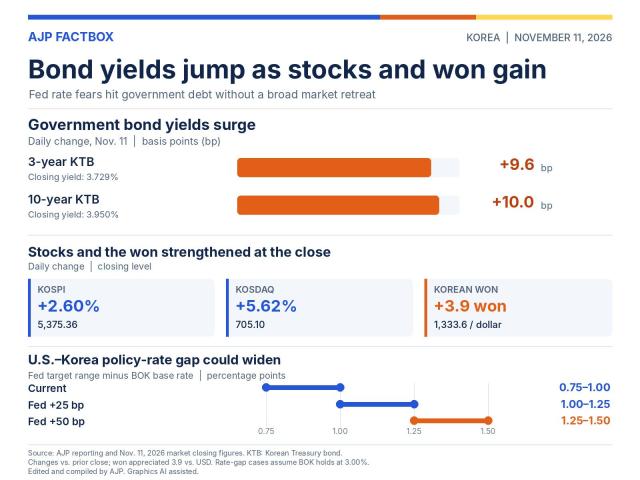
The three-year Korean government bond yield climbed 9.6 basis points to 3.729 percent, while the 10-year yield ended 10 basis points higher at 3.950 percent. Bond yields rise when prices fall.
The moves followed a jump in U.S. Treasury yields as investors reassessed the scale of the Fed’s next move. The two-year yield rose nearly 18 basis points to around 4.73 percent, while the 10-year yield approached 5 percent.
For Korean bonds, the selloff reversed part of a recent rally fueled by falling stock prices, demand for safer assets and expectations of reduced government bond issuance.
The won and equities, however, moved in the opposite direction.
The won closed 3.9 won higher at 1,333.6 per dollar, compared with Tuesday’s 3:30 p.m. close of 1,337.5. The benchmark KOSPI rose 2.60 percent to 5,375.36, while the KOSDAQ gained 5.62 percent to 705.10.
The divergence suggested that investors were adjusting bond prices to higher U.S. rate expectations without staging a broad retreat from Korean assets.
The trigger was Tuesday’s U.S. consumer price report. Headline inflation rose 0.4 percent in October from the previous month, exceeding the market forecast of 0.3 percent. Core inflation, which excludes food and energy, increased 0.3 percent against expectations of 0.2 percent, maintaining that pace for a third consecutive month.
The figures reinforced expectations of a Fed increase at its December 8–9 meeting and revived debate over whether a quarter-point move would be enough.
Fed Governor Christopher Waller had suggested that a half-percentage-point increase might warrant consideration if monthly core inflation remained around 0.3 percent or higher.
"Hiking only 25 basis points would put our credibility at risk, a risk I am not eager to take," Waller said.
The latest reading met that threshold, although a 25-basis-point increase remains the prevailing market expectation.
For Korea, the immediate concern is how that repricing could affect foreign demand for government debt alongside the recent foreign selling of equities.
Lim Jae-kyun, a bond analyst at KB Securities, said concerns about a larger Fed increase could weaken foreign purchases of Korean government bond futures. Higher yields could nevertheless offer opportunities to increase bond exposure.
"Even without a 50-basis-point hike, upward pressure on yields is likely to persist through year-end," said Won Yoo-seung, a bond analyst at SK Securities.
That prospect complicates the Bank of Korea’s (BOK) final rate-setting meeting of the year on November 26. Holding steady would give policymakers more time to assess domestic risks, but could leave Korean debt facing stronger competition from higher-yielding U.S. assets.
The BOK raised its base rate by 25 basis points in both July and August before holding it at 3.00 percent in October. It has kept further tightening on the table while assessing the effects of those increases.
The Fed’s current target range of 3.75 to 4.00 percent already stands 0.75 to 1.00 percentage points above Korea’s rate.
If the BOK holds this month and the Fed raises rates by a quarter point in December, the gap would widen to 1.00 to 1.25 percentage points. A half-point Fed increase would push it to 1.25 to 1.50 percentage points.
A wider gap does not automatically weaken the won or trigger capital outflows. Wednesday’s currency gains underscored that exchange rates respond to more than interest rate differentials. But rising overseas yields can still push up Korean market borrowing costs even if the BOK leaves its own rate unchanged.
Domestic inflation and household borrowing also give the central bank reasons to consider another increase.
South Korea’s consumer prices rose 2.8 percent from a year earlier in October, remaining above the BOK’s 2 percent target. Bank household loans increased by 5 trillion won, sharply exceeding September’s revised 500 billion won gain, according to data released Wednesday.
Yet further tightening would add to the burden on borrowers already struggling with interest payments.
The BOK estimated in September that another 25-basis-point increase could add roughly 7 trillion won to annual household and corporate interest expenses. Delinquency among financially vulnerable self-employed borrowers had reached 12.71 percent in the second quarter.
Uncertainty over global AI investment and semiconductor demand adds another reason for caution in an economy heavily dependent on chip exports.
There may be some relief beyond December.
"We maintain our view that the Fed will keep rates on hold after a December increase," said Park Sang-hyun, an economist at iM Securities.
Park expects inflationary pressure to ease gradually as oil prices decline and wage growth slows, although persistent supply-side risks and strong investment demand could slow that process.
For the BOK, however, the next decision comes before that outlook becomes clearer. Another increase could help restrain inflation and borrowing while deepening debt-servicing strains. A pause would buy time to assess domestic risks, but would offer no guarantee of stable financing costs.
Wednesday’s bond selloff made that constraint clear: even if Seoul keeps its policy rate unchanged, borrowing in Korea can still become more expensive.
Copyright ⓒ Aju Press All rights reserved.