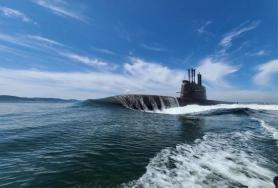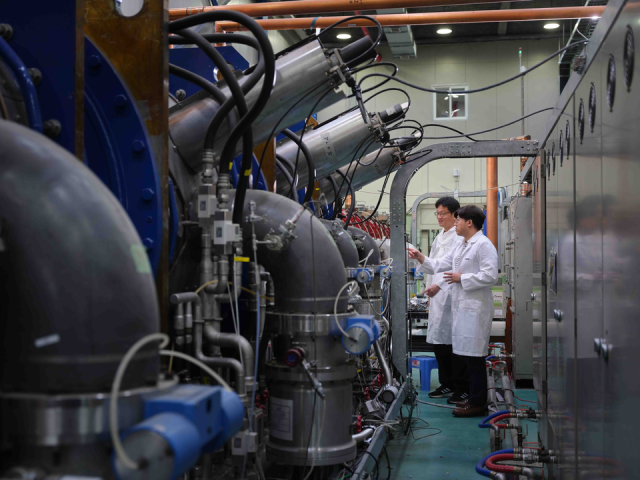
The country has an established nuclear industry and several small modular reactor (SMR) designs. But a reactor intended to supply electricity on land faces a different assignment beneath the waves, where space is tight, crews live nearby and maintenance cannot interrupt a deployment.
Civilian technology provides a starting point. How far South Korea has progressed toward a working naval reactor remains largely outside public view.
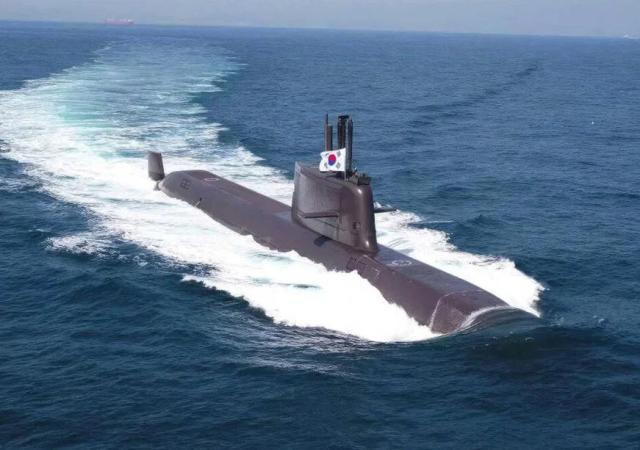
The question has become more pressing since the Defense Acquisition Program Administration (DAPA) announced approval of the basic acquisition strategy for the Jang Bogo N nuclear-powered submarine project on Nov. 6.
Development is scheduled to begin in 2027, with the first vessel targeted for launch in the mid-2030s and deployment in the late 2030s or beyond.
Domestic shipbuilders will compete to design and construct the submarines. The government will separately develop or secure their nuclear reactors and supply them to the selected contractor.
That establishes how the vessels will be procured. It leaves important questions about their power source unanswered, including the reactor’s development status and the organizations responsible for delivering it.
South Korea’s civilian credentials offer grounds for confidence, though they do not settle those questions.
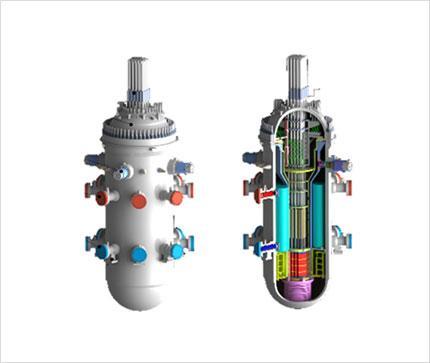
The Korea Atomic Energy Research Institute (KAERI) received standard design approval for its SMART reactor in 2012. An upgraded version, SMART100, secured approval in 2024. These are design approvals, distinct from experience operating a reactor aboard a vessel.
The newer innovative SMR, known as i-SMR, entered the standard design approval process in February 2026. Designed to produce 170 megawatts of electricity per module, it is targeting regulatory approval in 2028.
An SMR is generally defined as a reactor producing up to 300 megawatts of electricity per unit. Civilian developers aim to use smaller, modular designs to serve electricity grids, industrial facilities, remote communities and increasingly power-hungry data centers.
A submarine needs energy for propulsion and onboard systems, delivered within the constraints of a moving, submerged vessel.
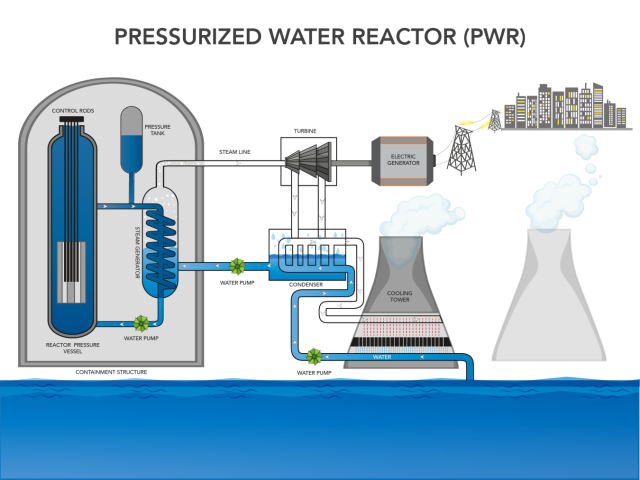
The underlying process is familiar. Nuclear fission produces heat. In a PWR, water under pressure carries that heat to a separate circuit, where steam is produced to drive turbines. On a submarine, those turbines provide propulsion and generate electricity for onboard equipment.
Because fission does not require oxygen, a nuclear-powered submarine does not need to surface or use a snorkel to run diesel engines and recharge its batteries. Food, maintenance and crew requirements become important limits on how long it can remain deployed.
But “small reactor” and “small modular reactor” are not necessarily interchangeable descriptions.
Cheong Jae-hak, a nuclear engineering professor at Kyung Hee University, said naval reactors are smaller than those at large power plants but do not necessarily follow the standardized, factory-built modular approach associated with civilian SMRs.
The shared technology also comes with different operating demands, particularly the need to sustain long deployments without frequent fuel replacement.
A KAERI official told AJP that the institute is developing reactor technologies for civilian ships but is not separately developing a reactor specifically for nuclear-powered submarines.
The official highlighted the challenge of protecting people living and working close to a reactor.
“Crew members also work close to the reactor in a confined space, making radiation shielding particularly important.”
Movement adds another complication.
“While conventional ships generally make gradual turns, submarines can make sharp turns and rapid descents,” the official said. “That means you need technologies capable of absorbing vibrations and minimizing the impact of those movements.”
Fuel longevity is another major consideration.
“With submarine reactors, the goal is to avoid replacing nuclear fuel frequently. Ideally, you would load the fuel once and use it throughout the submarine’s service life,” the official said. “That’s different from the SMRs we develop for use on land.”
A lifetime fuel supply, however, is one design approach rather than a universal requirement for nuclear propulsion.
The U.S. Navy’s Virginia-class attack submarines have reactor plants designed to operate throughout their planned service lives without refueling. That reduces lengthy maintenance interruptions and increases the time vessels can spend at sea.
France takes a different approach. Its Suffren-class attack submarines use K15-derived pressurized-water reactors fueled by low-enriched uranium, with periodic refueling during their operating lives.
The comparison matters for South Korea, which plans to use uranium enriched to below 20 percent, rather than the highly enriched uranium used in U.S. naval reactors.
Low-enriched uranium contains less than 20 percent uranium-235. Uranium enriched to 20 percent or more is classified as highly enriched and carries greater proliferation sensitivity.
Brazil offers another lesson: a reactor must be demonstrated as part of a functioning propulsion system before it goes to sea.
The Brazilian navy is building a land-based prototype known as LABGENE to validate its nuclear propulsion technology. The facility brings together a pressurized-water reactor and associated systems for testing ahead of their use aboard Brazil’s first nuclear-powered submarine.
For South Korea, civilian expertise can support that development effort, but publicly available information does not establish how much naval testing and validation has already been completed.
“It’s not a matter of starting from scratch,” the KAERI official said, pointing to the country’s existing SMR technology base.
The official added that the government had not yet clarified the detailed division of responsibilities for the naval reactor program, making it difficult for KAERI to confirm whether it would participate.
Cheong likewise cautioned against drawing firm conclusions about the military program from civilian projects.
“There’s very little information available outside,” he said, noting that military nuclear research is not disclosed as openly as civilian development.
Fuel supply also remains an unresolved part of the project.
Washington has approved Seoul’s pursuit of nuclear-powered attack submarines and agreed to work with it on the requirements, including ways to source fuel. That political backing does not amount to a completed fuel-supply arrangement.
South Korea therefore faces several connected tasks: developing a naval reactor, demonstrating its reliability within a submarine propulsion system and securing the fuel to operate it.
Its civilian nuclear industry gives it a substantial base from which to work. The test now is whether that experience can deliver a proven naval power system in time for the first submarine to leave the shipyard.

Copyright ⓒ Aju Press All rights reserved.