A: There is a historical reason behind Seoul's shortage of public trash bins. The city began removing them after introducing a pay-as-you-throw waste disposal system in 1995. Under the system, residents must buy designated garbage bags and sort their waste before disposal.
The problem was that some people tried to get around the rules by dumping household rubbish into public bins. Rather than becoming convenient collection points for pedestrians, the bins were increasingly used as a way to avoid paying for garbage bags. The city responded by cutting their numbers.
Q: Just how many bins disappeared?
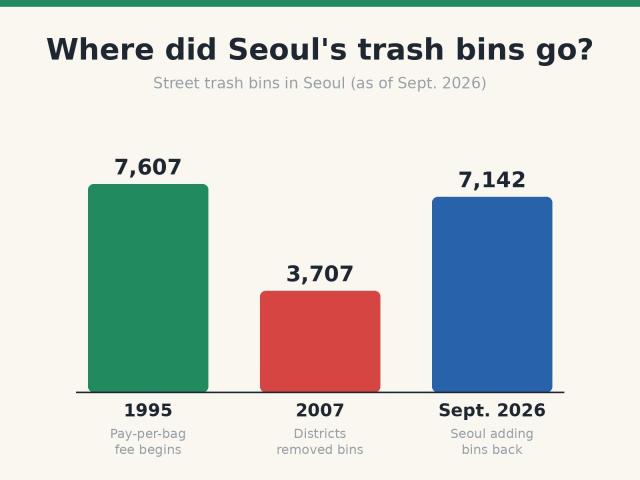
A: Quite a lot. Seoul had 7,607 public trash bins in 1995, but the number had fallen to 3,707 by 2007. The city began putting more bins back on the streets in 2023. As of September this year, Seoul had 7,142, still fewer than it had nearly three decades ago. The gap becomes even more striking when compared with other major cities. Paris has about 24,000 public bins, while Madrid, which has a similar land area to Seoul, has around 90,000. In other words, finding a bin in Seoul can require considerably more effort than finding one in some European capitals.
Q: Hasn't Seoul added more bins in recent years? Why is there still a problem?
A: More bins have certainly helped, but the city has another problem: tourism is growing faster than the supply of places to throw things away. This is particularly noticeable in busy shopping and tourist districts such as the capital's main shopping district of Myeongdong, where visitors can spend hours walking around with empty coffee cups, food wrappers and shopping bags.
Q: Is Myeongdong really that short of trash bins?
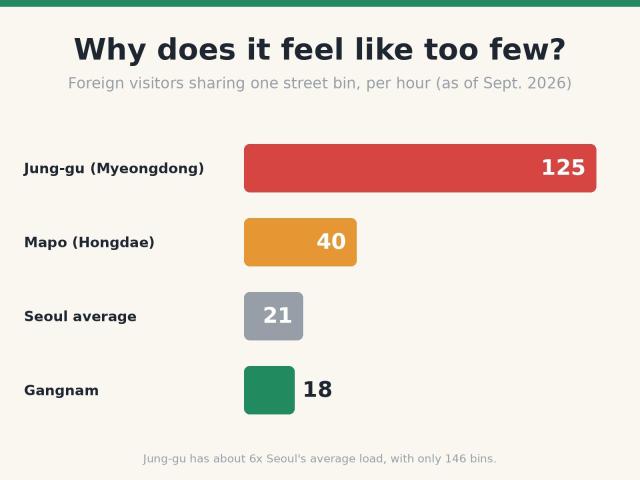
A: The numbers suggest so. In Jung-gu, the district that includes Myeongdong, an average of about 125 foreign visitors share each public bin every hour. That is roughly six times Seoul's average of 21 visitors per bin. By comparison, Gangnam in southern Seoul, which has considerably more bins, has just 18 visitors per bin. Clearly, not all parts of the city are equally well equipped to deal with the rubbish generated by crowds.
Q: Why doesn't the city simply install more bins?
A: Because putting a bin on the street is only half the job. Someone has to empty it, clean it and make sure it does not overflow. More bins mean higher maintenance costs and a need for additional workers to collect the rubbish regularly. These expenses fall largely on individual districts, which decide how many bins they can afford to install. Seoul encourages districts to add more bins and provides financial support, but it cannot force them to do so.
Q: So, what's the solution?
A: Seoul faces a balancing act between keeping its streets clean, making life easier for pedestrians and managing the cost of public services. For now, tourists visiting busy areas such as Myeongdong may still have to walk a little farther to find a bin. After all, enjoying Seoul's shopping streets should not mean carrying an empty coffee cup around for the rest of the afternoon.
Copyright ⓒ Aju Press All rights reserved.