

The Cathay Pacific subsidiary is expanding its share of flights between the two markets even as overall Korean visitor arrivals in Hong Kong decline. Its challenge is to turn that growing passenger base into sustained profits while preparing for a larger Korean competitor.
Korean Air and Asiana Airlines are scheduled to merge on Dec. 17, followed by the consolidation of Jin Air, Air Busan and Air Seoul under the Jin Air brand on March 17, 2027.
“HK Express is already well known in Hong Kong, but our brand awareness in South Korea is still relatively low,” CEO Jeanette Mao said at a press briefing in Seoul’s Seongsu-dong on Thursday.
“We want more Korean travelers to know about HK Express and recognize us as a quality low-cost carrier that offers value for money. This is where we intend to invest in the medium to long term.”

According to the company, the airline now accounts for about one-third of available seats between South Korea and Hong Kong after increasing its capacity on the routes by 29 percent from a year earlier.
Mao said HK Express carried more than 1 million passengers on its Korean routes in the first 10 months of this year, up about 24 percent.
Passengers departing from South Korea accounted for 42 percent of traffic between the two markets. Their numbers rose 36 percent over the same period.
The growth, however, comes in an industry where carrying more passengers does not necessarily mean earning more money.
HK Express carried approximately 7.9 million passengers in 2025, up 29.7 percent, according to Cathay’s annual results. Passenger revenue increased just 6.7 percent, while yield — revenue earned per passenger kilometer — fell 15.3 percent.
Its loss before net finance charges and taxation widened to HK$996 million, or about $128 million, from HK$204 million in 2024. Cathay attributed the weaker performance partly to changing destination preferences, new routes that needed time to mature and aircraft groundings caused by Pratt & Whitney engine problems.
More recent results show improvement. HK Express narrowed its loss on the same basis to HK$73 million in the first half of 2026 from HK$524 million a year earlier. Passenger revenue rose 37.8 percent, outpacing passenger growth of 9.8 percent, although higher fuel costs continued to weigh on performance.
Asked about consolidation among Korean low-cost carriers, Mao acknowledged the competitive market but said HK Express would concentrate on its operating strengths.
“Competition is fierce, but our key advantages are operational efficiency, our network and value for money,” she said.
“For us, low fares are not the key. Value for money is the key. We want customers to receive the quality experience they pay for.”
Mao dismissed suggestions that her visit was timed around the launch of the enlarged Jin Air.
HK Express has traditionally relied heavily on travelers departing from Hong Kong, she said. It now wants to attract more customers from overseas markets, including South Korea, Japan, Taiwan and Southeast Asia.
“South Korea is actually my first stop,” she said. “It is more about our strategy to go beyond our home market and bring more overseas customers on board.”
That strategy requires the airline to sell Hong Kong as a destination as well as its own seats.
According to the Korea Tourism Organization’s Hong Kong office, Korean visitor arrivals in Hong Kong fell 13.3 percent in the first eight months of 2026 from a year earlier. They stood at just 61.8 percent of the corresponding 2019 level.
Traffic in the other direction was stronger. Hong Kong visitor arrivals in South Korea increased 18.1 percent over the same period.
The contrasting figures suggest HK Express is gaining customers in a Korean outbound market that has yet to recover its former appetite for Hong Kong.

Kim Jae-heon, 26, who visited Hong Kong with his mother and sister in late 2023, said he felt the city had lost some of the distinctive appeal that once attracted Korean visitors.
“Hong Kong used to have a unique charm of its own,” he said. In his view, closer political integration with mainland China had diminished that appeal.
Other visitors retain warmer associations. Vivian Huang, 60, a Taiwanese tourist visiting South Korea with her husband, recalled Hong Kong’s food as a highlight of her two trips there, although she had never flown with HK Express.
The airline is now bringing a taste of the destination to Seoul.
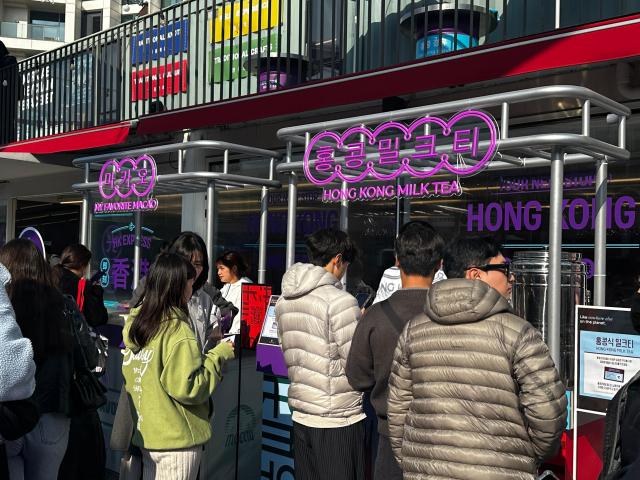
Its first consumer-focused offline brand event in South Korea opened Thursday in Seongsu-dong and runs through Sunday, with support from the Hong Kong Tourism Board and Macao Government Tourism Office.
Hong Kong-inspired street scenes, food and cultural activities are intended to introduce visitors to the destination while making the airline more familiar to Korean consumers.
Promotional one-way fares start at 94,600 won from Incheon and 89,600 won from Busan, Jeju and Daegu. Services outside the selected fare package cost extra.
The fares may attract attention. HK Express’s longer-term test is whether that interest produces repeat travelers — at prices that also leave room for profit.

Copyright ⓒ Aju Press All rights reserved.
