The easing supply squeeze marks a reversal for an industry that only weeks ago feared a shortage in November as the Middle East war dragged into its ninth month. Now recovering shipments and hopes for an end to the conflict threaten to unwind some of the windfall.
Crude shipments secured for November and December each equal more than 90 percent of last year's monthly average, the Ministry of Trade, Industry and Resources said at its Middle East war response briefing on Tuesday. November's figure stood at about 70 percent in mid-September, when disruptions to Saudi crude exports fueled talk of a "November crisis."
"Flows out of the Strait of Hormuz are running at about 75 percent of prewar levels, and supply itself has stabilized somewhat," said Chang Tae-hun, an associate research fellow at the Korea Energy Economics Institute.
"With more than 90 percent secured for November, the numbers do not suggest supply is something to worry about, unless there is an unusual shift in demand," Chang said.
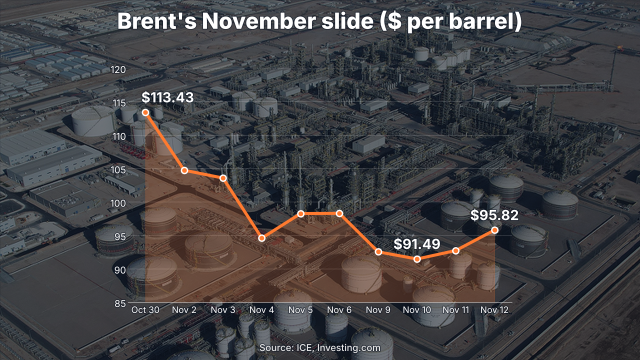
Brent crude closed at $91.49 a barrel on Nov. 10, its lowest since late August, after U.S. President Donald Trump said further strikes on Iran were unlikely. It rose 3.3 percent on Thursday to $95.82 but remained down about 20 percent for the month.
Democratic control of both chambers of Congress following the Nov. 3 midterm elections has added to expectations of pressure for a negotiated settlement.
"Democrats are likely to use war funding and congressional oversight to press for negotiations to normalize the Strait of Hormuz," said Yoon Jae-sung, an analyst at Hana Securities.
"Along with the recovery in Middle East crude exports, stronger expectations for an end to the war will lower geopolitical risk around oil and gas markets in the short term and weigh on prices," Yoon said.
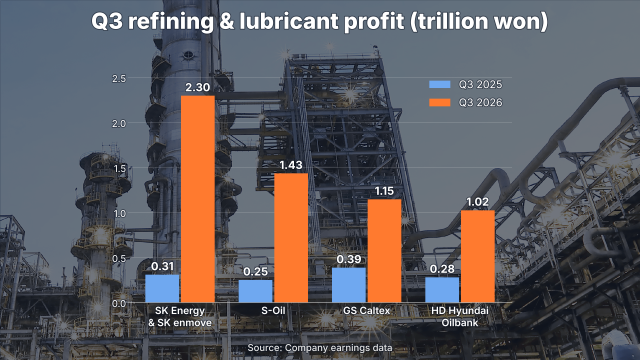
The shift follows an exceptional quarter. Combined operating profit from refining and lubricants at SK Innovation, S-Oil, GS Caltex and HD Hyundai Oilbank reached 5.9 trillion won ($4.4 billion) in the third quarter, 4.8 times the level a year earlier but 7.4 percent below the second quarter.
For refiners, cheaper crude offers lower future purchasing costs but can bring an immediate accounting sting. Oil bought weeks earlier at higher prices may have to be processed into fuel sold into a falling market, exposing companies to inventory losses.
GS Caltex and HD Hyundai Oilbank both reported third-quarter operating profit down more than half from the previous quarter.
Brokerages disagree on how deep the fourth-quarter dent will be. Hana Securities expects S-Oil to earn 1.29 trillion won in operating profit, down 9 percent from the third quarter, while Mirae Asset Securities forecasts 911 billion won.
The companies still see reasons for margins to hold up. SK Innovation cited maintenance shutdowns and winter demand, while S-Oil pointed to low global inventories. Both identified a recovery in Middle East supply as the main risk.
The U.S. Energy Information Administration on Nov. 10 forecast Brent at around $100 a barrel for November and December and $86 in 2027.
At home, another unsettled bill awaits.
Refiners continue to sell fuel under a government price cap introduced on March 13. The ministry plans to calculate the first round of compensation, covering March 13 to June 30, by the end of this month.
The industry estimated its losses at about 5 trillion won as early as June. The government set aside a 4.2 trillion won reserve fund in March and has proposed another 1.45 trillion won in next year's budget to cover the fourth quarter.
The dispute centers on how those losses should be measured. The ministry plans to base compensation on production costs. Refiners argue that it should reflect Singapore product prices, a benchmark that would yield a substantially larger payout.
"It is now time to consider an exit strategy for the price cap," Chang said, adding that one should ideally be in place from the first quarter of next year.
Prosecutors indicted all four refiners on July 6 on charges of coordinating price increases immediately after the war broke out. They put sales associated with the alleged collusion at about 14.2 trillion won. The companies denied the charges at their first hearing on Aug. 20.
Korea's refiners look better supplied for winter than they did two months ago. Whether they remain as profitable will depend on how quickly Middle Eastern barrels return — and how much of their domestic price-cap bill the government agrees to pay.

Kim Dong-young
Kim Dong-young is a bilingual journalist at AJU Press (AJP), covering Korean tech, energy, and bio/pharma.
He reports from the field at events like CES and APEC, runs AJP's YouTube channels,
and is pursuing a master's at Sogang's MOT program.
Copyright ⓒ Aju Press All rights reserved.