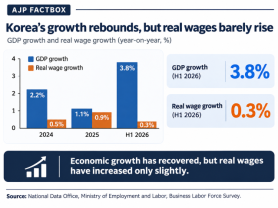
The report found that weak productivity outside the semiconductor sector was a major reason real wages, adjusted for inflation, have barely risen since 2021.
In the first half of 2026, average real wages rose just 0.3 percent from a year earlier, while inflation-adjusted regular pay fell 0.3 percent. Workers in industries where average real wages declined accounted for 53.2 percent of the workforce.
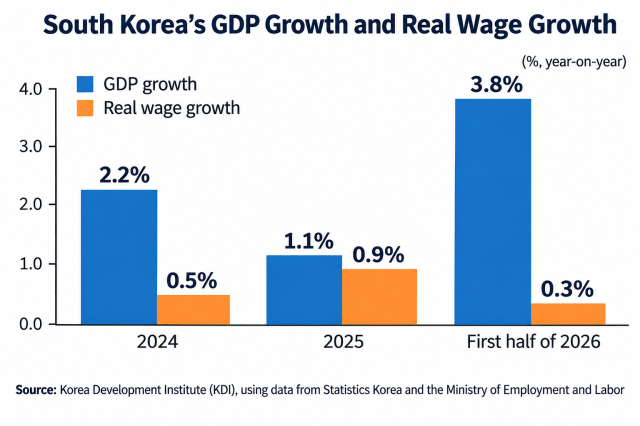
Wage gains were concentrated in a few high-paying industries. Nominal wages rose 21.6 percent in electronics manufacturing, which includes semiconductors, and 12.3 percent in financial and insurance-related services, with bonuses and other special payments accounting for much of the increase.
The broader wage stagnation has persisted for years. Average real wages across all workers rose just 0.2 percent from 2021 to 2025, compared with a 24 percent increase over the previous decade.
The report linked the wage gap to a widening productivity divide. From 2011 to 2025, semiconductor productivity increased an average of 11.3 percent annually, compared with just 1 percent in non-semiconductor industries.
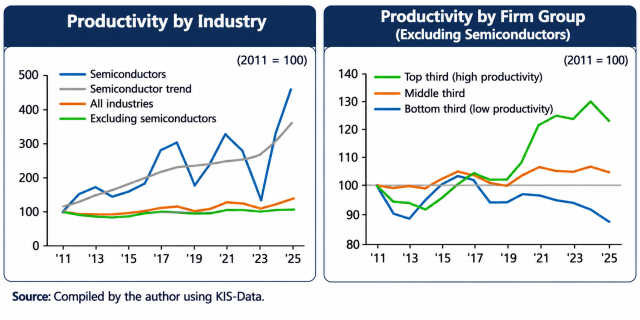
KDI measured productivity using company financial statements to assess how much value firms generate from labor and capital. The measure reflects technological improvements as well as changes in demand and selling prices.
That divide was also reflected in regular pay. From 2021 to 2025, inflation-adjusted regular pay in electronics manufacturing grew about 9 percentage points faster than in other industries. KDI estimated that differences in productivity growth accounted for roughly one-third of that gap.
Industries with 10 percentage points higher cumulative productivity growth from 2021 to 2025 saw inflation-adjusted regular pay rise an average of 0.9 percentage points more than in other industries, according to the report.
The weakness extended even to more productive companies outside the chip industry. Among non-semiconductor firms, the top third by productivity recorded a cumulative increase of just 0.8 percent from 2021 to 2025. Productivity in the middle third fell 2.5 percent, while the bottom third recorded a 9.7 percent decline.
The prolonged weakness has also left an increased share of non-semiconductor firms struggling financially. The share of marginal firms, measured by value added, in non-semiconductor industries nearly doubled from 3.2 percent in 2021 to 6.2 percent in 2025.
KDI attributed much of the increase in marginal firms in industries with the lowest productivity growth to poor productivity rather than higher borrowing costs.
Without broader productivity gains, KDI warned, wage increases could remain concentrated in a handful of industries. It called for existing industries to develop higher-value products and for barriers to entry and growth in emerging industries to be removed.
The institute also urged policymakers to prioritize business restructuring and worker retraining over blanket financial support, such as loan extensions and interest subsidies, to help labor and capital move toward more productive businesses.
Tags: South Korea wage gap, KDI productivity report, semiconductor industry, real wage stagnation, non-semiconductor productivity

Ryu Yuna
Yuna Ryu covers finance, capital markets and Southeast Asian affairs.
She is drawn to the questions that numbers raise and the stories that data alone cannot answer.
Prior to journalism, she worked at Hyundai Motor Company and the Singapore Chamber of Commerce, focusing on business strategy and international affairs. She has also hosted diplomatic receptions and international conferences as an MC.
Ryu holds a master's degree in Media and Communication from Korea University, where her research focused on neuroscience-based studies of media effects.
Copyright ⓒ Aju Press All rights reserved.