

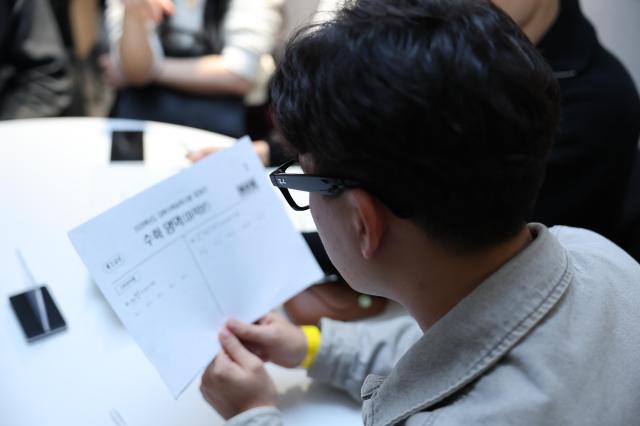
Days before Thursday's College Scholastic Ability Test (CSAT), the scandal has rattled students and supervisors and shaken trust in state-administered exams and a exposed a widening gap between increasingly discreet devices and powerful AI software on one side and detection technology, staffing and regulatory oversight on the other.
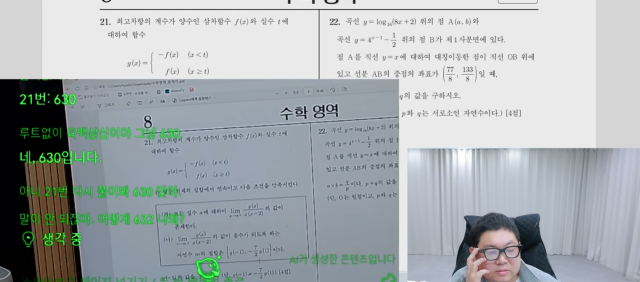
Han photographed questions with a miniature camera, sent them to an AI program and read the answers on a smartphone. He got 159 of 160 questions right in the first round in April and placed first overall.
"My top score was not the result of honest effort," Han said in a video posted on his lawyer's YouTube channel on Sunday. He turned himself in after his extraordinary results drew suspicion.
Cheong Wa Dae ordered a review of all national certification exams for possible AI cheating the same day. The scandal drew in the president and prime minister as online allegations multiplied ahead of the once-a-year university entrance exam, known as the suneung.
South Korea is acutely sensitive to the fairness of a test that can shape university admission, career prospects and a student's future after years of preparation.
"The fairness of exams is directly tied to public trust, and no cheating of any kind can be tolerated," said Ha Joon-kyung, presidential chief of staff for policy, who chaired an emergency meeting.
The hardware behind the anxiety is neither confined to glasses nor entirely new.
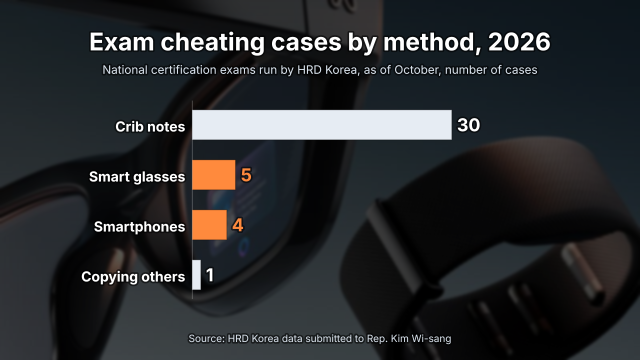
According to postings in online communities, covert cameras and earpieces trade openly and two proctors in each of Han's tax exam sessions failed to detect his cheating.
What AI adds is the ability to generate answers.
Devices once used to communicate with an accomplice can now connect a test-taker to software capable of reading questions and producing responses.
The combination brings readily available hardware and increasingly capable software into exam rooms whose defenses still depend heavily on human observation.
The immediate concern is whether supervisors can distinguish ordinary personal items from devices capable of receiving outside help — and whether the state has given them the tools, training and clear procedures to do so.
Yu Dae-jong, one of the country's best-known cram school instructors teaching Korean, called Monday for the suneung to be postponed unless adequate safeguards were in place.
"If there are no clear measures to ensure that every student at every test site can take the exam fairly, the suneung must be postponed," Yu wrote on social media. He nevertheless urged students to maintain their routines for Thursday.
The Ministry of Education ruled out a delay.
"We are not considering postponing the suneung," a ministry official told a regular briefing Monday, adding that officials would review whatever measures were realistic in the time remaining.
Wearing smart glasses during the test is grounds for invalidating a candidate's score and barring them from the following year's exam. The ministry also plans to assign a dedicated inspector to each of the 1,312 test sites.
But penalties after detection do not resolve the difficulty of spotting a prohibited device in the first place.
North Jeolla's education office is going further by requiring test-takers to leave their bags in the hallway. It said it could not search students' belongings and warned that some candidates surrender a dummy phone while keeping a working one.
No purpose-built detector will be ready in time. The Korea Communications Agency only issued a tender in late October for a handheld device intended to identify AI glasses through Bluetooth and Wi-Fi signals.
In a mock drill by the Human Resources Development Service of Korea (HRD Korea), metal detectors and radio detectors both failed to flag AI glasses. That leaves proctors inspecting frames by sight — with ordinary glasses also attracting suspicion.
"My eyesight isn't great, but I thought I could manage without glasses," said Park, a woman in her early 20s who took a recent Korean History Proficiency Test. "The print was so small that I took them out, and the proctor got suspicious right away and tried to inspect them."
"I'd stayed up all night and forgot to put them on before going in," she said. "Next time, I'm wearing them into the exam room."
For proctors, a missed device or a mistaken accusation can carry consequences far beyond the exam room.
“Securing the fairness of the suneung is the state's responsibility, and that burden must not be pushed onto individual proctors,” the Korean Teachers and Education Workers Union said in an Oct. 29 statement.
The union warned of complaints over false alarms and blame for undetected devices. Proctors have already faced 12 lawsuits over suneung supervision in the past five years.

China's Ministry of Industry and Information Technology said its response to this year's gaokao, the national university entrance exam, included 7,306 deployments of mobile radio-monitoring vehicles and 15,624 deployments of monitoring equipment. Its June 11 tally also recorded 30,705 personnel deployments.
Hunan's education examination authority combined electronic security gates and manual checks with wireless-signal blocking.
China's Education Ministry said exam rooms were continuously recorded, with footage available for review afterward. The approach adds opportunities to intercept outside communications and investigate misconduct missed during the test.
Some Chinese authorities are also applying AI to supervision. Hubei's education examination authority said its system flags suspected rule violations to video supervisors, with penalties dependent on confirmation at the test site. That places software alongside human monitors rather than leaving every suspicious movement to an individual proctor's unaided attention.
U.S. institutions have responded to different vulnerabilities. Princeton University began requiring proctors for in-person exams in July, ending a practice of unsupervised examinations dating to 1893. Its honor code remains in place, including students' obligation to report suspected cheating, but supervisors now share responsibility for observing what happens in the room.
In an online setting, Alcorn State University history instructor Jason Gibson used AI's tendency to follow embedded instructions to expose suspected misuse. NBC reported that he hid a directive in white text asking for an irrelevant reference to Madagascar in an exam response. He said 32 of 35 students across two courses failed that portion of their midterm after submitting AI-generated answers.
For Korea's supervised, high-stakes exams, the broader challenge is to keep detection equipment, staffing, inspection procedures and rules abreast of devices that are becoming harder to see and software that is becoming more capable.
The distrust may outlast Thursday.
"Give in to a moment's temptation, and even a university place won't mean anything," Cho said. "You learn nothing, and nothing stays with you."
Kim Dong-young
Kim Dong-young is a bilingual journalist at AJU Press (AJP), covering Korean tech, energy, and bio/pharma.
He reports from the field at events like CES and APEC, runs AJP's YouTube channels,
and is pursuing a master's at Sogang's MOT program.
Copyright ⓒ Aju Press All rights reserved.
