


The bets come amid rising U.S. borrowing costs, doubts about the durability of artificial intelligence spending and uncertainty over Nvidia’s future following the departure of its founder and chief executive. Investors are wagering on a recovery that may take longer than their borrowed money allows.
“Nobody knows where the bottom is,” said Lee Jeong-hwan, a professor of economics and finance at Hanyang University. “People may buy thinking they’ve found the bottom, but it may not be the case at all.”
Some investors regard the steep declines as a buying opportunity, Lee said. Others are drawn to the prospect of magnifying their returns through leverage, even as further losses remain possible.
That appetite is particularly evident in the country’s two chip giants.
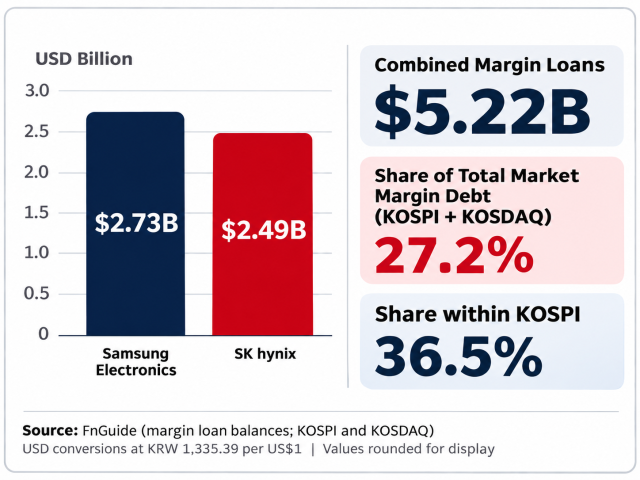
Outstanding margin loans tied to Samsung Electronics stood at 3.64 trillion won as of Nov. 12, while those linked to SK hynix totaled 3.33 trillion won, according to financial data provider FnGuide.
Their combined 6.97 trillion won accounted for 27.2 percent of the 25.60 trillion won in margin debt across the benchmark KOSPI and junior KOSDAQ markets. Within the KOSPI alone, the two companies represented 36.5 percent of outstanding margin loans.
The concentration has risen sharply. The chipmakers accounted for an average of just 6.73 percent of market-wide margin debt last year. Their share averaged 22.35 percent from the beginning of this year through Nov. 12 and peaked at 33.6 percent on Aug. 12, according to FnGuide.
Margin loans allow investors to borrow from securities firms to buy stocks, using their holdings as collateral. If falling prices push the collateral below the required value, investors must provide additional cash or shares. Otherwise, their holdings may be forcibly sold.
Bank borrowing has also increased, although how much of that money is finding its way into stocks remains unclear.
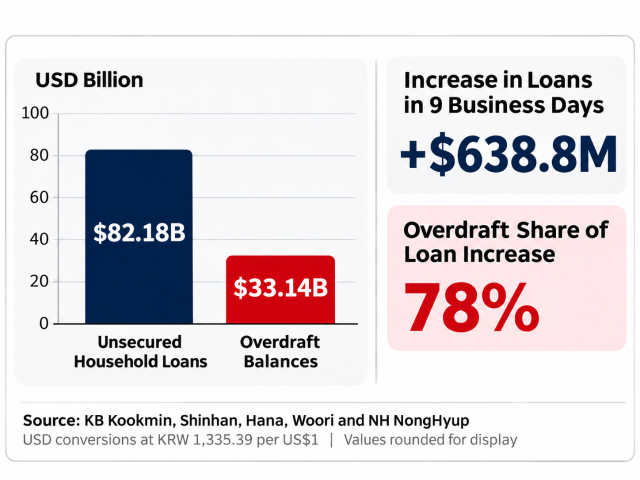
Outstanding unsecured household loans at the country’s five largest banks — KB Kookmin, Shinhan, Hana, Woori and NH NongHyup — reached 109.75 trillion won as of Nov. 12, up 853.1 billion won in nine business days.
That increase already exceeded the 668.7 billion won rise recorded in all of October, which followed two consecutive months of declines.
Much of the increase came from overdraft accounts, which allow borrowers to draw funds up to a preset limit and pay interest on the amount used.
Outstanding overdraft balances climbed to 44.26 trillion won, their highest level since August 2022. They accounted for roughly 78 percent of the increase in unsecured household lending this month.
The government raised banks’ annual household loan growth target from 1.5 percent to around 3 percent in August, giving lenders more room to extend credit, particularly for housing. Restrictions on unsecured borrowing remained in place.
Borrowers have nevertheless drawn more heavily on existing credit lines. Usage rates at some major banks have risen by 5 to 6 percentage points this year to nearly 50 percent.
“I don’t see a need to reduce overdraft borrowing. Investors can get cash back by selling their stocks,” said Kim Sang-bong, an economics professor at Hansung University.
Unlike brokerage margin loans, bank overdrafts do not generally trigger forced stock sales when share prices fall. Selling shares at a loss, however, may leave investors with outstanding debt as interest continues to accrue.
For investors who missed the spectacular chip rally earlier this year, the subsequent collapse may look like a second chance.
From the start of the year through June 22, when the KOSPI reached its record closing high, Samsung Electronics surged 194.8 percent and SK hynix jumped 348.4 percent, according to Korea Exchange (KRX) data.
Between that date and Nov. 13, the shares fell 41.7 percent and 58.3 percent, respectively, as doubts grew over the pace and profitability of AI infrastructure spending.
The selloff deepened Monday.
As of 2 p.m., the KOSPI was down 3.53 percent at 5,104.03. Samsung Electronics fell 4.66 percent to 196,400 won and SK hynix plunged 7.48 percent to 1,125,000 won, according to KRX market data.
Retail investors bought a net 1.20 trillion won in KOSPI shares as foreign investors sold 1.44 trillion won and institutions offloaded 155.8 billion won. The KOSDAQ fell 4.13 percent to 670.74.
Persistent foreign selling has overwhelmed retail buying, leaving the market struggling to establish a floor.
An analyst at Yuanta Securities offered a more constructive assessment of chipmakers’ earnings. The selloff, the analyst argued, reflected uncertainty over AI spending beyond 2028 and an imbalance between buyers and sellers rather than deteriorating near-term profits.
“The earnings outlook for Samsung Electronics and SK hynix remains largely intact through 2027, supported by November’s semiconductor exports and CoreWeave’s results,” the analyst said.
CoreWeave, a U.S. AI cloud provider, reported a 168 percent jump in third-quarter revenue to $3.66 billion on Nov. 10. It also posted a $709 million net loss, with net interest expenses reaching $846 million, according to its earnings release.
The analyst recommended holding major chip stocks while selectively seeking opportunities in semiconductor equipment and materials suppliers and energy storage companies hit hard by the selloff.
Rising U.S. borrowing costs present another obstacle.
The yield on the benchmark 10-year U.S. Treasury note climbed to 5.15 percent on Friday from 4.86 percent a week earlier, according to U.S. Treasury data. Higher yields can increase financing costs for AI infrastructure projects while putting pressure on technology stock valuations.
“Markets are in turmoil,” said Hanyang University’s Lee. “Stocks could fall further.”
Cho Hong-chong, an economics professor at Dankook University, remained optimistic about the industry’s longer-term prospects.
“I think fears of an AI slowdown are overblown,” Cho said. “The direction is clear. Whether in semiconductors or power infrastructure, the broader momentum is unlikely to fade.”
South Korea’s semiconductor exports also suggest near-term demand remains strong. Shipments surged 331.2 percent from a year earlier to $16.6 billion in the first 10 days of November, according to the Korea Customs Service.
“Some companies may struggle to raise funds, but the semiconductor industry’s fundamentals remain strong,” Cho said.
This week will test whether that confidence can withstand the market turmoil.
Nvidia is scheduled to report fiscal third-quarter earnings Tuesday after the U.S. market closes. Analysts surveyed by LSEG expect revenue of $109.2 billion, up 91.6 percent from a year earlier, and adjusted earnings of $2.48 per share. The revenue estimate is slightly above Nvidia’s forecast of $108 billion.
The results will be its first since Jensen Huang stepped down last week and Chief Financial Officer Colette Kress took over as interim chief executive.
The leadership uncertainty has deepened as Huang’s supporters press for his return. An online petition seeking his reinstatement has attracted more than 160,000 signatures, with prominent technology executives among its supporters. Major shareholders have also urged Nvidia’s board to consider bringing him back.
“Nvidia plays a pivotal role in the AI industry,” Lee said. “After the CEO change, it needs to let the numbers speak for themselves.”
Two days later, Anthropic, the developer of the Claude AI models, is expected to make its Nasdaq debut under the ticker ANT, according to the exchange.
The AI boom may have years to run. Those betting on it with borrowed money may not have that luxury.

Ryu Yuna
Yuna Ryu covers finance, capital markets and Southeast Asian affairs.
She is drawn to the questions that numbers raise and the stories that data alone cannot answer.
Prior to journalism, she worked at Hyundai Motor Company and the Singapore Chamber of Commerce, focusing on business strategy and international affairs. She has also hosted diplomatic receptions and international conferences as an MC.
Ryu holds a master's degree in Media and Communication from Korea University, where her research focused on neuroscience-based studies of media effects.
Copyright ⓒ Aju Press All rights reserved.
