

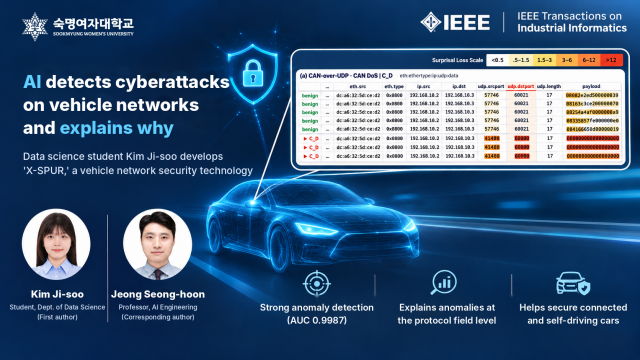
SEOUL, November 16 (AJP) - Researchers at Sookmyung Women's University have developed an artificial intelligence system that detects cyberattacks on a vehicle's internal network and shows exactly which signals set off the alarm, addressing a long-standing complaint about AI security tools that flag threats without saying why.
The technology, named X-SPUR, was published in October in IEEE Transactions on Industrial Informatics, a journal ranked in the top 8.5 percent of its field. The study was led by Kim Ji-soo, an undergraduate majoring in data science, as first author, with Jeong Seong-hoon, a professor in the university's Division of Artificial Intelligence Engineering, as corresponding author.
The work targets a problem that grows with every new generation of cars. Autonomous and connected vehicles carry dozens of electronic devices that constantly exchange data over internal networks, and each exchange is a potential opening for hackers.
Defending those networks with AI has run into two obstacles. Real attack data from vehicles is scarce, which makes it hard to train detection models, and existing AI detectors tend to work as black boxes, spotting anomalies without revealing the reasoning behind the judgment.
X-SPUR answers the first problem by learning from normal traffic alone. The system studies what ordinary communication on a vehicle network looks like and treats meaningful deviations as signs of an attack, an approach known as unsupervised learning that removes the need for large sets of attack examples.
It answers the second by pointing to the evidence. When the system flags a communication as suspicious, it identifies which fields in the network messages drove that judgment, so a security officer can check the basis of the decision and shape a response rather than taking the AI's word for it.
The system also analyzes traffic across different communication protocols without manual feature engineering, the labor-intensive step in which engineers hand-pick the data characteristics a model should examine.
In tests on a widely used benchmark dataset for automotive Ethernet, the high-speed network standard spreading through modern vehicles, X-SPUR scored an AUC of 0.9987, a measure of how cleanly a model separates attacks from normal traffic in which 1 represents a perfect score.
The results so far come from benchmark testing, and the system has not yet been demonstrated in vehicles on the road. The university said it expects the technology to contribute to analyzing security threats to connected and autonomous vehicles and to improving the safety and reliability of vehicle systems.
The same pair has had a second study accepted as a regular paper at IEEE BigData 2026, an international conference, with Kim again as first author and Jeong as corresponding author. The paper passed a review with an acceptance rate of 19.4 percent.
That study analyzed about 12.7 million real requests to an e-commerce web service and found that the top 1 percent of sessions accounted for 48.8 percent of the total damage to cache performance, the mechanism that lets websites serve repeat requests quickly. Rather than simply sorting bot traffic from human visitors, the method identifies which sessions actually harm the service and need attention first.
The conference results will be presented at IEEE BigData 2026 in Phoenix, Arizona, in December.
[Reference Information]
Journal/Source: IEEE Transactions on Industrial Informatics (IF 9.8, JCR top 8.5%)
Title: X-SPUR: Explainable Surprisal-Based Protocol-Aware Unsupervised Reasoning for Automotive Ethernet Intrusion Detection
Link/DOI: https://doi.org/10.48550/arXiv.2609.21217

Park Sae-jin
Experienced journalist and editor at AJU PRESS specializing in multilingual news. I cover international diplomacy, geolpolitics, and policy, consistently delivering highly accurate, compelling reporting for a worldwide audience.
Copyright ⓒ Aju Press All rights reserved.
