SEOUL, November 17 (AJP) - Battery additives that each extend the life of lithium-ion cells can work against each other when combined, shortening battery life instead of protecting it, South Korean researchers have found.
KAIST said Tuesday that a joint team led by Choi Nam-soon, a professor in the Department of Chemical and Biomolecular Engineering, and Seo Dong-hwa, a professor in the Department of Materials Science and Engineering, identified the chemical reaction behind the conflict and developed a new additive that avoids it.
The finding matters because electric vehicle batteries are judged as much by how long they hold their capacity as by how much energy they store. A car that starts with ample driving range covers less distance on a single charge as its battery fades, and the fading accelerates in hot conditions, where unwanted chemical reactions inside the cell speed up.
Additives mixed into the electrolyte, the liquid that carries lithium ions between a battery's two electrodes, are a standard defense against this decay. Added in small amounts, they form a thin protective film on the electrode surfaces that suppresses the unwanted reactions, in effect coating the inside of the battery.
The film is especially important on anodes containing silicon, a material increasingly used in electric vehicle batteries because it stores large amounts of lithium. Silicon swells and shrinks sharply during charging and discharging, and when the swelling damages the film, the electrolyte breaks down again and lithium is steadily consumed to rebuild it.
The battery loses capacity because less lithium remains available for charging.
The researchers examined what happens when two widely used additives, lithium bis(oxalato)borate, known as LiBOB, and succinonitrile, known as SN, are used together. Each performs well on its own. In combination, the team found, a byproduct created as LiBOB breaks down triggers the unwanted decomposition of SN, which in turn blocks the formation of a stable protective film on the anode.
The damaged film lacked lithium fluoride, a key protective ingredient, and electrical resistance inside the cell rose. At high temperatures the electrolyte broke down faster and lithium was consumed more quickly. Additives installed to protect the battery ended up weakening its protection.
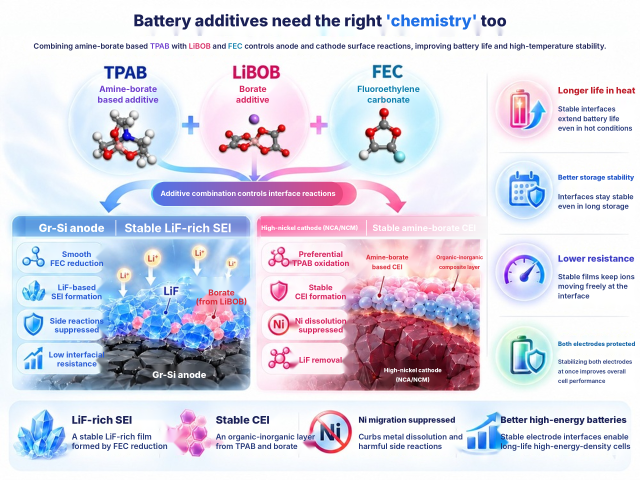
To solve the problem, the team turned to triisopropanolamine borate, or TPAB, a compound that joins an amine group and a borate group in a single molecule. Rather than mixing separate additives and hoping their chemistry stays compatible, the design builds the protective functions into one structure.
In batteries using TPAB, stable protective films formed on both the cathode and the anode, suppressing the reactions that drain the electrolyte. The team confirmed the performance in high-energy cells built with the high-nickel cathodes and graphite-silicon anodes used in electric vehicles.
The TPAB cells retained more capacity after repeated charging and discharging than cells using the conventional additive pair, and degraded less after long storage at high temperature.
The results were obtained in laboratory test cells, and the additive has not yet been applied to commercially produced batteries.
The work points to a new standard for additive development. How good each additive is on its own, the researchers argue, matters less than what the additives do to each other once they share a battery.
"We showed that additives that each perform well can actually shorten battery life when used together," Choi said. "Precisely controlling the reactions between additives and building a stable protective film is the key to making batteries last." She said she expects the result to contribute to the development and commercialization of electric vehicle batteries that hold their charging capacity through long use.
Lee Ki-hun and Han Seung-hee of the Department of Chemical and Biomolecular Engineering and Seo Ji-won of the Department of Materials Science and Engineering, all at KAIST, are co-first authors of the paper, which was published online in ACS Energy Letters on Oct. 19 and selected as a cover article.
The research was funded by Samsung SDI, the National Research Foundation of Korea under the Ministry of Science and ICT, and the Korea Planning and Evaluation Institute of Industrial Technology under the Ministry of Trade, Industry and Energy.
[Reference Information]
Journal/Source: ACS Energy Letters
Title: Rational Integration of Multiple Additives for High-Temperature Lithium-Ion Batteries
Link/DOI: 10.1021/acsenergylett.6c02555

Park Sae-jin
Experienced journalist and editor at AJU PRESS specializing in multilingual news. I cover international diplomacy, geolpolitics, and policy, consistently delivering highly accurate, compelling reporting for a worldwide audience.
Copyright ⓒ Aju Press All rights reserved.