

SEOUL, November 17 (AJP) - South Korean day traders were labeled gamblers for their frenzied appetite for exotic, high-risk ETFs tied to chip stocks during the summer. Those bets have soured as Samsung Electronics and SK hynix have lost around half their value from their June peaks.
Like a gambler who keeps returning to the table chasing the memory of that first sweet win, Korean retail investors cannot easily kick the habit of leveraged investing.
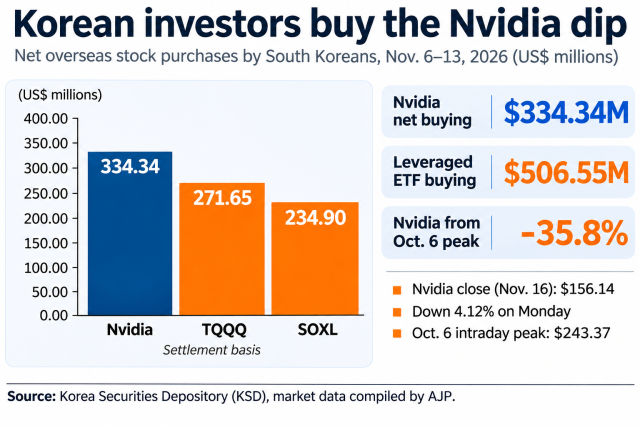
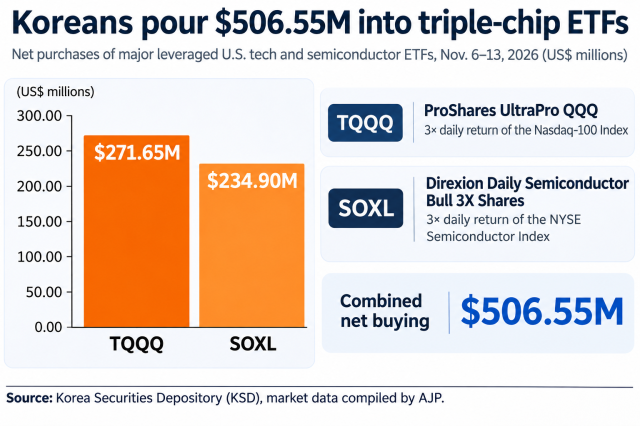
Korean individuals poured $334.34 million into Nvidia shares over the week through November 13, betting on a rebound even as the artificial intelligence (AI) chip giant lost more than a third of its value from its October peak. Another $506.55 million went into triple-leveraged U.S. technology and semiconductor ETFs.
The buying spree comes ahead of Nvidia’s first earnings report since Jensen Huang’s resignation, raising the question of whether its battered shares offer a bargain or carry risks investors have yet to fully reckon with.
Nvidia topped South Korean investors’ overseas stock purchases from November 6 to 13, according to Korea Securities Depository (KSD) settlement data.
The stock fell another 4.12 percent Monday to close at $156.14, nearly 36 percent below its October 6 intraday peak of $243.37.
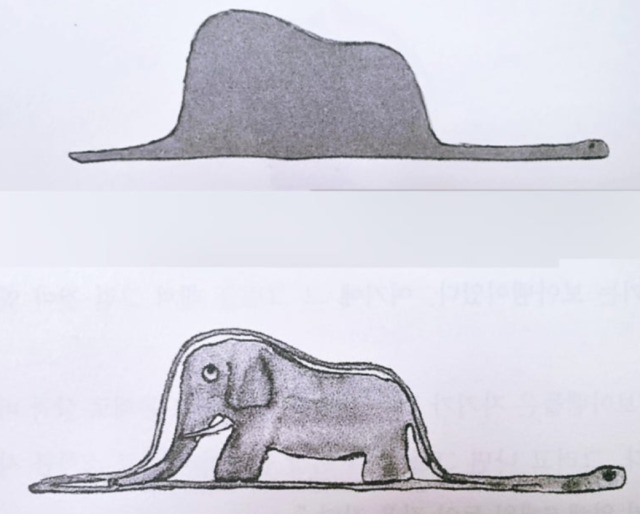
“The chart looks like a boa constrictor that swallowed an elephant,” one investor wrote on Naver’s discussion board for SOXL, a triple-leveraged U.S. semiconductor exchange-traded fund (ETF), referring to the famous illustration from Antoine de Saint-Exupéry’s The Little Prince.
“Lose money in Korean stocks, then head to Wall Street to trade triple-leveraged funds. How lame can we be?” another wrote in self-reproach.
For some, the response to losses has been to raise the stakes.
ProShares UltraPro QQQ (TQQQ), an ETF designed to deliver three times the Nasdaq-100 Index’s daily return, ranked second with net purchases of $271.65 million during the period. Direxion Daily Semiconductor Bull 3X Shares (SOXL), which targets three times the daily return of the NYSE Semiconductor Index, followed with $234.90 million.
Both funds use derivatives and other financial instruments to amplify daily market movements. A 1 percent rise in the underlying index can translate into roughly a 3 percent gain before fees and expenses. A 1 percent decline can produce a loss of roughly the same magnitude.
The risks grow when markets swing. Because leverage resets daily, repeated falls and rebounds can leave investors in the red even if the underlying index fully recovers.
“Even a 33 percent plunge doesn’t necessarily mean a stock is undervalued,” said Kim Dae-jong, a professor of business administration at Sejong University.
He warned that triple-leveraged ETFs can magnify losses in volatile markets, with currency fluctuations adding to the risks for Korean investors.
The appetite for high-stakes bets extends well beyond Korea.
In the United States, retail investors and hedge funds have also flocked to high-risk derivatives offered by Kalshi, a U.S. prediction-market operator.
Its stock-linked perpetual futures allow investors to bet on share-price movements without owning the stocks. Unlike conventional futures, the contracts have no fixed expiration date.
Nvidia-linked contracts offer leverage of up to 4.6 times, amplifying both gains and losses. Trading in those contracts reached about $116 million over 24 hours, according to Kalshi data.
For Nvidia investors, the earnings outlook is further complicated by uncertainty at the top.
Huang resigned as president, chief executive officer and board member last week. Nvidia appointed Chief Financial Officer Colette Kress as interim CEO while its board searches for a permanent successor.
The company has sought to reassure investors that its operations, customer commitments and product development plans will continue without interruption.
But questions remain over whether the chip giant can maintain its lead without Huang.
“Nvidia’s competitiveness doesn’t depend on Jensen Huang alone,” Kim said.
He cited its graphics processing unit (GPU) technology, CUDA (Compute Unified Device Architecture) software platform, data-center dominance and global customer network. CUDA helps developers run applications on Nvidia’s chips.
“Those strengths won’t disappear overnight,” he said. “But a prolonged leadership transition could weigh on the stock if key talent leaves or innovation slows.”
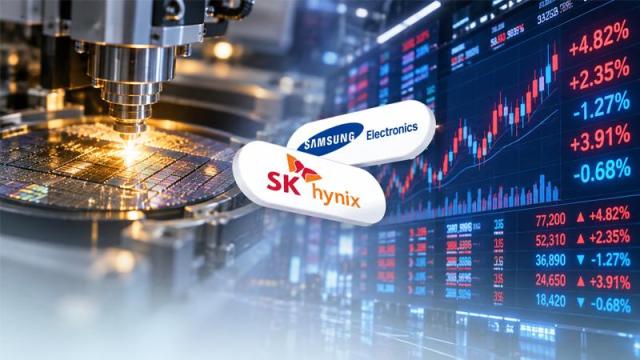
The uncertainty has added to pressure on Asian chip stocks.
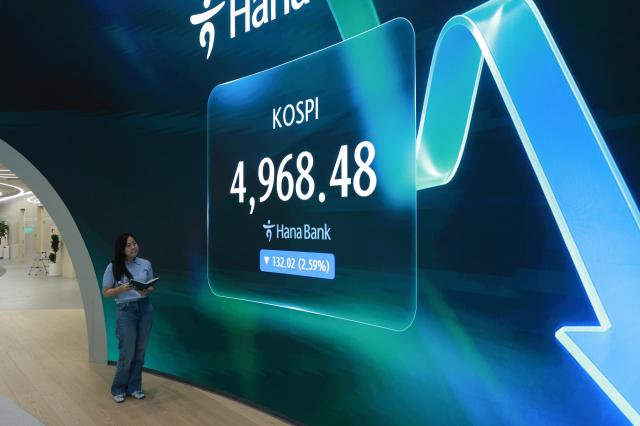
South Korea’s benchmark KOSPI fell 2.59 percent to close at 4,968.48 on Tuesday, dropping below 5,000 as foreign selling outweighed purchases by retail and institutional investors. The junior KOSDAQ lost 2.34 percent to 650.06.
The KOSPI’s decline followed Monday’s 3.59 percent plunge, when Samsung Electronics and SK hynix lost 4.47 percent and 7.89 percent, respectively.
Taiwan’s benchmark index fell 6.03 percent Monday, while Japan’s Nikkei 225 lost 2.42 percent.
Attention now turns to Nvidia’s fiscal third-quarter results, due after U.S. markets close Tuesday, followed by its first earnings call since Kress took over.
Wall Street expects revenue of about $109.08 billion and adjusted earnings of $2.47 per share.
Strong results, however, may not guarantee a rebound.
“Even strong earnings could disappoint investors if they fall short of expectations,” Kim said. “A clear beat and an upbeat outlook, however, could trigger a rebound.”
Beyond the figures, investors will be looking for evidence of management stability.
“The interim CEO’s strategy and the search for a permanent successor will also be crucial,” he added.
An analyst at Yuanta Securities said the recent selloff did not necessarily signal weakening AI demand, citing strong computing demand reported by CoreWeave, a U.S. AI cloud provider, and robust South Korean chip exports in November.
“The industry’s underlying business remains resilient,” the analyst said.
The distinction, the analyst argued, is between uncertainty that unsettles investors and disruption that damages demand.
“What matters is whether Nvidia’s leadership uncertainty leads to canceled orders or cuts in capital spending.”
Customer contracts, financing commitments and the launch of next-generation AI chips would be key indicators to watch, the analyst added.
Kim also identified continued AI investment by Microsoft, Google and Amazon, U.S. chip export restrictions on China, and Nvidia’s margins and cash flow as longer-term factors.
He said the AI industry’s growth prospects remained strong, but lofty expectations could keep share prices under pressure even as earnings improved.
“Investors should focus on earnings, cash flow and fair valuation rather than short-term price swings,” Kim said.
A packed calendar could keep markets on edge for the rest of the week.
Anthropic, the AI developer behind Claude, is expected to begin trading on the Nasdaq on Thursday, offering a fresh test of investor appetite for AI stocks.
Minutes from the U.S. Federal Reserve’s latest policy meeting and the Asia-Pacific Economic Cooperation (APEC) leaders’ summit in Shenzhen, China, could also shape sentiment on interest rates and U.S.-China technology tensions.
The Yuanta analyst expects markets to remain volatile this week but sees room for uncertainty to ease once those events have passed.
“There is little evidence of a fundamental deterioration in the semiconductor industry or its 2027 earnings outlook,” the analyst said.
Foreign selling remained a concern, the analyst added, but there was little reason for investors to join the selloff.
For now, Korean investors have placed their bets on a bottom. Nvidia’s earnings may help determine whether they have found one—or merely another reason to return to the table.

Ryu Yuna
Yuna Ryu covers finance, capital markets and Southeast Asian affairs.
She is drawn to the questions that numbers raise and the stories that data alone cannot answer.
Prior to journalism, she worked at Hyundai Motor Company and the Singapore Chamber of Commerce, focusing on business strategy and international affairs. She has also hosted diplomatic receptions and international conferences as an MC.
Ryu holds a master's degree in Media and Communication from Korea University, where her research focused on neuroscience-based studies of media effects.
Copyright ⓒ Aju Press All rights reserved.
