Developed by Lockheed Martin subsidiary Sikorsky, X2 technology enables helicopters to fly faster and farther than conventional models while retaining their ability to hover and take off and land vertically.
The company said it has been in discussions with KAI for much of this year over South Korea’s High-Speed Medium Utility Helicopter (HSMUH) program, which aims to meet the Army’s future operational needs.
Speaking to reporters ahead of an event celebrating the 250th anniversary of the founding of the United States in Seoul on Wednesday, Dylan Landis, a principal of business development at Lockheed Martin, said the company was prepared to share technology it had spent more than $1 billion developing.
“We have invested north of a billion dollars to set a foundation for the X2 technological capability,” Landis said.
“We are prepared to transfer up to 90 percent of the intellectual property” developed through the program to Korean industry, he added, enabling local companies to design, develop, produce and maintain the aircraft.
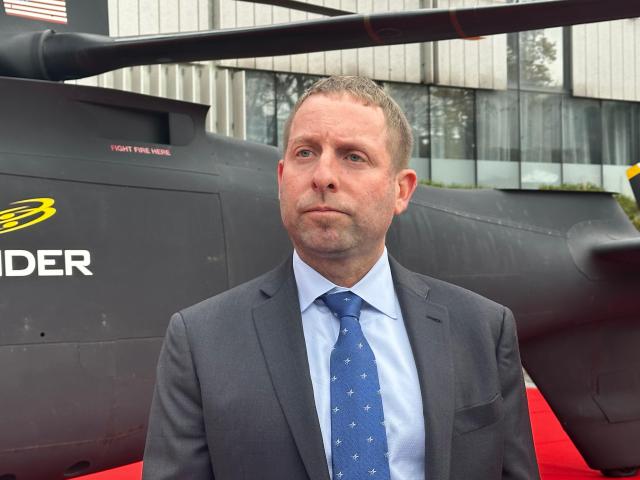
“KAI is the identified prime that the Republic of Korea Army has put forward,” Landis said, explaining that the Korean company was conducting a feasibility study and gathering information.
“We have a very active conversation that has been going on with KAI for the better part of the year.”
“The idea is that KAI will be the prime contractor,” he said. “They will have the ultimate responsibility to both design and produce it.”
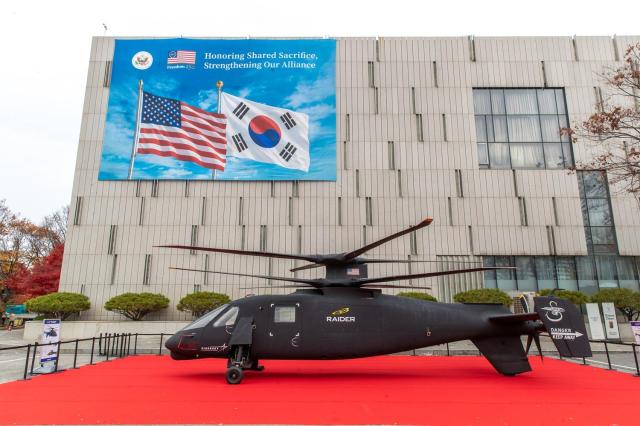
Displayed outside the event venue was Sikorsky’s S-97 Raider, an experimental helicopter incorporating X2 technology.
Unlike conventional helicopters, the Raider has two sets of stacked rotor blades that spin in opposite directions and a rear propeller that provides forward thrust.
The configuration is designed to improve speed, range and maneuverability while retaining vertical takeoff and landing capability.
“X2 is a capability, not a configuration,” Landis said, emphasizing that the company was offering technology rather than a specific aircraft.
“Given that we do not have the final requirements for the program yet, we do not want to commit to a particular configuration,” he said.
“Rather, we’d like the ability to take those requirements and design an aircraft uniquely for the Korean needs.”
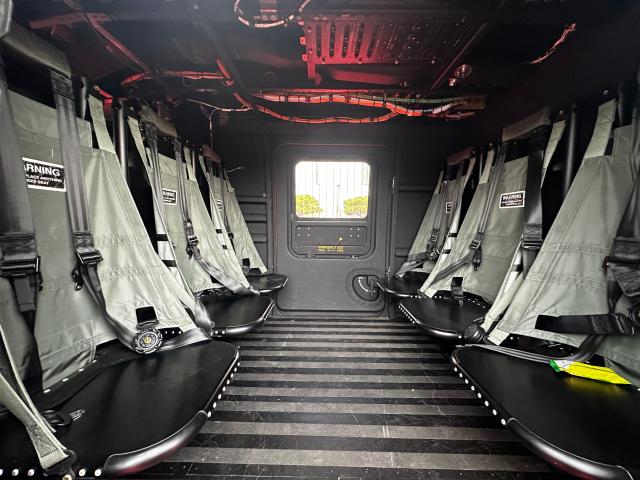
The proposed helicopter would weigh around 29,000 pounds (13.2 metric tons), more than three times the 9,000-pound S-97 Raider. It would accommodate two pilots, two crew chiefs and 12 passengers, according to Landis.
Lockheed Martin also highlighted the potential advantages of its rotor technology in South Korea’s mountainous terrain, where helicopters must maneuver in confined areas and operate at varying elevations.
“The combination of the stacked rotors provides a 60 percent increase in the lift capability,” Landis said, comparing the technology with conventional aircraft.
The scale of Lockheed Martin’s investment, however, remains undecided.
“The final investment decision we’re holding until we understand the program requirements,” he said. “It’s hard to commit to a specific number or area until we understand the full needs of the ROK Army.”
The proposed industrial partnership would extend beyond KAI and other major Korean defense manufacturers to smaller suppliers.
“We want to cover both the large organizations as well as the small and medium enterprises,” Landis said.
“So we’re looking to engage with them and identify their capabilities now such that when the requirement is completed, we can move very quickly.”
The offer comes as competition builds over the South Korean Army’s next-generation helicopter program, with other international manufacturers, including Bell and Airbus, also engaging with KAI.

Kim Hee-su
Kim Hee-su is a bilingual reporter at AJU Press, covering defense and foreign affairs. Before joining AJP in 2025, she worked at The Korea Times, where she wrote interview stories, including a profile of North Korean defector Kim Gum-hyok, and produced digital content. She also previously worked as a researcher for KBS News 9’s International News Department, supporting correspondents in 10 countries around the world. She graduated from the University of Toronto in Canada with a double major in Book and Media Studies and East Asian Studies.
Copyright ⓒ Aju Press All rights reserved.