SEOUL, November 18 (AJP) - Nvidia’s third-quarter results remained stellar, with operating profit more than doubling to a record $77.5 billion and its outlook staying bullish as the interim leadership scrambled to assure investors, suppliers and customers alike that the AI flagship is in safe hands even without its iconic founder and longtime leader Jensen Huang.
Investors welcomed the numbers. Nvidia shares rose more than 3 percent in extended trading on Tuesday (U.S. time), after closing down 0.44 percent at $155.46 ahead of the release.
Before the report, the stock had fallen about 36 percent from its 52-week high of $243.37, as concerns over AI spending and the leadership upheaval erased more than $1 trillion from its market value, according to Axios.
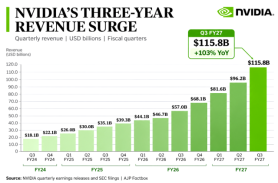
Revenue rose 103 percent from a year earlier and 20 percent from the previous quarter to $115.8 billion. That was about 5.8 percent above the analysts’ average estimate of $109.5 billion compiled by Visible Alpha.
Operating income grew faster than revenue, jumping 115 percent from $36 billion a year earlier and 22 percent from $63.7 billion in the previous quarter. The operating margin widened to 66.9 percent from 63.2 percent a year earlier. Net income climbed 105 percent to $65.3 billion, beating expectations of about $60.95 billion.
The data center business remained the engine of growth. Its revenue surged 110 percent to $107.6 billion, accounting for nearly 93 percent of total sales.
For the fourth quarter, Nvidia forecast revenue of $130 billion, plus or minus 3 percent, above the Visible Alpha consensus of $124.8 billion. The forecast covers a 14-week quarter and assumes no data center computing revenue from China. Kress also raised the company’s revenue growth outlook for the next fiscal year.
The guidance carried one caution. Nvidia expects a fourth-quarter gross margin of 71 to 72 percent, below the third quarter’s adjusted 74.9 percent, which points to cost pressure as it ramps up its newest products.
The results arrived during Nvidia’s first leadership change in more than three decades. Huang resigned as chief executive and president on Nov. 12, ending his run at the helm of the company he co-founded in 1993. His departure followed a scandal that has reportedly prompted a U.S. Securities and Exchange Commission investigation, according to Axios.
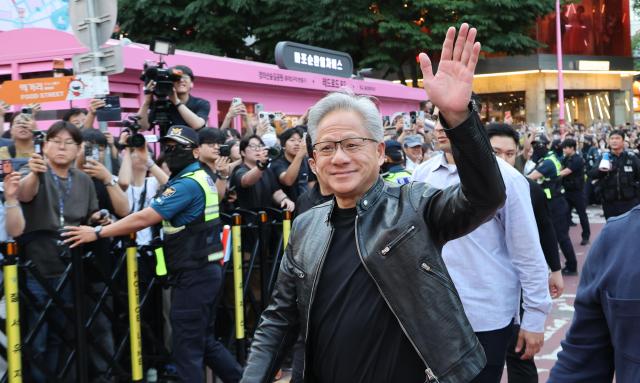
Colette Kress, Nvidia’s chief financial officer since 2013, became interim CEO and will keep the CFO role. Longtime director Harvey Jones became the board’s first-ever chair.
Jones left no room for a comeback. Opening the earnings call, he said the board had unanimously accepted Huang’s resignation, did not intend to reinstate him and would not take questions about his departure. Hours earlier, Huang had said he would be open to returning if the board judged it to be in the best interest of shareholders and the company.
The board has hired executive search firm Heidrick & Struggles to find a permanent successor and is considering candidates from inside and outside the company.
Kress used the call to reassure investors, customers and suppliers that operations were intact. “Our leadership has stood up so strongly over the last week,” she told analysts. “We’ve got this.” She said executives at Taiwan Semiconductor Manufacturing Co. (TSMC), Nvidia’s main manufacturing partner, had stayed closely engaged with the company since Huang’s exit.
Nvidia also pointed to the rollout of its next-generation Vera Rubin platform as proof that its technology lead is holding. The company has begun shipping Vera Rubin NVL72 systems and called it the fastest product ramp in its history. Partners already running the systems include CoreWeave, Google Cloud, Microsoft Azure, Oracle Cloud Infrastructure and Nebius.
“Vera Rubin is off to an explosive start, our roadmap is on track and our ambition has never been greater,” Kress said in the earnings release.
The ramp matters directly to South Korea’s two memory chipmakers, Samsung Electronics and SK hynix. Both are competing for a larger share of high-bandwidth memory, or HBM, the stacked memory that sits alongside AI processors. More powerful accelerators require faster memory and more advanced packaging, which keeps HBM a key growth driver for both companies. How much each one gains will depend on confirmed supply deals, production yields and customer allocations.
The results also test the wider AI investment cycle. Data center operators face rising electricity costs, grid constraints and questions about returns on their spending. Tuesday’s numbers show that demand for AI computing remains strong, but they do not settle whether customers can keep up the current pace of capital spending.
For Samsung and SK hynix, the short-term signal is clear: orders from the world’s largest AI accelerator supplier remain strong. The longer-term question is whether Nvidia’s leadership change, and the economics of AI infrastructure, will slow the flow of future chip orders.

Candice Kim
Candice Kim is a dedicated business and technology reporter specializing in the intersection of high-tech innovation and fast-paced consumer trends. Her core beats span the semiconductor, IT, cosmetics, and retail sectors, where she provides in-depth coverage of industry titans including Samsung Electronics, SK hynix, and LG Electronics, alongside leading consumer brands like Olive Young and Musinsa. Whether analyzing complex silicon supply chains or tracking the latest shifts in beauty and fashion retail, Candice is committed to delivering sharp, accurate reporting that keeps readers informed on the forces shaping today's most dynamic markets.
Copyright ⓒ Aju Press All rights reserved.