

The author, Abe Kwak, is the Chairperson of the Asia-Pacific Media Association based in Seoul.
In February 1945, three men gathered at a seaside resort on the Black Sea to discuss the future of a world still at war.
Franklin D. Roosevelt, Winston Churchill and Joseph Stalin had come to Yalta as allies. Nazi Germany was approaching defeat. The outlines of a postwar order were beginning to emerge. Questions of territory, security and political influence were placed before leaders whose armies, economies and ambitions gave them extraordinary power.
The people whose futures were being discussed were largely absent.
Koreans knew what that absence could mean.
For decades, they had struggled against Japanese colonial rule. Independence movements had operated across Korea, China, Russia and the United States. Yet the Korean people had little direct influence over the arrangements that would shape their liberation and the division that followed.
Historical precision matters here. The 38th parallel was not drawn at Yalta. The line was proposed months later, in August 1945, as the boundary between American and Soviet occupation zones.
But the larger lesson survived the distinction.
A nation can be liberated from one empire only to discover that its future has become entangled in the calculations of others.
Eighty-one years later, another gathering of three powerful leaders is about to take place.
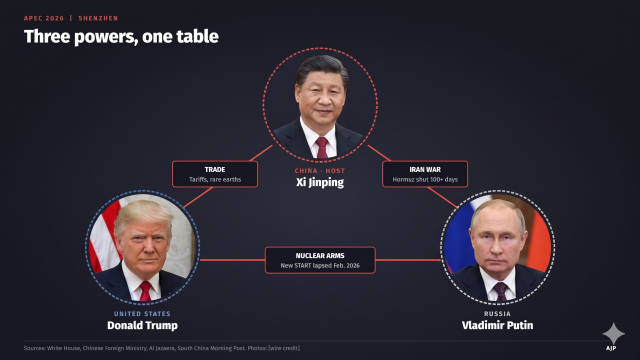
On November 19, Donald Trump, Xi Jinping and Vladimir Putin are scheduled to meet in Shenzhen, China, on the sidelines of the Asia-Pacific Economic Cooperation summit. Their encounter will bring together the leaders of the United States, China and Russia—three nuclear powers whose decisions reach far beyond their borders.
The meeting has already invited comparisons with Yalta.
The analogy is seductive. It is also imperfect.
Roosevelt, Churchill and Stalin were wartime allies approaching victory. Trump, Xi and Putin represent competing powers navigating unresolved wars, economic confrontation and a dangerously unsettled nuclear order. None possesses the authority, or the practical ability, to redraw the international system at will.
Yet the comparison raises a question that South Korea cannot afford to dismiss.
When great powers discuss the security of smaller nations, who ensures that those nations have a voice?
The Meaning of Shenzhen
The choice of Shenzhen is more than a matter of geography.
Once a modest settlement near Hong Kong, Shenzhen became the emblem of China's reform era. It grew into a manufacturing powerhouse and then into a center of technological ambition. Huawei, Tencent, BYD and DJI embody different dimensions of that transformation: telecommunications, digital platforms, electric vehicles and drones.
China is presenting a city that tells a carefully constructed national story.
A country once associated with inexpensive manufacturing now competes in artificial intelligence, advanced industrial systems, electric mobility and critical supply chains.
Shenzhen is both a place and an argument.
The leaders' meeting is expected to take place at Qilin Mountain Villa, a secluded guesthouse associated with high-level diplomatic hospitality. Kim Jong Il stayed there during his 2006 visit to southern China, when he examined the economic changes that had transformed the region.
Diplomatic settings are rarely accidental.
A secluded residence allows for security and discretion. It also offers the host a degree of control over the atmosphere and imagery of the encounter. Xi will be welcoming the American and Russian presidents in a city closely identified with China's economic ascent.
The symbolism will be difficult to miss.
But symbolism is not strategy, and hospitality is not hegemony.
The United States retains unmatched advantages in its alliance network, global finance, advanced technology and military reach. Russia commands a vast nuclear arsenal and remains a consequential military power despite the costs of its war in Ukraine. China possesses formidable manufacturing capacity, commercial influence and growing technological strength.
Each brings something the others must take seriously.
Each also carries vulnerabilities.
The venue belongs to China. The outcome belongs to no one yet.
Three Leaders, Three Strategic Calculations
Trump arrives in Shenzhen with political pressures at home and an unusually crowded diplomatic agenda abroad.
His party's losses in the American midterm elections have made foreign-policy achievements potentially more valuable. But reducing his approach to a search for favorable headlines would underestimate the strategic problems facing Washington.
The United States must manage its economic rivalry with China without inflicting excessive damage on its own companies and consumers. It must confront the erosion of nuclear arms-control arrangements with Russia. It must also contend with wars in Ukraine and Iran, both of which carry consequences for American power, credibility and resources.
Trump has reason to seek agreements.
He also has reason to demand concessions.
Xi's priorities are different. China wants greater recognition of its international standing, fewer restrictions on its technological development and a more stable commercial relationship with the United States. Beijing would prefer a world in which American economic pressure becomes less effective and China's own diplomatic influence becomes more difficult to challenge.
Yet China cannot simply disengage from the international economy.
Its prosperity depends on markets, investment, technological exchange and the confidence of trading partners. Its manufacturing strength gives Beijing leverage, but its global economic integration also imposes constraints.
Xi must balance ambition with interdependence.
Putin faces another calculation.
Russia's invasion of Ukraine has brought immense human costs, sanctions and prolonged confrontation with Western governments. A meeting with the American and Chinese presidents offers Moscow a chance to demonstrate that it remains central to the diplomacy of great powers.
That diplomatic recognition, however, cannot erase the question of responsibility.
A state may have legitimate security concerns. It does not follow that those concerns authorize the conquest of another state's territory.
The three presidents therefore arrive with divergent objectives.
Trump seeks agreements that can advance American interests and demonstrate presidential effectiveness. Xi seeks greater strategic room for China. Putin seeks recognition of Russia's enduring influence.
Their interests overlap in one essential respect: none can be certain of controlling the consequences of a direct military confrontation.
They do not need to trust one another to recognize the danger.
That is the opportunity for diplomacy.
The Nuclear Question Has Become More Dangerous
The expiration of New START in February 2026 marked a serious deterioration in the framework governing the world's two largest nuclear arsenals.
For decades, American and Russian strategic stability rested on an unsettling proposition: each side had to believe that the other could retaliate devastatingly after absorbing a nuclear attack.
This capacity for a second strike helped deter the first.
It was never a comforting foundation for peace. It was simply less dangerous than a world in which either side believed it could strike without suffering catastrophic consequences.
Now the strategic environment is changing.
The United States and Russia still possess nuclear stockpiles numbering in the thousands. China's arsenal is considerably smaller but expanding. Beijing has long argued that Washington and Moscow should make deeper reductions before demanding comparable commitments from China.
That disagreement cannot be resolved by pretending the three arsenals are equivalent.
Nor can modern arms control be confined to counting warheads.
Hypersonic weapons, missile defenses, space-based surveillance, cyber operations and artificial intelligence are altering the calculations of deterrence. AI systems can process warning signals and battlefield information with extraordinary speed.
Speed may improve defense.
It may also compress the time available to recognize a mistake.
What happens when an automated system misinterprets a missile launch? Who is responsible when an algorithm produces a dangerously confident assessment? How much time will a political leader have to question a military recommendation before events become irreversible?
These are no longer abstract questions.
A credible arms-control agenda must address crisis communication, verification, escalation risks and the continuing authority of human decision-makers over nuclear weapons.
A comprehensive agreement among the three powers is unlikely to emerge overnight. Even a durable channel for strategic dialogue would be a meaningful beginning.
The ultimate test of nuclear power is not how many weapons a country can deploy.
It is whether its leaders can prevent those weapons from being used.
Ukraine and Iran: The Limits of Great-Power Bargaining
Wars create powerful incentives for diplomatic negotiation. They also expose its moral and political limits.
Russia's full-scale invasion of Ukraine in 2022 transformed European security. It devastated communities, displaced civilians and brought territorial sovereignty back to the center of international debate.
Washington and Moscow may discuss possible ways to end the conflict. Beijing may seek a diplomatic role. European governments will have their own interests and obligations.
But Ukraine is not an object to be exchanged for concessions elsewhere.
Any durable settlement must confront the rights and security of the country whose territory and people are at stake.
The same principle applies, in a different regional setting, to Iran.
The conflict has drawn attention to the fragility of Middle Eastern security and the vulnerability of global energy markets. China has significant interests in Iranian oil and regional stability. Russia maintains strategic ties with Tehran. The United States has its own military objectives and diplomatic demands.
Their interests intersect without becoming identical.
The consequences of instability extend far beyond the Middle East. Disruption around the Strait of Hormuz can affect energy prices, shipping costs, industrial production and household budgets across Asia.
South Korea is particularly exposed.
Its economy relies heavily on imported energy and international trade. A crisis thousands of miles away can raise costs for Korean manufacturers, weaken consumer purchasing power and complicate national economic planning.
Modern wars do not remain within the borders where they begin.
Their economic consequences travel.
That is why the value of great-power diplomacy must be measured not only by whether leaders reach an understanding, but by whether that understanding reduces the dangers borne by others.
North Korea: The Question Seoul Cannot Leave to Others
For South Korea, the most consequential uncertainty surrounding the Shenzhen talks may be the future treatment of North Korea's nuclear arsenal.
Pyongyang has made nuclear weapons central to its national security doctrine. Kim Jong Un has repeatedly rejected denuclearization on the terms sought by Washington and Seoul. North Korea's growing military cooperation with Russia has further complicated the regional security environment.
Trump has expressed interest in renewed contact with Kim. Whether such a meeting will occur remains uncertain.
The more important question is what a renewed diplomatic process would seek to achieve.
There is a fundamental distinction between acknowledging that North Korea possesses nuclear weapons and recognizing it as a legitimate nuclear-weapon state.
The first is a strategic reality.
The second would carry profound political and legal implications.
South Korea cannot formulate an effective security policy by denying the reality of Pyongyang's arsenal. Nor should it abandon the long-term objective of denuclearization merely because that objective has become more difficult to achieve.
The challenge is to combine deterrence with diplomacy.
The U.S. extended nuclear deterrent remains central to South Korea's security. So do the capabilities of South Korea's own armed forces: surveillance, intelligence, missile defense, precision strike and resilient command systems.
Yet military preparedness alone cannot eliminate the danger of miscalculation.
Communication matters. Crisis management matters. Agreements that reduce the immediate risk of conflict may matter even when a comprehensive political settlement remains distant.
Seoul must therefore resist a false choice between uncompromising rhetoric and uncritical accommodation.
It needs a policy capable of defending the country while preserving a path away from war.
If the Korean Peninsula is discussed in Shenzhen, South Korea has a legitimate expectation that its security interests will be represented and that meaningful consultations will follow.
Diplomatic language will deserve close attention. A shift away from explicit references to denuclearization could signal a change in emphasis. It would not, by itself, amount to legal recognition of North Korea's nuclear status.
Words matter in diplomacy.
Actions matter more.
South Korea's Defense Must Be Stronger Than Its Assumptions
The shifting strategic environment also brings renewed attention to South Korea's own defense capabilities.
The transfer of wartime operational control is frequently presented as a question of sovereignty or national pride. It is better understood as a demanding military undertaking.
South Korea must be able to lead combined wartime operations with the necessary command systems, intelligence capabilities, operational readiness and capacity to respond to North Korea's evolving threats.
A politically attractive deadline cannot substitute for those conditions.
The debate over nuclear-powered submarines requires similar discipline.
Nuclear propulsion is not the same as nuclear armament. A submarine powered by a nuclear reactor can remain submerged for extended periods and sustain operations over long distances. Those capabilities may offer military advantages.
But acquiring them involves complex questions of reactor technology, nuclear fuel, international safeguards, financing, construction and long-term operations.
None can be resolved through symbolism alone.
South Korea should pursue the capabilities its defense genuinely requires while preserving its standing as a responsible participant in the international nonproliferation system.
Strategic autonomy should not be confused with strategic isolation.
A more capable South Korean military can strengthen the alliance with the United States by making it more effective, resilient and balanced.
An alliance is strongest when both partners contribute substantial capabilities and understand their shared obligations.
Self-reliance and alliance cooperation are not opposites.
They can reinforce one another.
The Other Contest in Shenzhen: Chips, AI and Industrial Power
There is an irony in holding a summit devoted to regional economic cooperation while the world's most powerful states compete over the technologies that will define future military and economic strength.
Shenzhen embodies that contradiction.
Its industrial ecosystem links telecommunications, software, batteries, electric vehicles, robotics and advanced manufacturing. These are sources of commercial prosperity. They are also increasingly relevant to national security.
Semiconductors power artificial intelligence systems, advanced computing and sophisticated military platforms. Drones, autonomous vehicles and robotics have applications in civilian industries and defense. Rare-earth materials are critical to a range of technologies, from electric motors to military equipment.
Washington has used export controls to limit China's access to certain advanced technologies. Beijing has invested heavily in domestic alternatives and retains considerable influence over parts of the world's critical-minerals supply chains.
Both governments possess leverage.
Neither possesses complete independence.
The United States benefits from China's manufacturing capacity and market. China remains affected by American technology, international financial systems and access to global customers.
Their rivalry is real. So is their interdependence.
South Korea sits at the intersection.
Samsung Electronics and SK Hynix are central to the global memory-chip industry. Korean companies also hold important positions in automobiles, batteries, shipbuilding and defense manufacturing.
These industries give Seoul more than export revenue.
They provide strategic relevance.
But economic importance does not automatically translate into diplomatic influence. It must be converted into a coherent national strategy.
South Korea should deepen its technological capabilities while participating more actively in the international rules governing AI, advanced manufacturing, digital infrastructure and critical supply chains.
There is a difference between producing the technologies of the future and helping determine the conditions under which they will be used.
South Korea should aspire to do both.
A More Confident Korean Diplomacy
For President Lee Jae Myung, the Shenzhen summit presents a demanding diplomatic test.
South Korea cannot control the agenda of every meeting among the major powers. It can, however, define its interests clearly, communicate them in advance and build relationships that make those interests difficult to disregard.
That work does not begin when presidents sit down for a photograph.
It begins with national security advisers, foreign ministers, diplomats and officials who prepare the arguments and negotiate the language long before a summit takes place.
Seoul should pursue three objectives.
It should maintain a credible commitment to peace and denuclearization on the Korean Peninsula while developing practical measures to reduce immediate nuclear dangers. It should insist on close consultation over decisions that directly affect South Korean security. And it should connect its defense, technological and economic strengths to a broader diplomatic strategy.
This requires judgment rather than theatrical confrontation.
The United States remains South Korea's indispensable security ally. China is a major economic and regional power whose relationship with Seoul requires careful management. Japan is both an industrial competitor and an important partner in regional security and technological cooperation. Relations with Russia must be approached in light of the war in Ukraine, international law and longer-term strategic interests.
These relationships are not interchangeable.
Nor should they be reduced to a single choice between competing camps.
A successful foreign policy preserves principles while expanding options.
South Korea must also recognize that its influence rests on more than military and economic assets. Democratic legitimacy, institutional credibility, cultural achievement and social resilience matter in international affairs.
The country that emerged from colonial rule, war and poverty has become an advanced industrial democracy with a global cultural presence.
That transformation has given it something that was absent in 1945.
A voice of its own.
But a voice is effective only when backed by preparation, credibility and the capacity to act.
Beyond the Shadow of Yalta
The leaders meeting in Shenzhen may discuss nuclear arms, war, trade and the technologies that will shape the next generation of global power.
Their talks could produce progress. They could yield little more than carefully worded statements. It is too early to know.
What South Korea must not do is confuse diplomatic spectacle with historical destiny.
Shenzhen is not Yalta. The world is not divided into three obedient spheres, and the countries affected by great-power decisions are not without agency.
South Korea in particular is no longer the powerless nation it was in 1945.
Its security rests on alliances, its economy on technological strength, and its international standing on decades of national achievement. These assets must now serve a clear purpose: ensuring that decisions affecting the Korean Peninsula cannot be made as though Koreans were absent.
Eighty-one years ago, Korea had little influence over the arrangements shaping its future.
Today, it has the means—and the responsibility—to insist on being heard.
South Korea may not have a chair at every table where the great powers meet.
But it must never surrender its right to shape its own future.
The views expressed in this article are solely those of the author and do not necessarily reflect the editorial position of AJP.
Copyright ⓒ Aju Press All rights reserved.
