

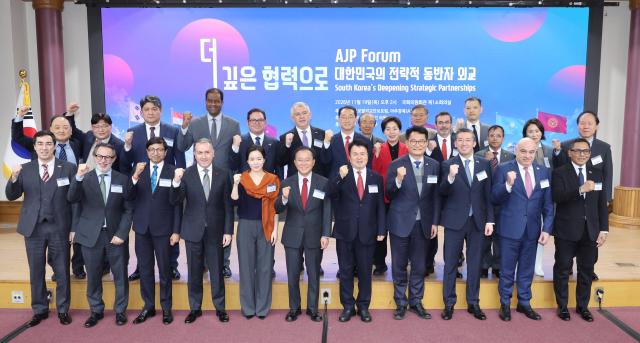
Ambassadors welcomed the opportunity to follow through on the extensive agendas agreed at bilateral summits throughout the year. The forum, titled “Deepening South Korea’s Strategic Partnership,” was jointly hosted by the National Assembly Global Diplomacy and Security Forum and AJP to mark the news outlet’s second anniversary.
"The countries represented are valued partners for South Korea, with vast opportunities for cooperation spanning energy, critical minerals, defense, nuclear power, artificial intelligence and infrastructure," said Rep. Yun Jae-ok, chair of the parliamentary forum, in his opening remarks.
Aju News Corporation Chairman Kwak Young-kil welcomed the guests and stressed the importance of translating diplomatic commitments into tangible outcomes. “A strategic partnership is not completed by declarations. It becomes a living force when agreements between leaders turn into investment, trade and results,” Kwak said.
As South Korea seeks to diversify its energy suppliers amid the wars in Ukraine and Iran, the ambassadors outlined how their countries could help meet Korean import needs and how expanding trade could benefit both sides.
The first session featured ambassadors Gourangalal Das of India, Fernando Meirelles Pimentel of Brazil and Fatih Yıldız of Türkiye. In New Delhi on April 20, President Lee Jae Myung and Indian Prime Minister Narendra Modi agreed to establish an industrial cooperation committee covering shipbuilding and critical mineral supplies.
In Brasília on July 27, Lee and Brazilian President Luiz Inácio Lula da Silva backed expanded local processing of minerals, including rare earths. In Seoul on Nov. 3, Lee and Turkish President Recep Tayyip Erdoğan reviewed site assessments for a proposed nuclear power plant at Sinop. The two countries also signed a memorandum on financing nuclear projects.
Four Central Asian ambassadors spoke in the second session — Kirom Salohiddin Amriddinzoda of Tajikistan, Alisher Abdusalomov of Uzbekistan, Asset Issenali of Kazakhstan and Melis Mamadaliev of Kyrgyzstan. Their presidents held separate talks with Lee in Seoul over three days in September.
On Sept. 14, South Korea and Uzbekistan agreed to expand joint exploration and processing of rare metals. A day later, Seoul and Kazakhstan signed a framework agreement on crude oil, following up on a plan for South Korea to import 18 million barrels of Kazakh crude.
At separate summits on Sept. 16, South Korea and Tajikistan established a comprehensive partnership covering railways and mineral exploration, while South Korea and Kyrgyzstan agreed to open a Korean trade office in Bishkek and identify potential critical mineral projects.Rep. Kim Gunn moderated the closing discussion on how lawmakers in South Korea and its partner countries could use legislation and budget decisions to help turn the summit agreements into concrete projects.
"I spent many years in the diplomatic service, and I learned that an agreement between leaders does not complete cooperation by itself. Ministries and businesses must stay in close contact and keep their commitments, so that people feel the results in their lives, said Rep. Kim.
Lee Jung-woo
I studied philosophy in college, and sociology and journalism in graduate school. I cover North Korea, South Korean politics, foreign affairs and films. I enjoy Nordic cinema, Indian cuisine and Japanese detective novels. I have a cat and like bright, acidic coffee.
Copyright ⓒ Aju Press All rights reserved.
