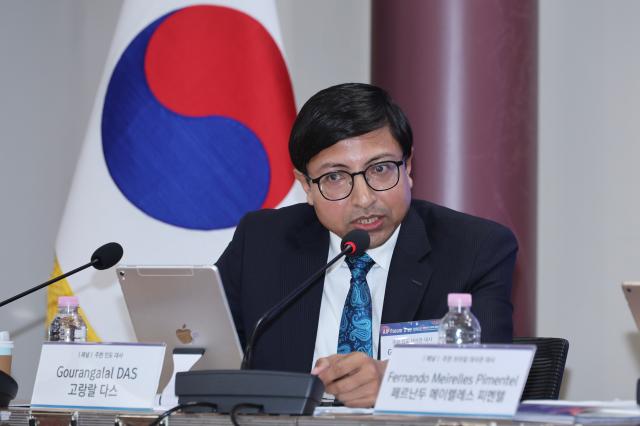
"I find that on the Korean side, once the visit is over, the attention shifts to something else," Indian Ambassador Gourangalal Das told a forum in Seoul. Ministers, vice ministers and sometimes even director generals were "very difficult to meet," he said.
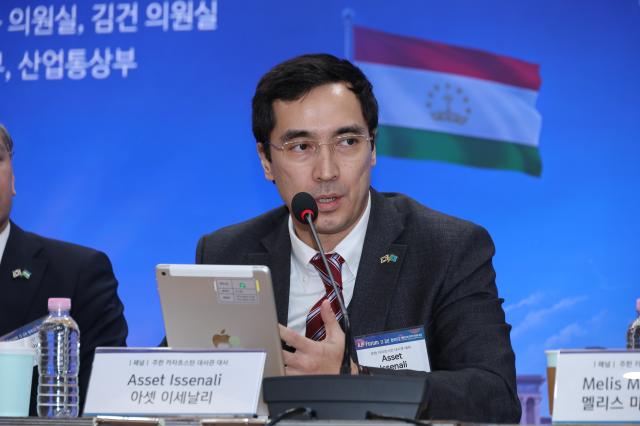
Kazakh Ambassador Asset Issenali was blunter. Without companies at the table, lawmakers, officials and diplomats "will sit, talk, talk and again talk, while businesses will do business."
The unusually candid criticism exposed a persistent weakness in South Korea's summit diplomacy: agreements are celebrated when leaders meet, but the hard work of turning them into investments and commercial projects often falls victim to bureaucratic inertia, frequent personnel changes and poor follow-through.
The government said it shares the concern. "The true test of summit cooperation is how faithfully its outcomes are implemented and how much companies feel the results on the ground," said Kim Jung-yae, director of the Trade Cooperation Policy Division at the Ministry of Trade, Industry and Resources.
Director Kim said the ministry regularly convenes a public-private task force, chaired by the minister for trade, to check whether projects agreed at summit-level economic events are being carried out and to spot difficulties companies face.
Those problems can be taken up with partner governments through consultation channels set up at summits, she said, adding that outcomes had become far easier to manage since the platform was created.
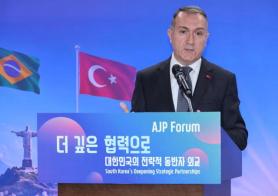
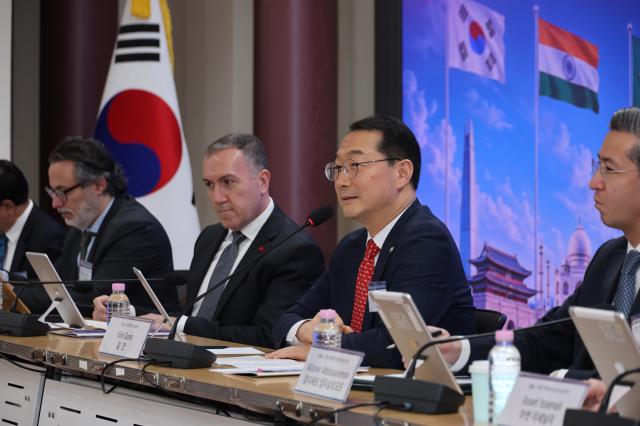
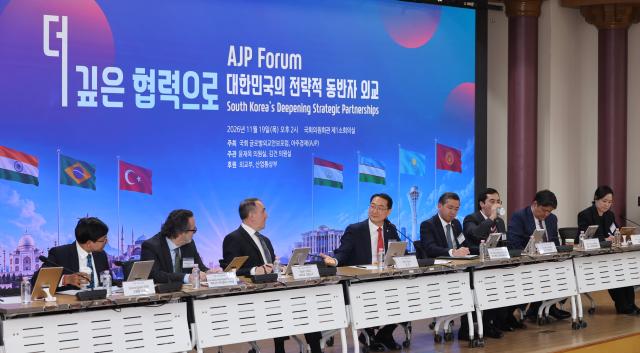
The discussion closed the forum "South Korea's Deepening Strategic Partnerships," held at the National Assembly Members' Office Building and co-hosted by the National Assembly Global Diplomacy and Security Forum and AJP. The offices of Reps. Yoon Jae-ok and Kim Gunn organized the event, which was sponsored by the Ministry of Foreign Affairs and the Ministry of Trade, Industry and Resources.
The ambassadors of India, Brazil, Türkiye, Tajikistan, Uzbekistan, Kazakhstan and Kyrgyzstan joined the panel, moderated by Rep. Kim Gunn of the People Power Party, a former ambassador to Britain.
"Once we have a breakthrough, another story starts: how to make happen what is agreed on paper," he said.
There is no shortage of paper. Lee signed 126 memorandums of understanding during visits to 14 countries in his first year in office. A tally presented to the Cabinet in September counted 163 economic MOUs with 22 countries, and Lee told ministers to make sure they were followed through.
The Korea-Central Asia summit in Seoul that month alone produced nine government documents and 116 business MOUs.
Uzbek Ambassador Alisher Abdusalomov, who served in Seoul as a trade and economic counselor from 2018 to 2024 and visited the ministry in Sejong almost every week, blamed staff rotation. Officials change posts every two years, he said, eroding the "institutional memory" of how agreements came about.
"Today I urge the Ministry of Trade, Industry and Resources to be more aggressive," he said. In Uzbekistan, he noted, a special committee chaired by the head of the Senate monitors implementation of agreements with Korea.
Kim acknowledged the weakness, pointing to her own appointment as an example. "Our rotation is indeed very fast. In fact, I have been in this post for less than a month," she said.
She argued, however, that the integration of industry and trade functions allows officials to draw on experience gained elsewhere in the ministry. The Foreign Ministry and ministerial meetings chaired by the deputy prime minister also monitor summit outcomes.
Rep. Kim offered the ambassadors a political shortcut around unresponsive ministries.
Ministers are "very weak against National Assembly members," he joked, suggesting that envoys enlist the help of lawmakers heading parliamentary friendship groups.
The frustrations are understandable. South Korea and India began negotiations in 2016 to upgrade their 2010 trade agreement. The talks stalled after 2022 and resumed only after Lee's summit with Indian Prime Minister Narendra Modi in April. The two governments are now aiming to conclude the upgrade in the first half of 2027.
Negotiations for a free trade agreement with Mercosur, the South American bloc led by Brazil and Argentina, have been frozen since 2021. Lee and Brazilian President Luiz Inácio Lula da Silva agreed in July to work toward announcing their resumption in December.
He suggested that civil society could help hold governments accountable between summits rather than leaving implementation entirely to officials.
Turkish Ambassador Fatih Yıldız warned against grand diplomatic promises without realistic targets and follow-up mechanisms. Goals set too high "will definitely create disappointment and frustration," he said. His example was the Sinop nuclear power plant, which "has been long in discussion."
That may be an understatement. South Korea was widely expected to win the Black Sea project in 2010 before Ankara turned to Japan. Korea Electric Power Corp. returned to the negotiating table with a cooperation MOU in November 2025.
Another MOU, this time covering financing, followed when Lee hosted Turkish President Recep Tayyip Erdoğan in Seoul on Nov. 3. Yet a contract to build the plant remains elusive.
Sixteen years after Seoul first pursued the project, the two sides are still signing preliminary agreements.
For the Central Asian ambassadors, the problem extends beyond diplomatic follow-through to who actually benefits from economic cooperation.
Speaking on their behalf, Rep. Kim asked how Seoul would respond to countries seeking to process critical minerals domestically rather than merely exporting raw materials to South Korea.
Kim Jung-yae said critical mineral supply chains had been discussed at every summit with the seven countries and remained among the ministry's highest priorities.
"Rather than stopping at resource development or trade as in the past, we aim to combine partner countries' rich mineral resources with Korea's processing and refining technology, processing locally and producing materials there," she said.
The approach would give Korea a more stable supply chain while helping resource-rich partners capture more value from their mineral deposits.
Korea has established or is developing rare metal cooperation centers in some partner countries through official development assistance. The facilities are intended to support technology transfers, joint research and workforce training.
But the gap between diplomatic ambition and actual trade remains stark.
South Korea's exports surged 93.7 percent to $115.3 billion in October, yet shipments to the Commonwealth of Independent States, which includes Central Asia, plunged 31.6 percent to $910 million. Exports to Latin America fell 37 percent to $2.96 billion.
Together with India, the two regions accounted for less than 6 percent of Korea's total exports that month, according to trade ministry data.
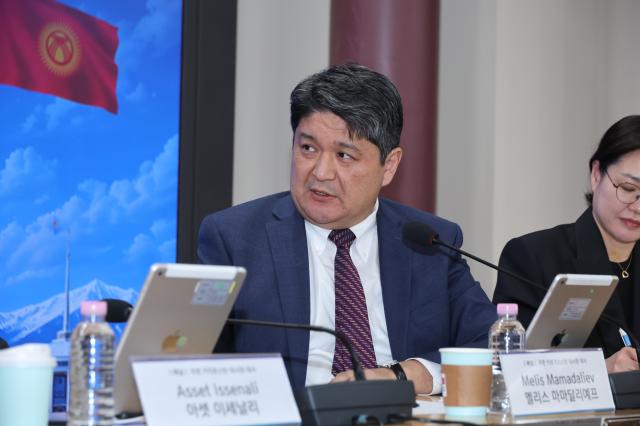
Kyrgyz Ambassador Melis Mamadaliev, speaking in Korean, complained that Kyrgyz goods accounted for less than 5 percent of bilateral trade. The obstacles he witnessed during his earlier posting in Seoul from 2008 to 2017, he said, remained "almost unchanged."
India's Das also pointed to weak people-to-people ties as a symptom of the broader relationship.
Only about 2,000 Indian students study in Korea, he said, out of roughly 1.5 million Indians who pursue education abroad each year. Visa bottlenecks and limited direct flights continue to hold back exchanges.
The next tests are already approaching.
Seoul and Mercosur are targeting a restart of trade negotiations in December. Korea and India hope to conclude their long-delayed trade pact upgrade in the first half of 2027. The second Korea-Central Asia summit is scheduled for 2028 in Astana, Kazakhstan.
When leaders gather again, Mamadaliev warned, another round of ambitious plans will not be enough. They will want to see what has actually been delivered.
Wrapping up the nearly three-hour forum, Rep. Kim acknowledged that the discussion itself had barely scratched the surface. "It's a pity that we have had not much time to hear more and discuss more. The important thing is to have more forum like this to keep up the communication," he said.
Kim Yeon-jae is a journalist at AJU Press (AJP's English platform),
covering macroeconomics, international finance, and geopolitics.
He closely tracks central bank monetary policies, global energy supply chains,
and the Korean defense industry.
Copyright ⓒ Aju Press All rights reserved.