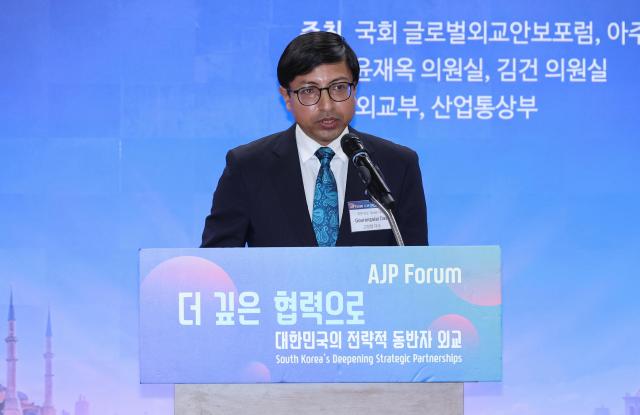
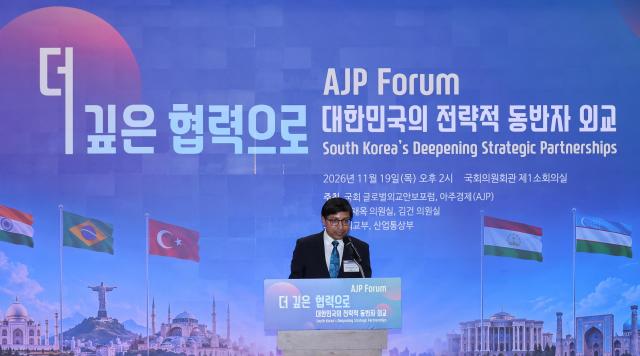
Speaking at the AJP Forum at the National Assembly in Seoul, Das outlined India's priorities for 2027, focusing on turning agreements reached during the April summit between the two countries into concrete industrial and economic projects.
The forum, titled "Beyond the Summit: From Agreement to Action," brought together ambassadors from seven countries including Brazil, India, Türkiye, Tajikistan, Uzbekistan, Kazakhstan and Kyrgyzstan that held summit-level talks with South Korea this year.
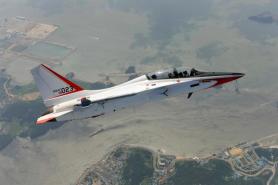
"Right now we are discussing a third phase of the K9 program," Das said, referring to the South Korean-developed self-propelled howitzer known as the K9 Vajra-T in India.
While he did not disclose the potential size or timeline of the third phase, Das said similar industrial cooperation could be extended to other defense platforms.
Shipbuilding is another major priority for India next year, with discussions between a South Korean company and Indian authorities progressing over the development of a new shipyard.
During President Lee Jae Myung's state visit to India in April, the two governments welcomed a non-binding memorandum of understanding involving HD Korea Shipbuilding & Offshore Engineering (HD KSOE) for the joint development, financing and operation of a large shipyard in southern India.
"We want the final binding agreement to be signed with all the details of investment," Das said.
India is also seeking South Korean assistance in modernizing its shipbuilding industry, including a workforce training program involving the Korea International Cooperation Agency (KOICA).
The two countries also aim to hold vice-ministerial defense policy talks and convene a newly established "two-plus-two" dialogue between their vice ministers of foreign affairs and defense next year.
India has set a target of increasing the number of South Korean companies operating in the country tenfold, he said, identifying semiconductors, critical minerals, solar manufacturing, heavy machinery and shipping containers as key areas for cooperation.
Nuclear energy is another area of potential cooperation as India seeks to expand its nuclear power capacity roughly tenfold by 2047.
Das described South Korea as having one of the most competitive offerings available for India's planned nuclear expansion.
The ambassador also highlighted opportunities for cooperation in artificial intelligence, cybersecurity and the space industry, alongside efforts to facilitate travel between the two countries.
Reflecting on progress since the April summit, Das said both the list of accomplishments and the list of remaining tasks ran to five pages.
"I think we have not done too badly, but I think we have still a very rich agenda for next year," he said.

Kim Hee-su
Kim Hee-su is a bilingual reporter at AJU Press, covering defense and foreign affairs. Before joining AJP in 2025, she worked at The Korea Times, where she wrote interview stories, including a profile of North Korean defector Kim Gum-hyok, and produced digital content. She also previously worked as a researcher for KBS News 9’s International News Department, supporting correspondents in 10 countries around the world. She graduated from the University of Toronto in Canada with a double major in Book and Media Studies and East Asian Studies.
Copyright ⓒ Aju Press All rights reserved.