

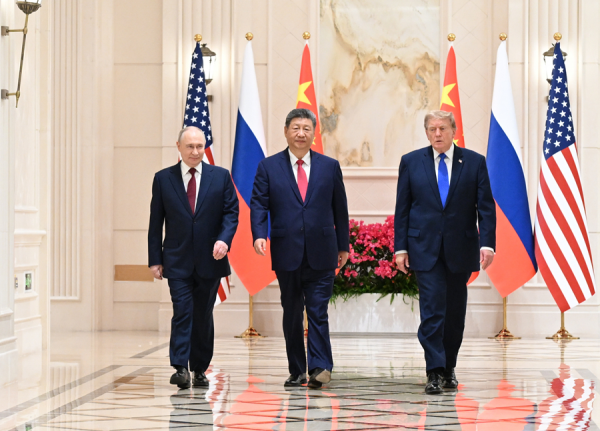
SEOUL, November 20 (AJP) - The leaders of the United States, China and Russia put their collective power on display at a historic summit Thursday and pledged to reduce nuclear dangers, but left uncertain whether their shared taste for grand gestures could produce lasting restraints on their national ambitions.
Chinese President Xi Jinping hosted U.S. President Donald Trump and Russian President Vladimir Putin in Shenzhen for their first dedicated three-way summit, held alongside the Asia-Pacific Economic Cooperation (APEC) gathering.
The historic the meeting offered a striking image of three powers claiming special responsibility for world order, while post-meeting four-point declaration offered few details on how they would exercise it.
The nuclear commitment stopped well short of denuclearization.
The leaders reaffirmed that “a nuclear war cannot be won and must never be fought” and promised dialogue on reducing nuclear risks and preventing proliferation. They announced no arsenal reductions, negotiating timetable, inspection arrangements or verification mechanism. Nor did the declaration specifically commit North Korea to abandoning its nuclear weapons.
Trump himself illustrated the difficulty. In a Fox News interview from Shenzhen, he said that being asked to reduce the U.S. nuclear force by 2,000 weapons would be “a hard thing for me to do.” His enthusiasm for a historic agreement came with an acknowledgment of the political and strategic cost of making one.
The gains were in personal favor rather than for universal goods.
For Xi, convening the American and Russian presidents placed Beijing at the center of a conversation about global security. For Putin, appearing alongside them reinforced Russia’s claim to great-power status despite its war against Ukraine. For Trump, the gathering supplied another occasion to present personal diplomacy as a route to deals that conventional diplomacy had failed to deliver.
The pageantry was itself part of Trump’s measure of success. Before the summit, he praised the elaborate Chinese welcome and described the respect shown to him as a win for both countries.
Their common ground also extended to protecting the authority of states and their officials. The declaration stressed official immunities and warned against international courts abusing their jurisdiction. That language carried particular significance for Putin, against whom the International Criminal Court issued an arrest warrant in 2023 over the alleged unlawful deportation and transfer of Ukrainian children.
The document also promised U.N. reform and increased production and supply of refined petroleum products. It provided no reform blueprint, production targets or implementation schedule. China’s account said the leaders discussed Ukraine, the Middle East and the Korean Peninsula, but the declaration contained no specific settlement for any of them.
The gap between peace language and national objectives was apparent almost immediately. At his post-summit press conference, Putin threatened retaliation for Ukrainian attacks on the Crimean Bridge and ruled out negotiations on proposed limited ceasefires covering energy infrastructure or the Black Sea in their aftermath.
For South Korea, the inclusion of the peninsula in the discussion offered evidence of attention, but no new security assurance. More broadly, smaller countries have reason to distinguish dialogue among major powers from arrangements made over their heads.
The meeting opened a channel worth testing. Its durability will depend on whether three leaders who attach national prestige closely to personal authority will accept constraints that survive beyond the ceremony. The next evidence of progress will be negotiating instructions, follow-up meetings and measurable commitments—and whether the countries whose futures are discussed have a voice in shaping them.
Copyright ⓒ Aju Press All rights reserved.
