

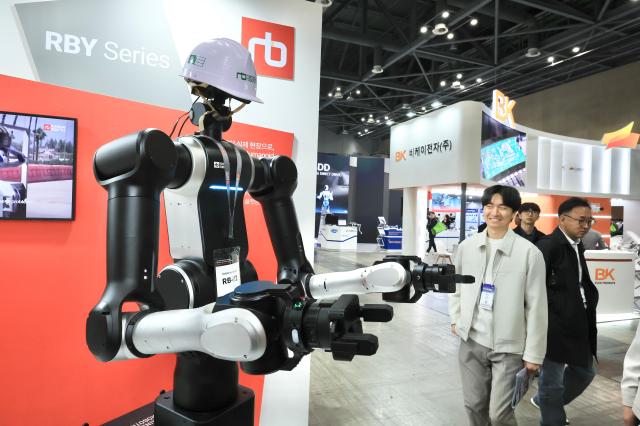
Chinese companies accounted for 21 of the 38 humanoid exhibitors at CES 2026, although Hyundai Motor Group-controlled Boston Dynamics took CNET Group's Best Robot award with Atlas. The next edition runs Jan. 6 to 9.
The competition is expected to shift from crowd-pleasing stunts toward machines that can handle tools, move goods and complete tasks with less human intervention.
"More than half will probably move toward autonomous work," said Park Dong-il, head of the advanced robotics research center at the Korea Institute of Machinery and Materials, who leads the team developing the state-backed KAIROS humanoid.
"Especially in the United States, autonomous work is being put far out front."
Only a handful of exhibitors emphasized their robots' work skills at the last show, drawing a lukewarm reception, Park said. Dancing, boxing and other athletic demonstrations will increasingly be taken for granted, with more companies expected to showcase practical tasks.
But development is moving so quickly that the demonstrations themselves remain a work in progress.
Industry sources say Samsung plans to unveil two humanoids: HR, short for Human Reference, and HE, or Humanoid Extreme. HE is the higher-end model, with more degrees of freedom — independently controlled movements that provide greater flexibility for complex tasks. Samsung has not confirmed the plans.
Samsung has also been testing a bipedal humanoid intended for round-the-clock work in factories and warehouses, with employees monitoring it in three shifts, according to sources.
Much of the attention is likely to fall on its hands.
The two models reportedly have five-fingered hands operated through tendon-like cables. A Samsung U.S. patent application published Oct. 22 describes a cable-driven finger mechanism, although the filing alone does not establish which technology will appear in the finished robots.
"Without tendons, you would have to fit an actuator into every finger joint," said You Bum-jae, a principal research scientist and former head of humanoid development at the Korea Institute of Science and Technology, who developed the MAHRU humanoid. "With tendons, the actuators can gather in the palm, so the fingers can be made slimmer."
That compact design brings its own engineering demands.
"But you have to keep the tension constant so the cables never sag," You said. "Whether they have secured all those technologies, we will have to see."
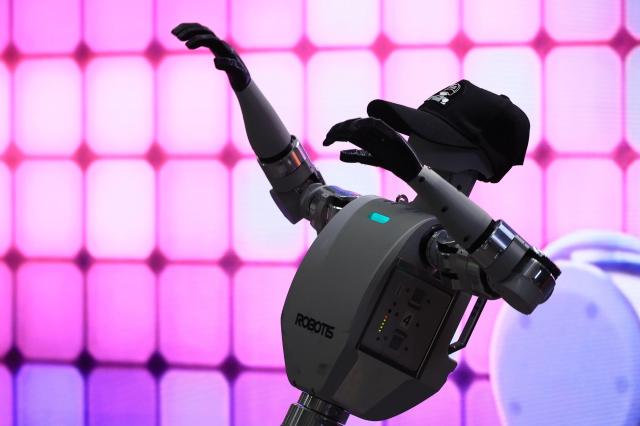
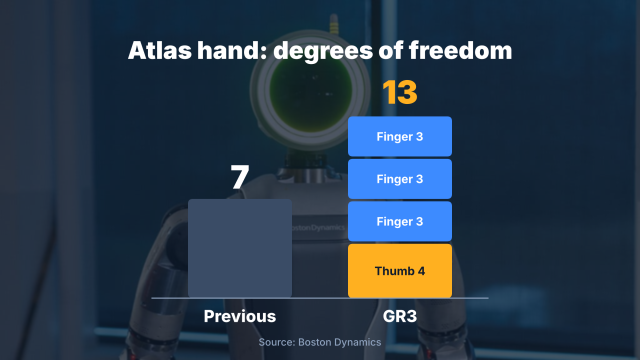
Boston Dynamics has taken a different approach with the GR3 hand unveiled for Atlas on Oct. 1. Its four fingers are driven directly at the joints, with 13 degrees of freedom. The design allows the robot to manipulate objects and operate tools, including gripping a handle while pressing a trigger.
Park said Samsung's apparent emphasis on hand dexterity reflects the same push to prove that humanoids can perform useful work.
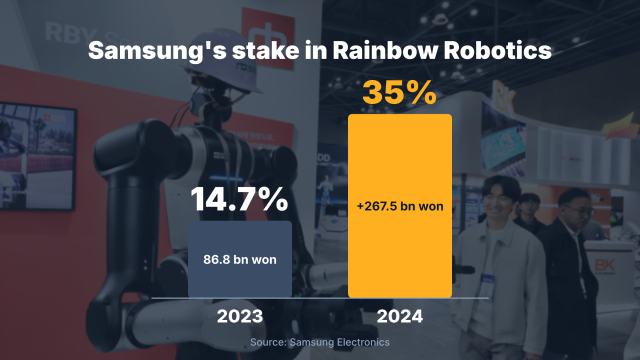
Rainbow Robotics, the HUBO developer that Samsung took control of through a deal announced in December 2024, will not operate its own booth at CES. A company official said it would participate in a government-organized robotics pavilion and declined to discuss Samsung's plans.
Oh Jun-ho, who led HUBO's development and co-founded Rainbow, continues to head Samsung's Future Robotics Office, which was incorporated into the company's new robotics unit in July. The Rainbow official declined to disclose the extent of his advice to Samsung.
The competition extends well beyond the exhibition floor.
Hyundai Motor Group aims to establish annual production capacity for 30,000 Atlas robots by 2028 as it prepares to introduce the machines into automotive manufacturing.
LG plans to unveil a bipedal humanoid in the first quarter of 2027 using Nvidia's Isaac GR00T model and Jetson Thor computing platform. That timetable makes CES a possible debut venue, although LG's announcement did not identify the show.
Tesla said in October that early production of Optimus had begun at its Fremont factory. It has announced no plans for the Las Vegas show.
Chinese manufacturers already have a substantial lead in shipments. Unitree Robotics and AgiBot each shipped more than 5,000 humanoids in 2025, out of approximately 15,000 worldwide, according to figures reported by The Associated Press.
Access to the U.S. market presents a separate hurdle. Since July 28, the Federal Communications Commission has restricted new equipment authorizations for foreign-produced advanced robotic devices, including covered humanoids made in South Korea, unless they receive conditional approval.
For Korean developers, the challenge is also to establish that the components behind their demonstrations can compete.
Reliability remains another obstacle between a compelling demonstration and a machine that can earn its place on a factory floor.
"Task success rates for models around the world are still below 90 percent," You said. "To unveil physical AI, performance has to go beyond that."
"How well it works, we will only know on the day," Park said.

Kim Dong-young
Kim Dong-young is a bilingual journalist at AJU Press (AJP), covering Korean tech, energy, and bio/pharma.
He reports from the field at events like CES and APEC, runs AJP's YouTube channels,
and is pursuing a master's at Sogang's MOT program.
Copyright ⓒ Aju Press All rights reserved.
