SEOUL, November 20 (AJP) — Headline inflation is softening and stronger-than-expected growth is expected to carry into 2027, but the recovery in domestic demand remains sluggish, complicating the case for extending the Bank of Korea’s restrictive policy beyond this year.
The bond market is leaning toward an end to the tightening cycle, with a final increase of 25 basis points to 3.25 percent at the Nov. 26 meeting.
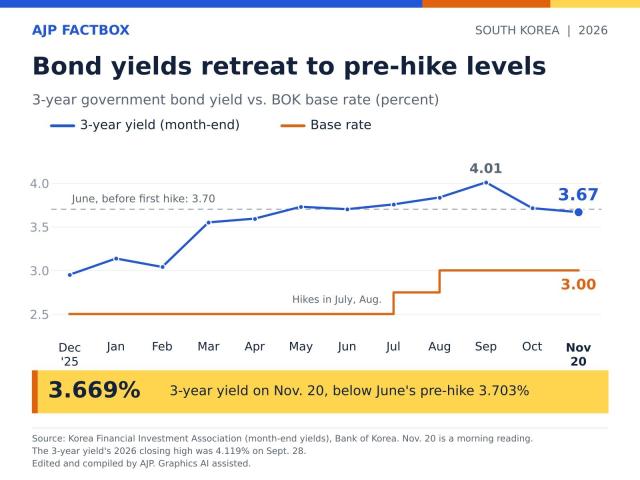
The three-year government bond yield closed Friday at 3.642 percent, down 7.4 basis points, while the 10-year yield fell 8.5 basis points to 3.857 percent.
Both revisited levels seen before the benchmark rate began rising from July, after holding at 2.50 percent for more than a year since May 2025.
The 10-year yield had surged to 4.6 percent in September after a second rate increase in August, amid fears of aggressive tightening under a hawkish governor.
The backdrop has sharply changed since the summer when leveraged investment peaked from red-hot stock and housing market.
Softer oil prices and a stock-market correction are testing the case for further increases, while the benefits of the chip-led expansion have yet to spread evenly through the economy.
October’s producer prices also lessened the rationale.
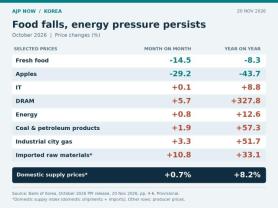
The producer price index fell 0.1 percent from September to 129.66, its first monthly decline in three months, the BOK said Friday. Annual growth slowed to 7.2 percent from 7.6 percent, matching April’s pace. September’s monthly increase was revised down to 0.1 percent from a preliminary 0.2 percent.
Agricultural, forestry and fishery prices dropped 8.3 percent as demand faded after the Chuseok holiday and harvest conditions improved. Apple prices fell 29.2 percent and pork prices declined 12.8 percent.
Excluding agricultural, forestry and fishery products, however, producer prices would have risen 0.2 percent. The BOK cautioned that temporary factors had driven the overall decline.

The domestic supply price index, which includes imported goods, rose 0.7 percent in October. Imported raw-material costs jumped 10.8 percent as September’s 28.1 percent surge in dollar-denominated Dubai crude prices fed through to customs-cleared imports with a lag.
More recent readings point in the opposite direction. Contract-based import prices, which lead the customs-cleared figures, fell 1.8 percent in October as the won strengthened and Dubai crude slipped 2.6 percent.
International oil prices through Nov. 18 were about 15 percent below October’s average, the BOK said, although higher wholesale industrial gas rates and airline fuel surcharges could lift some prices this month.
Brent crude settled at $91.98 a barrel on Nov. 19, while West Texas Intermediate ended at $83.21, its lowest close since Aug. 26.
Government intervention has also cushioned the impact on consumers. Officials estimate that the cap on refiners’ fuel supply prices reduced October’s consumer inflation rate by 0.8 percentage point.
Cheaper oil could ease one of the concerns raised at the BOK’s October meeting: that the earlier energy shock would spread through the economy as businesses passed on higher costs.
Still persistent underlying inflation danger remains.
Consumer prices excluding food and energy rose 0.4 percent in October from September and 2.8 percent from a year earlier. Headline consumer inflation eased only slightly, to 2.8 percent from 2.9 percent in September.
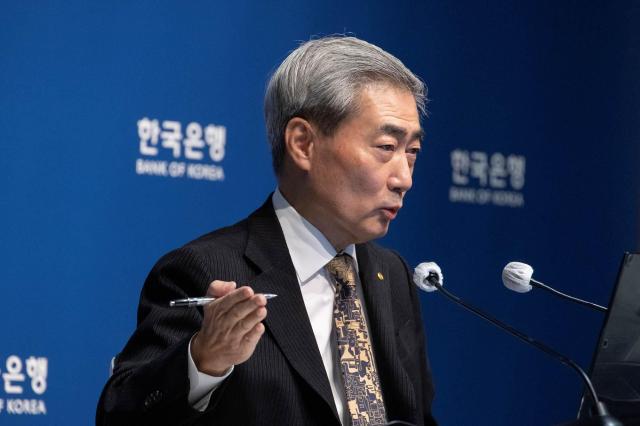
The BOK expects headline inflation to remain in the high-2 percent range in November, citing strong underlying price momentum. Governor Shin Hyun-song said in October that core inflation next year would probably exceed the bank’s earlier forecast of 2.5 percent.
Producer prices provide only a partial guide to those pressures. The producer index excluding food and energy rose just 0.1 percent in October, but its composition differs from consumer inflation and includes semiconductor prices, with DRAM up 327.8 percent from a year earlier.
The economy expanded 1.0 percent in the third quarter from the previous three months, more than three times the BOK’s August projection. Minutes of the October policy meeting, released Nov. 10, showed that a majority of board members saw a need for further tightening.
Forecasters are divided over whether that means one more increase or two.
Kiwoom Securities expects the BOK to raise the rate to 3.25 percent this month and to 3.5 percent in February if the central bank’s growth and inflation outlook materializes, fixed-income analyst Ahn Ye-ha wrote in an Oct. 22 report.
Ahn expects next year’s core inflation to exceed the BOK’s 2.5 percent forecast. Citi and Morgan Stanley also see the policy rate reaching 3.5 percent in the first quarter of 2027.
BNP Paribas, by contrast, expects 3.25 percent to mark the peak. Senior economist Yoon Ji-ho forecasts a quarter-point increase next week but calls the decision a close one, with one or two board members likely to favor a hold.
The bank points to limited spillover from the semiconductor boom and the risk that falling share prices and higher borrowing costs will delay the consumption recovery. Its inflation outlook is also lower than the BOK’s, reflecting a stable won and cheaper oil.
The KOSPI’s 16.2 percent fall in October has sharpened those concerns, eroding household wealth as the recovery in spending remains fragile.
“Expectations of a BOK hike are weakening, separate from rising expectations of Fed hikes,” said Lim Jae-kyun, an analyst at KB Securities.
Lim expects an increase this month but does not rule out a hold. Even if the board raises rates, he expects a dissenting vote in favor of keeping them unchanged.
The won weakened 6.2 won to close at 1,336.2 per dollar in Seoul on Friday as falling local stocks weighed on the currency. It nevertheless remains near its strongest level this year, helping contain import costs.
Household borrowing offers less reassurance. Bank loans to households rose 5 trillion won ($3.7 billion) in October, up from 500 billion won in September, keeping financial-stability concerns in play.
That leaves the BOK’s revised economic outlook, due alongside the Nov. 26 decision, central to the debate over what follows.
Lower oil prices could temper its headline inflation forecast. The scale of any upward revision to next year’s core inflation outlook — and the strength of dissent within the board — will offer a clearer indication of whether 3.25 percent is the stopping point or another step upward.

Kim Yeon-jae
Kim Yeon-jae is a journalist at AJU Press (AJP's English platform),
covering macroeconomics, international finance, and geopolitics.
He closely tracks central bank monetary policies, global energy supply chains,
and the Korean defense industry.
Copyright ⓒ Aju Press All rights reserved.