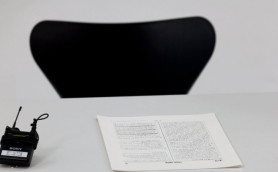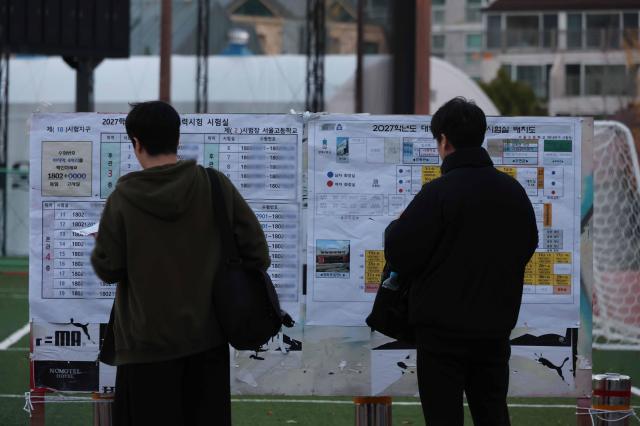
As separate essay tests and oral interviews for admission to the next academic year begin this weekend, they are introducing various measures to monitor applicants, restrict what they can bring into test sites, and implement additional security checks to prevent cheating.
According to education authorities on Saturday, major universities across the country have provided applicants with new guidelines for their respective admission tests following last Thursday's annual nationwide exam, placing particular emphasis on banning electronic devices that could be used to receive information or secretly transmit exam questions.
The country's most prestigious university Seoul National University (SNU) and other schools plan to provide applicants with writing materials rather than allow them to bring their own pens and other stationery from home. The measure is intended to prevent applicants from using writing instruments containing hidden electronic devices or other AI-powered tools.
Sogang University in western Seoul has also warned applicants against bringing devices that could be disguised as ordinary personal belongings and advised them to avoid clothing with buttons on the upper body or sleeves. Sungkyunkwan University, meanwhile, has restricted the wearing of hats and hooded sweaters.
Many universities are also banning personal accessories such as analog watches, earrings, necklaces, badges and earplugs, while increasing the number of staff and proctors to inspect applicants' belongings and detect concealed devices such as smart glasses and miniature cameras.
The developments followed a series of measures announced by the Korean Council for University Education earlier in the week to crack down on cheating in university admissions. Under the new rules, applicants caught cheating will have their exams invalidated and their admission revoked, while enrolled students found to have cheated could be expelled. Offenders will also be barred from applying to any of the council's 197 member universities for 10 years and could face legal action.
The tighter restrictions and tougher penalties come after a recent cheating scandal in which a top scorer on the state-administered certified public accountant exam admitted to using AI-powered devices. The case also immediately turned attention to another top scorer who was accused of cheating on a law school entrance exam in an attempt to gain admission to Seoul National University (SNU), which ended up with his death as he was found dead in an apparent suicide amid growing pressure to prove his innocence on the day of the exam on Thursday.
The case also brought attention to another top scorer who was accused of cheating on a law school entrance exam in an attempt to gain admission to Seoul National University (SNU). He was found dead in an apparent suicide on Thursday, the day of the nationwide exam, amid what appeared to be growing pressure to prove his innocence.
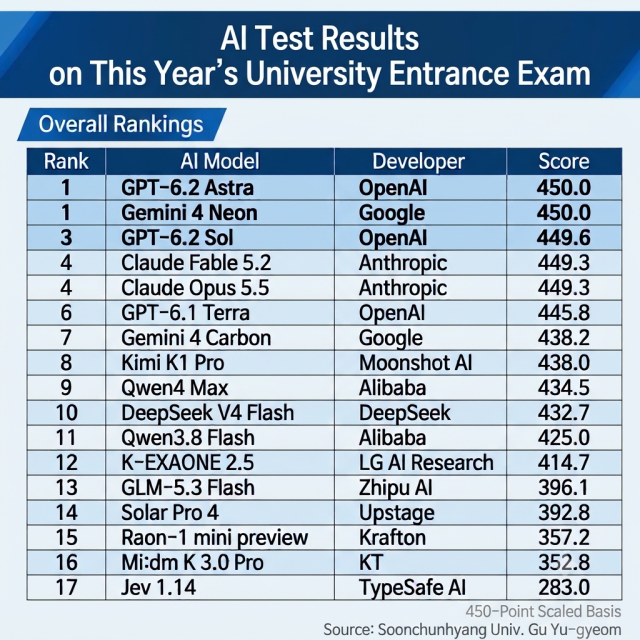
After testing various AI models on this year's exam questions, Gu released the results on Friday, with OpenAI's GPT-6.2 Astra and Google's Gemini 4 Neon tying for first place with perfect scores of 450 out of 450.
Among South Korean models, LG AI Research's K-EXAONE 2.5 earned the highest score with 414.7 points, ranking 12th. Chinese models also performed strongly with one from Moonshot AI scoring 438 points and another from Alibaba scoring 434.5, ranking 8th and 9th respectively.
Gu, who has been comparing AI performance on the exam since last year, used each model's application programming interface (API) rather than public chatbot services to exclude outside assistance such as internet searches and calculators. He said testing began almost immediately after this year's exam questions were released to reduce the possibility that the models had already memorized the answers.
Although differences in models and testing conditions mean that these scores do not provide a comprehensive measure of overall capabilities, the latest results underscore the rapid progress AI has made in solving complex academic problems, while raising broader concerns about its implications for society, the need for fundamental reforms in education, and various challenges in other areas.
Copyright ⓒ Aju Press All rights reserved.