

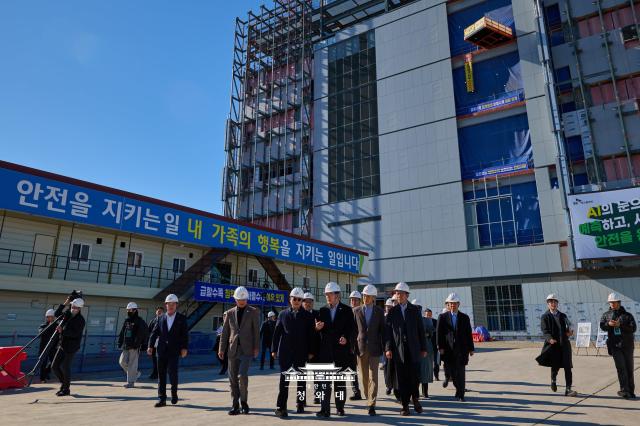
SEOUL, November 21 (AJP) -South Korea is pressing ahead with its data center and chip buildout despite growing talk of a slowdown in the United States and fears of an artificial intelligence (AI) bubble, with President Lee Jae Myung visiting a $5.2 billion SK data center construction site after his trip to Samsung Electronics' $34 billion advanced chip packaging project.
Fresh from his overseas trip to the Philippines and Shenzhen, China, Lee toured SK Group's AI data center under construction in the southeastern industrial city of Ulsan on Saturday, nine days after attending the groundbreaking ceremony for Samsung Electronics' high-bandwidth memory (HBM) packaging complex in Asan, South Chungcheong Province.
The back-to-back visits underscored Seoul's determination to push ahead with its AI infrastructure ambitions even as investors question the sustainability of massive technology spending and growing resistance to new data centers in the United States adds uncertainty to the industry's expansion.
SK Group is developing the Ulsan facility jointly with Amazon Web Services (AWS), with an estimated investment of 7 trillion won ($5.2 billion) through 2029.
The 100-megawatt facility, now 71 percent complete, is scheduled to begin operations in late 2027. It is the starting point for SK's far more ambitious plan to build 15 gigawatts of AI data center capacity across five regions of South Korea by 2035.
SK aims to expand Ulsan's capacity tenfold to 1 gigawatt and establish an initial 5 gigawatts of capacity nationwide, beginning phased operations in 2029. A further 10 gigawatts is envisioned by 2035.
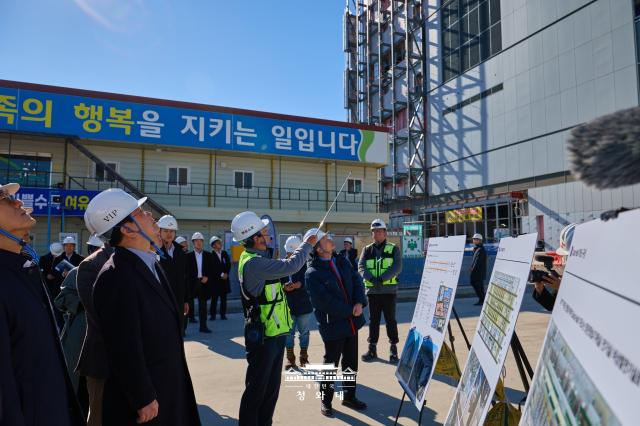
Tie-less and with a safety helmet on, Lee praised SK for its aggressive investment and rapid execution. He recalled attending the project's launch in June last year during his first regional visit after taking office.
"AI data centers are major sources of demand for semiconductors and essential infrastructure supporting physical AI, including robots and autonomous vehicles," Lee said.
"Just as the Gyeongbu Expressway opened the way for Korea's industrialization, the AI highway will open the way for Korea's AI transformation."
Lee expressed hope that the Ulsan project would attract further investment from global AI companies and demonstrate that large-scale technology infrastructure could generate new growth opportunities outside the capital region.
The ambitious expansion, however, faces formidable challenges, particularly in securing enough electricity, land, skilled construction workers and long-term customers to support investments on such a scale.
SK is in discussions with several global technology companies over potential data center contracts and plans to secure customer commitments before committing to further investments. The group is also seeking external investors and project financing to share the financial burden.
Lee acknowledged the growing shortage of skilled workers needed to construct advanced semiconductor fabrication plants and AI data centers.
"Speed is everything in today's global competition," he said, promising government efforts to address shortages of specialized workers.
During a closed-door meeting with SK executives, Lee discussed the outlook for AI infrastructure, the competitiveness of Korean data center locations and the importance of securing sufficient electricity at competitive prices.
According to presidential deputy spokesperson An Gui-ryeong, a project official predicted that recent market turmoil would subside and semiconductor demand would grow substantially as physical AI advanced.
Lee agreed that technological progress was likely to increase demand for AI data centers and memory chips.
He also emphasized that a stable supply of affordable renewable electricity would become a major determinant of industrial competitiveness over the longer term.

Samsung plans to invest 46 trillion won in the project, including 6 trillion won in construction and 40 trillion won in advanced equipment, to establish five HBM packaging lines.
Together, the two investments highlight Korea's strategy of building out both sides of the AI infrastructure chain: the memory chips powering advanced computing systems and the data centers needed to run them.
The investment push comes as Wall Street reassesses the AI boom amid concerns over stretched valuations, uncertain returns on enormous capital spending and the pace of future infrastructure demand.
Tags: SK Telecom, SK hynix, SK horizon, AI data center, South Korea, Samsung Electronics, semiconductors, packaging, HBM
Copyright ⓒ Aju Press All rights reserved.
