

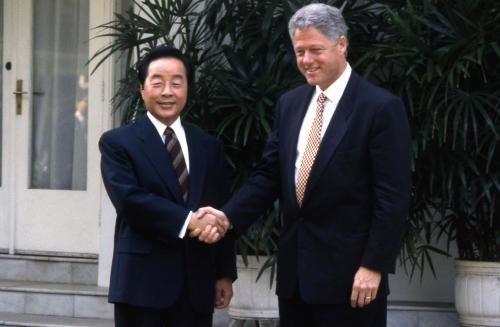
SEOUL, November 22 (AJP) - About 150 people gathered Sunday in Geoje, former President Kim Young-sam’s hometown on South Korea’s southern coast, to mark the 11th anniversary of his death. Two days earlier, President Lee Jae Myung paid tribute in a message recalling Kim’s observation that “reform is harder than revolution.”
Residents and officials gathered in the plaza outside the museum dedicated to Kim, next to the house where he was born. A string quartet played before the ceremony in a tribute to Kim’s love of classical music. Mourners laid flowers and heard a recorded message from his family.
“President Kim Young-sam stood up to dictatorship to defend democracy and pursued bold reforms after his civilian government took office,” Geoje Mayor Byeon Gwang-yong said.
At a separate memorial at Seoul National Cemetery on Friday, Choi In-ho, Lee’s senior secretary for political affairs, read the president’s message on his behalf.
“Now that I am leading the country, following the path you laid, I feel the full weight of your words that ‘reform is harder than revolution,’” Lee said.
He said reform required broad public support and a willingness to see it through together. Lee cited Kim’s 1993 decision to require people to use their real names in financial transactions, a measure aimed at curbing corruption. He pledged to crack down on stock price manipulation and recover illicit gains.
Lee, a former mayor of Seongnam and governor of Gyeonggi Province, credited Kim with restoring direct elections for mayors and governors in 1995.
In a later post on X, he pledged to strengthen local self-government and build on Kim’s maritime policies. Kim established the Ministry of Oceans and Fisheries in 1996. Kim spent decades in opposition to military rule.
In 1983, while under house arrest, he began a 23-day hunger strike to demand democratic reforms. Elected president in 1992, he took office the following February as South Korea’s first civilian president in more than three decades.
Early in his five-year term, Kim dismantled Hanahoe, a faction of military officers that had helped sustain military rule. In his final months in office, the Asian financial crisis forced his government to seek a bailout from the International Monetary Fund. He died on Nov. 22, 2015.
Lee Jung-woo
I studied philosophy in college, and sociology and journalism in graduate school. I cover North Korea, South Korean politics, foreign affairs and films. I enjoy Nordic cinema, Indian cuisine and Japanese detective novels. I have a cat and like bright, acidic coffee.
Copyright ⓒ Aju Press All rights reserved.
