
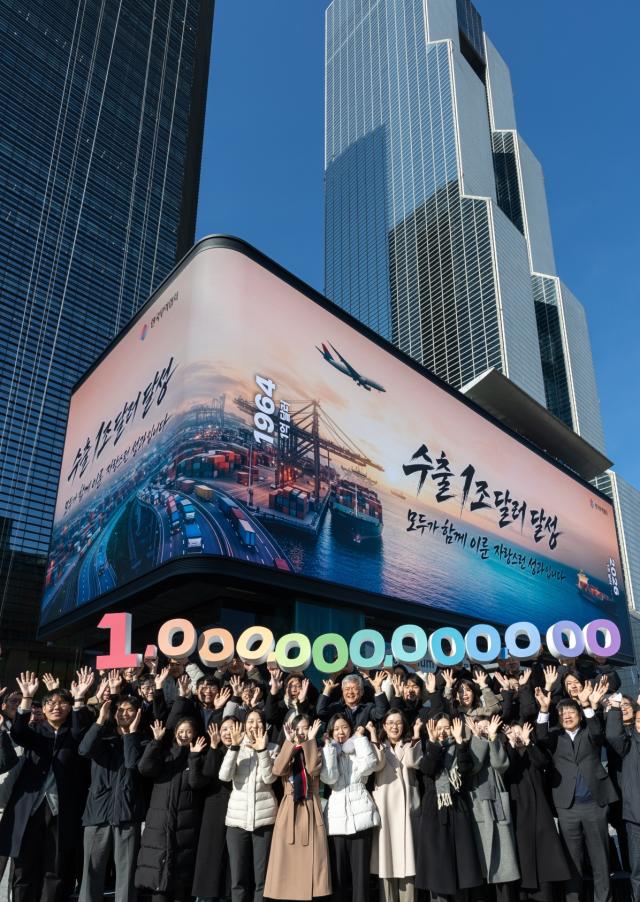
South Korea has finally entered the era of $1 trillion in annual exports, becoming only the fourth country in the world to reach the milestone after the United States, Germany and China.
Even Japan has yet to cross that threshold. A nation once short of natural resources and capital has risen into a global manufacturing powerhouse. It is a historic achievement built on the entrepreneurial spirit of business leaders, the sweat of workers, the determination of engineers and decades of industrial policy.
Yet as the nation raises a toast, it must confront two questions. How much of this export success is translating into better lives for ordinary Koreans? And how long can the boom last?
Semiconductors have powered this year's export record, accounting for 42.7 percent of total shipments in the January-October period. The explosive growth of artificial intelligence (AI) and worldwide investment in data centers have presented the Korean economy with an extraordinary opportunity. But the more dependent an economy becomes on a single industry, the more vulnerable it becomes when that industry falters.
The U.S. Federal Reserve recently warned in its Financial Stability Report of a surge in debt issuance tied to advanced computing infrastructure, including AI data centers. Such issuance exceeded $680 billion through October this year, roughly five times the amount recorded in all of 2023. If these enormous investments fail to generate sufficient returns, both corporations and financial markets could face serious strains.
The parallels with the dot-com bubble around the turn of the millennium are difficult to ignore. The internet did not disappear when the bubble burst. On the contrary, it went on to transform the global economy. But countless companies built on inflated expectations collapsed along the way. A technological revolution does not necessarily guarantee investment success. The same holds true for AI.
What Korea must guard against is not AI itself, but indiscriminate investment and excessive confidence in the semiconductor boom. If chip prices fall and global AI spending undergoes a correction, exports, corporate earnings, capital investment and tax revenues could all suffer at once. When the tide of prosperity recedes, the underlying strength of the Korean economy will be laid bare.
How, then, should Korea prepare for its future?
The answer lies partly in its own history of industrialization. Korea's manufacturing success was built on its ability to adapt to shifts in the global order. During the Cold War, it capitalized on the international political environment to lay the foundations for industrialization.
After China joined the World Trade Organization (WTO), Korea expanded exports of intermediate goods, including semiconductors, steel and petrochemicals. In shipbuilding, automobiles and electronics, it accumulated technological expertise and established a commanding presence in global markets.
But yesterday's formula for success offers no guarantee of tomorrow's prosperity.
China is no longer merely the world's factory, assembling products from components imported from Korea. It has become a formidable competitor in electric vehicles, batteries, solar power and advanced manufacturing. The United States, meanwhile, is reinforcing protectionism and industrial policies centered on domestic production.
The rules of global trade are being rewritten. An era in which price and production capacity largely determined competitiveness is giving way to one in which technology, supply chains, economic security and trust matter just as much.
For Korea, this transformation presents both a threat and an opportunity.
Few countries possess Korea's breadth of manufacturing capabilities across semiconductors, automobiles, shipbuilding, steel, batteries and electronics. That industrial diversity is a powerful strategic asset in the emerging international order.
Korea must now evolve beyond exporting finished products to exporting technology, production systems and entire industrial ecosystems. It should expand networks of industrial cooperation linking Europe, the Association of Southeast Asian Nations (ASEAN), India, the Middle East and Latin America. Economic diplomacy must also be reoriented toward joint investment, technological partnerships and resilient supply chains.
Domestic industrial policy must change as well.
Investment in AI and semiconductors must continue. But Korea should move beyond competing simply on the scale of investment. Commercial viability, profitability, technological differentiation and employment benefits must be rigorously assessed.
Physical AI, which brings artificial intelligence into machines and real-world industrial operations, offers a particularly important strategic path for a country with world-class manufacturing capabilities. Integrating AI into robotics, automobiles, shipbuilding, logistics, agriculture and health care could strengthen existing industries while creating entirely new ones.
Biotechnology, aerospace, advanced materials and energy industries also deserve sustained support. Concentrating investment in strategic sectors is necessary, but the entire national economy must not become hostage to the fortunes of a single industry. Korea must also overhaul its institutions for entrepreneurship, investment, research and development, and talent cultivation so that a new generation of globally competitive companies can emerge.
Above all, the success of exports must be translated into improvements in people's lives.
Strong earnings at semiconductor giants do not automatically create jobs for young Koreans. A rising stock market does not necessarily mean higher sales for small businesses and the self-employed. AI can raise productivity, but it can also displace workers. If the gains from technological innovation accrue mainly to a handful of companies and investors, the gulf between the achievements of an export powerhouse and the everyday realities of its people will only widen.
The government must stop treating industrial policy and public welfare as separate agendas. It must foster an economic structure in which large corporations and smaller businesses grow together, productivity gains translate into better wages and higher-quality jobs, and the benefits of innovation spread to regional economies and households across the country.
What, ultimately, is the purpose of an economy?
The classics of Eastern philosophy have long sought the answer in the well-being of human beings.
In the Tao Te Ching, Laozi cautioned that the hunger of the people could be traced to excessive demands imposed by their rulers. In the Analects, Confucius emphasized the importance of enriching the people before educating them. The concept of junghwa (中和), or harmonious balance, in the Doctrine of the Mean embodies the pursuit of an orderly society free from destructive extremes. These teachings can be understood as affirmations of a common principle: National prosperity cannot be separated from the welfare of the people.
Korea has its own enduring ideal in Hongik Ingan (弘益人間), the principle of broadly benefiting humanity.
The Cheonbugyeong, an ancient Korean philosophical text, contains the phrase Injungcheonjiil (人中天地一), which may be interpreted as heaven and earth coming together as one within the human being. It expresses a vision in which humanity, nature and the universe are not separate but fundamentally interconnected. That understanding also resonates with the spirit of Hongik Ingan.
Korea's national philosophy for the AI age should be rooted in these principles.
Technology must serve humanity, and industry must advance for the sake of people's lives. The fruits of growth should be shared, while human beings, culture and nature should flourish in harmony. Translating that vision into economic policy would give contemporary meaning to the spirit of Injungcheonjiil and bring the ideal of Hongik Ingan into practice.
Korea became prosperous through manufacturing. It must now move toward a future in which technology, industry and human well-being advance together. The $1 trillion export milestone is not a destination but a new point of departure.
Export records are measured in numbers. A nation's success is measured by the lives of its people.
Copyright ⓒ Aju Press All rights reserved.