

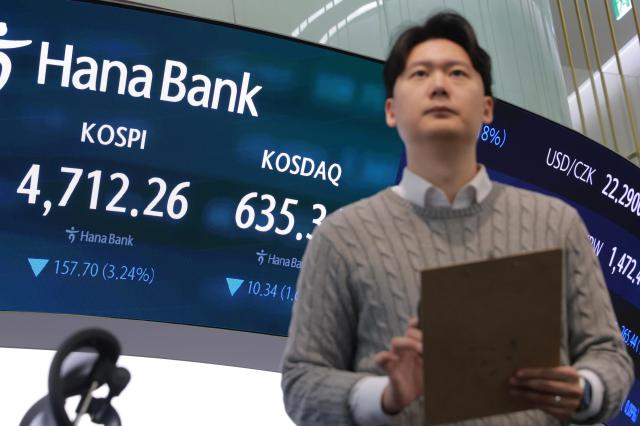
The KOSPI was down 4.27 percent from Friday’s close as of 11:20 a.m. Monday, extending the previous session’s 5.21-percent tumble. The benchmark has now lost more than half its value from its June intraday peak of 9,385.59.
Retail investors joined foreigners to rush to the exit, leaving institutions as the lone buyers among the three main investor groups after the government announced preparations to deploy a market stabilization fund.
The retreat below 4,700 took the index back to levels last seen around Jan. 13, when it closed at 4,692.64, erasing the spectacular advance that had made Korean equities a leading beneficiary of the global AI investment boom.
Samsung Electronics and SK hynix, which together account for more than 47 percent of the main board’s market capitalization, bore the brunt of the selling. Both were down more than 4 percent earlier in the morning as investors cut exposure to the chipmakers that had powered the rally.
The secondary KOSDAQ also fell below its previous intraday low for the year of 629.17. At 10:12 a.m., it was down 2.96 percent at 626.58.
The latest selloff followed another punishing session on Wall Street on Friday. The Nasdaq Composite slumped 5.28 percent and the Philadelphia Semiconductor Index plunged 10.73 percent.
Nvidia fell 14.01 percent to a 52-week low, slipping to fourth place by market capitalization. Sandisk, Micron, AMD, Broadcom and CoreWeave also suffered double-digit losses. At the center of the reversal is a widening loss of confidence in the profitability and financing of the AI buildout, compounded by turmoil at Nvidia and tighter restrictions on China’s access to advanced chips.
Nvidia announced Jensen Huang’s resignation as chief executive on Nov. 12. His departure has unsettled investors already questioning the interconnected investments and purchasing commitments tying the chipmaker to major AI developers and infrastructure operators.
U.S. Treasury Secretary Scott Bessent said Sunday that Washington was seeking answers about Nvidia’s chip sales to China. The administration has also tightened controls on Chinese access to advanced AI processors, adding uncertainty over future demand and the expansion of overseas data centers.
Korean brokerages warned that the market could fall further, although several said the speed and scale of the decline had left shares vulnerable to a sharp technical rebound.
Kiwoom Securities put a worst-case downside range at 4,200–4,300. Shinhan Securities saw the possibility of a retreat to 4,500, while Daishin Securities identified initial support at 4,510–4,580 and a second support range at 4,320–4,400.
Preparations for a stabilization fund could help restore confidence even if prices remained volatile, he added.
The won remained relatively steady at 1,346.5 per U.S. dollar as record-breaking exports extended into November, contrasting with the turmoil in equities.
Government bond yields continued to fall. The market turbulence adds to the case for the Bank of Korea to pause the tightening longer at Thursday’s final rate-setting meeting of the year.

Yuna Ryu covers finance, capital markets and Southeast Asian affairs.
She is drawn to the questions that numbers raise and the stories that data alone cannot answer.
Prior to journalism, she worked at Hyundai Motor Company and the Singapore Chamber of Commerce, focusing on business strategy and international affairs. She has also hosted diplomatic receptions and international conferences as an MC.
Ryu holds a master's degree in Media and Communication from Korea University, where her research focused on neuroscience-based studies of media effects.
Copyright ⓒ Aju Press All rights reserved.
