

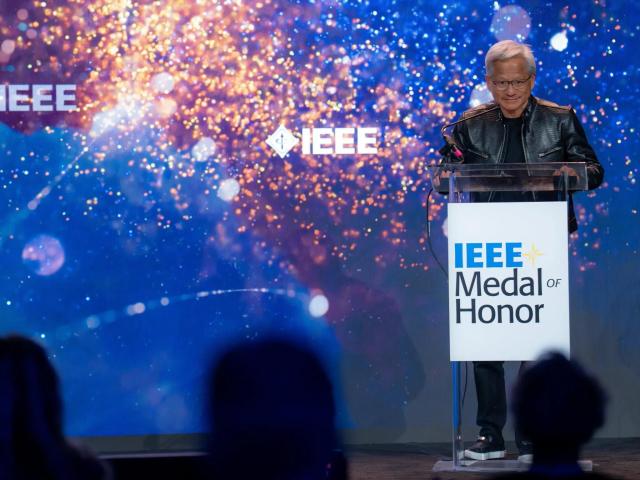
"When in doubt, throw doubt out and have a little faith," wrote E. A. Bucchianeri. Investors left astray in the AI transition were ready to set aside their doubt when their shepherd returned.
Huang's return was as dramatic as his exit. His reinstatement as Nvidia's chief executive sent the company's shares up 31.48 percent, adding $952 billion dollars in market value in a single session on Monday. It was Nvidia's biggest percentage gain since 2003 and the largest one-day increase in market capitalization on record for a U.S. company.
The euphoria spilled over to Seoul. The KOSPI jumped over 7 percent and reclaimed 5,000 mark, led by Samsung Electronics and SK hynix as foreign buying was turbocharged with the reassurance on AI drive.
Little about Nvidia's business changed during Huang's 11-day absence. Its engineers kept working. Its factories and suppliers kept producing. Its customers still needed computing power. What changed was investors' willingness to finance that future, and it swung on a single variable: the identity of the man at the top.
It would be easy to call this founder worship. It would also be too easy. Huang's importance is real. He spent decades assembling the technology, the relationships and the commercial ambition that placed Nvidia at the center of the AI industry. Replacing such a figure is not a matter of changing the name on an office door.
His reach extends well beyond the chips Nvidia sells. As Yale economist Natasha Sarin noted in a New York Times commentary, the company helps finance parts of the very ecosystem that buys its products. Its investments and commercial commitments bind together chip supply, computing capacity and the ambitions of AI developers.
The concentration has bulldozed AI investment but also stoked risk. When a supplier helps fund its customers' expansion, strong demand and easy financing feed each other. When confidence falters, the same links can carry doubt across businesses that looked like separate bets.
Huang's return restored faith in those links. It did not prove that the projects they support will pay off.
President Donald Trump grasped the stakes at once. He told CNBC that he had spoken to Nvidia's board and persuaded the directors to bring Huang back. The company, for its part, acknowledged receiving input from senior U.S. officials that left it confident his reinstatement posed no national security risk.
For a president whose economic agenda leans heavily on the AI boom, the motive to step in was obvious. A prolonged collapse in confidence would not have stopped at shareholders. It would have reached investment plans, suppliers and jobs. Preventing that damage is a legitimate concern.
The means still deserve scrutiny. A board is entitled to reverse itself when new evidence emerges. Government officials may hold information relevant to a security assessment. Huang deserves a fair process, and allegations are not proof of wrongdoing.
But shareholders deserve to know what changed. Bloomberg reported that senior executives were not consulted before the directors decided to reinstate him. Nvidia's independent investigation into reports of foreign intelligence targeting is still under way.
The U.S. administration habitually invoked national security to justify sweeping restrictions on trade and technology. If the standard is to mean anything, it must hold steady when an economically indispensable individual seeks reassurance from the same government.
There is a longer-term cost, too. Investors who come to believe the White House will shield strategically important companies will begin to price that protection in. Capital will then chase the promise of political support alongside commercial merit. And each successful rescue makes the next one look more necessary.
For South Korea, however, any criticism must come with an uncomfortable relief.
The AI boom has handed an economy weary of sluggish growth a powerful new engine. After expanding 1.1 percent last year, Korea is now projected by the International Monetary Fund to grow 3.9 percent this year and 3.3 percent next year.
Exports have crossed the $1 trillion mark. Semiconductors accounted for 42.7 percent of shipments in the first 10 months, and roughly half in recent months. The gains are spilling into factory equipment, power infrastructure and construction, holding out the prospect of stronger incomes and spending well beyond the chip industry.
These gains are the product of years of Korean investment, engineering and manufacturing discipline. They deserve celebration. They also explain why a boardroom decision in Santa Clara can rattle confidence in Seoul.
Even monetary policy feels the tremor. A sustained market rout would complicate the Bank of Korea's effort to contain inflation by sapping confidence and tightening financial conditions. A recovery, if it holds, gives policymakers more room to read domestic demand and prices.
Korea's task is to turn the chip windfall into a broader capacity for growth. That means spreading productivity gains to smaller manufacturers and service businesses, building the skills to put AI to productive use, and making sure infrastructure spending serves more than the next burst of data center demand.
Export strength should leave the domestic economy better prepared for the downturn that will eventually come.
Nvidia faces a parallel test of institutions. A credible succession plan, independent oversight and fuller disclosure of its financial commitments across the ecosystem would give investors firmer grounds for confidence. The board's new security and export-control committee and its planned chief compliance officer will matter only to the extent that they can exercise authority when doing so is inconvenient.
Huang's return was greeted with a roar, from shareholders around the world as well as from Nvidia's own staff and partner companies. Thanking the board and employees "for a second chance," he vowed to be a better chief executive.
The pledge is welcome. It should also be heard with humility, by him as much as by those cheering him on. Being a better CEO and laying the foundation of the AI age are not the same task. The first is measured in quarters, share prices and execution. The second is measured by whether what he leaves behind can stand without him.
His charisma and insight were needed to usher humanity into the AI era, and history will likely credit him for it. But a founder is judged not only by what he builds while he is indispensable. He is also judged by whether he recognizes the moment he no longer is. When his role is done, he must be willing to walk away, humbly and of his own accord.
There is every reason to welcome his return and the breathing room it has bought. That room should be used, not merely enjoyed. An industry that promises to transform the world needs institutions strong enough to carry its ambitions beyond the fortunes of its most gifted individual.
A revolution proves its durability when it can outgrow its revolutionary.
*The author is the managing editor of AJP.
**The views expressed are the author's own.
Copyright ⓒ Aju Press All rights reserved.
