

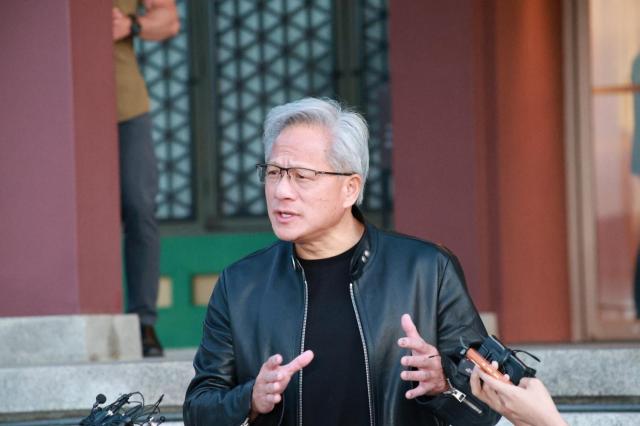
SEOUL, November 24 (AJP) - Skepticism, doubts and jitters were put on hold, at least for a day, as markets hailed the comeback of the poster child of AI.
Nvidia shares surged 31.48 percent to $165.05 in New York on Monday following Huang's reinstatement. The rally spilled into Seoul on Tuesday, with Samsung Electronics jumping 6.70 percent to 189,400 won and SK hynix climbing 6.73 percent to 1,158,000 won.
For Samsung Electronics and SK hynix, Jensen Huang’s return to Nvidia offers more than a lift in share prices. It restores the industry’s most forceful advocate at a moment when confidence in the AI investment boom — and the capital needed to sustain it — has become increasingly fragile.
The relief goes beyond Huang’s personal rapport with South Korea’s business leaders. His importance lies in his ability to turn the AI vision into product roadmaps, customer commitments and projects that keep investment flowing through the industry.
His return may buy Korean chipmakers more time. It does not guarantee how long the boom will last.
Despite the vote of confidence from U.S. President Donald Trump and Nvidia’s board, Huang still faces questions from lawmakers and federal authorities over his reported relationship with a woman alleged to have Chinese intelligence ties, allegations involving the diversion of advanced chips to China and the circumstances of his reinstatement.
He has publicly agreed to testify before the Republican-led Senate Banking Committee on Dec. 3.
For his Korean suppliers, the immediate question is whether his return can help prevent a crisis of confidence from becoming a disruption to orders.
Nvidia announced Huang’s resignation on Nov. 12 following reports about his personal relationships and possible foreign intelligence connections. Chief Financial Officer Colette Kress became interim chief executive, while Harvey Jones took over as board chairman.
The sudden departure raised questions about whether Nvidia could maintain its aggressive development schedule and relationships with customers, suppliers and governments without the executive most closely associated with its success.
On Monday, the board unanimously voted to reinstate Huang as president, chief executive and director following discussions with him and consultations involving senior U.S. government officials. It said his return posed no national security risk.
"The Board believes Jensen is the right person to lead NVIDIA, and that his reinstatement is in the best interests of our stockholders, employees, partners and customers," Jones said in the company’s announcement.
The reversal restored a familiar figure at the center of an increasingly interconnected investment cycle.
Nvidia’s processors underpin the AI infrastructure being built by cloud computing companies and other customers. Those processors require high-bandwidth memory, or HBM, making the pace of Nvidia’s shipments and its customers’ expansion plans critical to Korean memory suppliers.
SK hynix is a major supplier of HBM for Nvidia’s AI processors. Samsung is working to strengthen its position through next-generation products and closer cooperation with AI chip designers.
Lee Jong-hwan, a professor of system semiconductor engineering at Sangmyung University, said Huang's return was a positive signal for Korean chipmakers but cautioned that questions surrounding his leadership could still affect future business decisions.
"His leadership has clearly been shaken," Lee told AJP. "The question is whether he can perform as effectively as before with that damage to his leadership."
Lee said uncertainty surrounding Huang could also affect Nvidia's future HBM procurement decisions, including how much memory it continues to source from SK hynix.
Neither company’s production capacity or order book changes simply because Huang returns. But leadership continuity can matter when customers are deciding whether to proceed with projects costing billions of dollars.
The risk runs through financing as well as technology.
Doubts about the returns on AI spending can make investors and lenders more reluctant to provide capital. Tighter financing can delay data centers, slow equipment purchases and eventually weaken demand for memory chips.
For Korean suppliers expanding capacity to meet projected demand, a liquidity bottleneck could bring the next downturn forward, even if the longer-term case for AI remains intact.
Whether today’s investment commitments will translate into tomorrow’s purchases made the core of market jitters.
Long-term supply agreements offer a buffer, but their protection has limits.
SK hynix said in its October earnings announcement that it had signed agreements with 14 major customers covering more than half its planned production capacity for 2027 and 2028. The arrangements include advance payments intended to reinforce customers’ commitments.
Samsung has also been expanding multi-year supply agreements, securing deals with 10 major customers while negotiating with another 10.
Those commitments improve visibility over future demand. They do not make memory suppliers immune to financial stress elsewhere in the AI industry.
Customers facing funding shortages could seek to postpone deliveries, renegotiate volumes or cancel purchases where contracts permit. The terms have not been fully disclosed, making it difficult to assess how much protection the agreements would provide in a sharp downturn.
Huang’s return may help sustain the confidence supporting those commitments. It cannot ensure that every customer will have the funding — or the commercial need — to take all the memory it has agreed to buy.
Nor does his reinstatement necessarily improve Korean suppliers’ bargaining power. Nvidia’s central role gives it considerable influence over specifications, development schedules and purchasing decisions. A more influential Huang could reinforce that position.
The episode also exposes the vulnerability of an industry whose confidence rests so heavily on one executive. His ability to rally investors and business partners is an asset. The turmoil surrounding his departure shows how quickly that dependence can become a source of uncertainty.
Lee warned that further revelations about Huang could create fresh instability for Nvidia, even after his reinstatement.
"If additional allegations emerge, or something else we don't yet know comes to light, the situation could become much more difficult," he said. "Nvidia would be in serious trouble."
The episode could also accelerate efforts by major U.S. technology companies to reduce their reliance on Nvidia's GPUs, Lee said, pointing to the development of in-house AI chips and alternative processors.
"They have already been trying to reduce their dependence on GPUs, but this could push them to accelerate those efforts," he said.
For Samsung and SK hynix, the immediate response is nevertheless a sigh of relief. Huang is back to selling the AI vision and pushing the projects that turn it into chip demand.
Whether it postpones a downturn will depend on customers continuing to finance, build and equip AI infrastructure long after the comeback rally fades.

Candice Kim
Candice Kim is a dedicated business and technology reporter specializing in the intersection of high-tech innovation and fast-paced consumer trends. Her core beats span the semiconductor, IT, cosmetics, and retail sectors, where she provides in-depth coverage of industry titans including Samsung Electronics, SK hynix, and LG Electronics, alongside leading consumer brands like Olive Young and Musinsa. Whether analyzing complex silicon supply chains or tracking the latest shifts in beauty and fashion retail, Candice is committed to delivering sharp, accurate reporting that keeps readers informed on the forces shaping today's most dynamic markets.
Copyright ⓒ Aju Press All rights reserved.
