

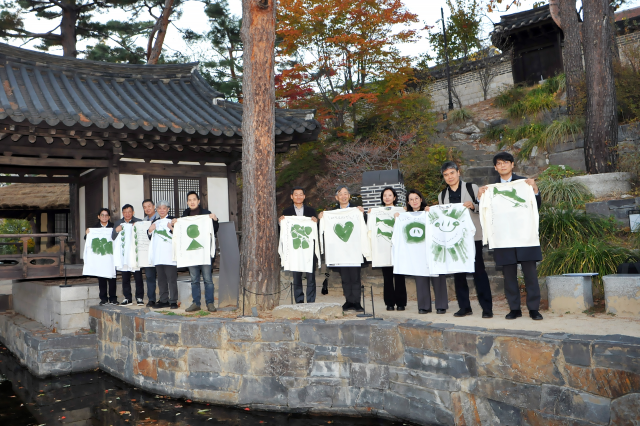
SEOUL, November 26 (AJP) - A barley patch planted in front of Kookmin University's main building in 2003 started a campus environmental movement. The Seoul university is now trying to carry that movement into its climate education.
The university's Climate Change Response Project Team held a seminar titled "Again, Green Campus" on Nov. 6 at Haeongheon, a hall in the university's Myungwon Museum. Professors who led the original movement joined current members of the team to review what it achieved and discuss how its practices can be passed on to today's students.
The barley plot covered about 33 square meters. The effort grew into a campus-wide program built on three values the university called Green Campus, Green Curriculum and Green Network. It led to green liberal arts courses, secondhand reuse markets and, in 2004, a declaration that made the campus car-free and pedestrian-centered.
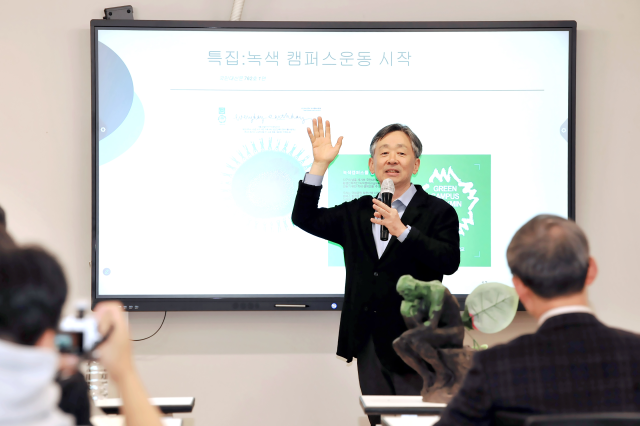
Lee Chang-hyun, a professor in the university's School of Media and Advertising, opened the presentations with a talk on the movement's origins and results. He said the movement had been an attempt to change the university's educational goals and the way its members lived, not just a campaign to protect the environment. He argued that the green campus should become a brand unique to Kookmin.
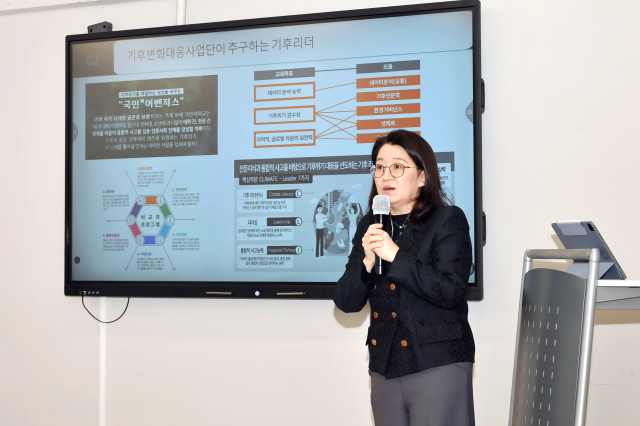
Jeong Ha-yoon, a research professor with the project team, explained how the movement's values carry on in current classes and student activities. She pointed to student environmental clubs Net Zero and D-Eco, which run a shared umbrella project and plogging outings, where participants pick up litter while jogging. She also described project-based learning courses in which students tackle environmental problems themselves, and partnerships with the Seoul YWCA and the Seongbuk District Office.
Two professors emeritus who took part in the 2003 movement, Cho Jung-bin and Jeon Yong-il, shared their experiences by video. Both stressed education that builds respect for life and ecological awareness, and both said environmental action should become a lasting part of the university's teaching and research rather than a series of one-off events.
Han Kyung-koo, former secretary-general of the Korean National Commission for UNESCO, attended in person. He said sustainability should be built into the entire curriculum to encourage students to take voluntary and creative environmental action.
Yoon Ho-seop, a professor emeritus of visual communication design, gave a live performance, painting designs on T-shirts. Yoon opened South Korea's first graduate program in green design at Kookmin in 2003. His message was that solving environmental problems takes a change in how people think and what they value, along with new rules and technology.
In a closing panel, Lee Ki-in, head of the university's Office of Facilities Management, joined Yeoun Myung-heum, a professor of industrial design, and Lee Won-deog, a professor in the Division of International Studies. They listed steps the university has already taken, including campus energy cuts, a resource-recycling space called Bugak Market and machines that collect plastic bottles for recycling.
The panel called for more eco-friendly design, more ecology education and more student-led environmental activities. Panelists also discussed tying the green campus to the university's long-term development plan and extending it to the surrounding community.
In 2023, the Ministry of Education chose Kookmin as the lead university for the environment track of its HUSS program, which trains humanities and social science students to work across disciplines. Kookmin runs the program with Duksung Women's University, the University of Ulsan, Inha University and Chosun University under the theme "Coexistence and Mutual Prosperity in the Era of the Climate Crisis."
Park Sae-jin
Experienced journalist and editor at AJU PRESS specializing in multilingual news. I cover international diplomacy, geolpolitics, and policy, consistently delivering highly accurate, compelling reporting for a worldwide audience.
Copyright ⓒ Aju Press All rights reserved.
