

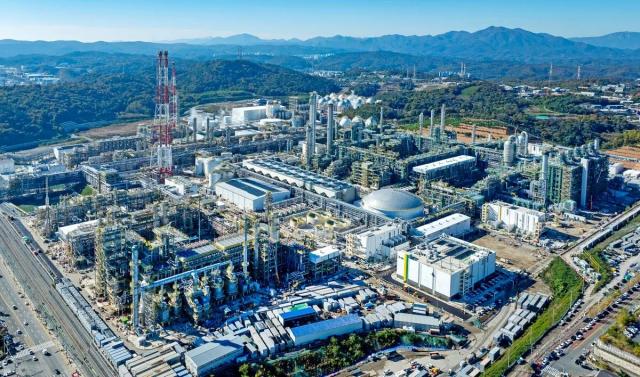
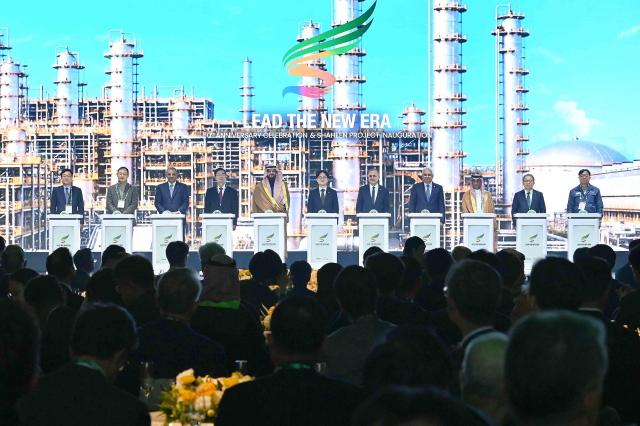
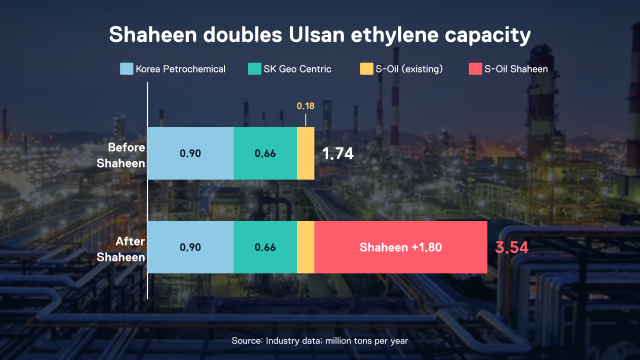
S-Oil, South Korea's third-largest refiner, on Wednesday celebrated the completion of the $7 billion project featuring the world's largest single steam cracker. Saudi state oil giant Aramco owns more than 63 percent of the company, and Shaheen is its largest investment in Korea.
With capacity to produce 1.8 million tons of ethylene a year, the cracker anchors a complex deploying the first major commercial application of thermal crude-to-chemicals (TC2C) technology. Developed by Aramco with Lummus Technology, the process converts crude oil directly into chemical feedstock.
Commercial production is scheduled to begin next year after commissioning and test runs, adding fresh capacity just as Korean producers face pressure to shut older facilities in return for debt relief.
Two days before the ceremony, Industry Minister Kim Jung-kwan summoned the heads of 10 petrochemical companies and set a year-end deadline for restructuring agreements.
"Every company must share responsibility for the future of the whole industry rather than immediate gains and losses," Kim said. "Please wrap up restructuring talks within this year so that we do not miss the golden time."
Sixteen producers submitted plans last December under a national goal to cut annual ethylene capacity by 2.7 million to 3.7 million tons. Projects in Daesan and Yeosu won approval in February and July and will together idle about 2.49 million tons.
The Bank of Korea's Ulsan branch estimated Tuesday that cracker cuts could shrink the city's output by up to 3.1 percent. Its researchers recommended shifting toward higher-value products, noting that Ulsan's crackers are smaller and tightly woven into downstream plants.
Much of the supply glut comes from China, whose annual ethylene capacity approached 60 million tons in 2025 and is set to reach about 86 million tons by 2030, according to ChemOrbis. Wood Mackenzie expects Chinese ethylene-polyethylene plants to post returns of minus 11 percent in 2026.
Korean producers have found some shelter in higher prices, although shipment volumes tell a weaker story.
Petrochemical exports are projected to rise 9.0 percent to $46.37 billion this year as war-driven price gains offset a 9.9 percent drop in volume, according to the Korea Institute for Industrial Economics and Trade.
The state think tank expects exports to fall 3.0 percent to $44.98 billion next year as lower oil and naphtha prices erase those gains and Chinese supply keeps growing.
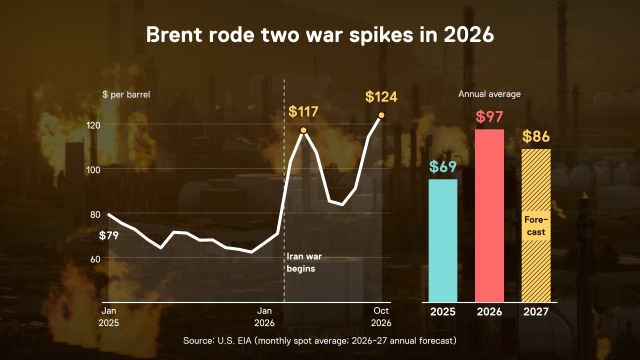
The International Energy Agency said Nov. 13 that the oil market would swing back to surplus this quarter. But Iran has vowed to keep the Strait of Hormuz closed until its demands are met, and fresh tanker attacks lifted Brent above $90 a barrel Tuesday.
"Lower oil prices would ease cost burdens for every producer alike, so they are unlikely to widen the cost gap," said Chang Tae-hun, an associate research fellow at the Korea Energy Economics Institute.
"Shaheen's competitiveness comes from its technology, which cuts a step out of the production process."
Hours after the ceremony, another threat landed. The Office of the U.S. Trade Representative proposed tariffs of up to 15 percent on Korean goods following its industrial overcapacity investigation, naming petrochemicals alongside autos and semiconductors as sectors of concern.
For goods already subject to the 12.5 percent forced-labor tariff introduced in July, it could mean an additional 2.5 percentage points. Public hearings begin Jan. 25.
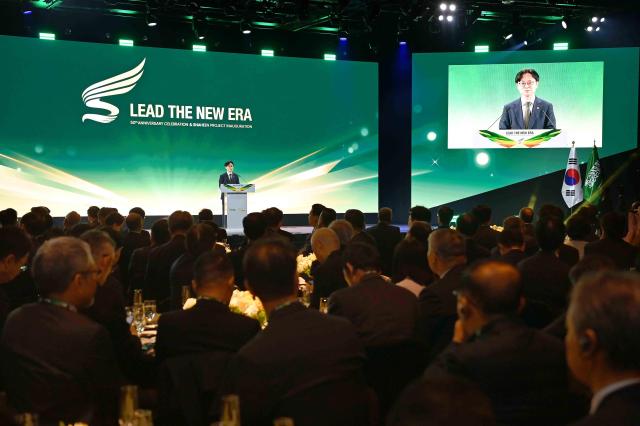
At the ceremony, Kim said he hoped Shaheen would open "new paths and possibilities" for an industry at a turning point.
Whether the falcon can lift the wider industry may depend on how much older capacity Ulsan makes room to retire.
Kim Dong-young
Kim Dong-young is a bilingual journalist at AJU Press (AJP), covering Korean tech, energy, and bio/pharma.
He reports from the field at events like CES and APEC, runs AJP's YouTube channels,
and is pursuing a master's at Sogang's MOT program.
Copyright ⓒ Aju Press All rights reserved.
