SEOUL, November 26 (AJP) - By controlling which way enzymes face on the surface of a fat droplet inside yeast cells, a South Korean research team raised output of a natural pigment by up to 13 times, a result that puts enzyme orientation alongside enzyme placement in the design of microbes built to manufacture fragrances, cosmetics ingredients and drug materials.
KAIST said Thursday that the technology came from Lee Ju-young's team at its Graduate School of Engineering Biology, working with Son Chang-yun at Seoul National University and Oh Seung-soo at POSTECH. The work was published in the journal Science Advances on Nov. 6.
A microbial cell factory is a microbe engineered to produce a target substance as it grows. Inside the cell, enzymes, the proteins that drive chemical reactions, work in sequence, each one converting the material it receives and passing it along, much as workers on an assembly line each perform a single step before handing the piece to the next station.
That chain falters when the substances change character along the way. A step that acts on a water-soluble compound and a step that acts on an oily one need different surroundings, and an enzyme sitting in the wrong part of the cell struggles to meet the material it is meant to work on. Yield falls as a result.
The team looked for an answer at the lipid droplet, the small compartment a cell uses to store fat. Its core is oily, the cytoplasm around it is watery, and a thin lipid membrane separates the two, making the droplet surface one of the few places inside a cell where water and oil meet along a stable boundary.
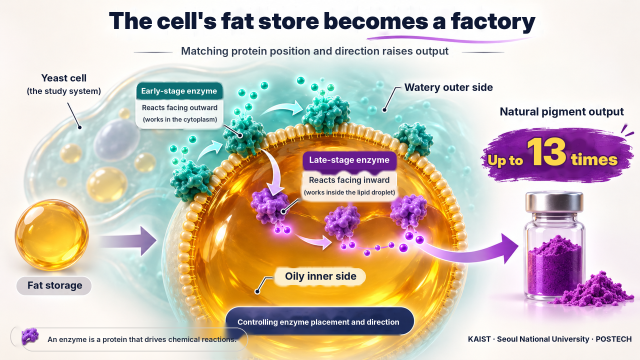
Lee's group treated that boundary as a workbench. The researchers designed a structure that anchors a protein to the droplet surface, then tuned it so an enzyme attached to it would point either outward into the watery cytoplasm or inward into the oil, according to the kind of material that enzyme handles.
Son's team at Seoul National University (SNU) traced how the orientation control works at the level of individual molecules, using computer simulations. Son called the result an achievement that "successfully fused computational science and cell experiments."
Applied to prodeoxyviolacein, a natural pigment that also serves as a pharmaceutical material, the method produced its largest gain when the enzymes acting early in the pathway were placed on the outer, watery side and those acting later were placed on the inner, oily side. Production rose by as much as 13 times.
Clustering enzymes in one spot was not what delivered that. The gain came from matching each enzyme's position and facing to the chemistry of the material it works on, which turned a fat store into a space where a multi-step reaction could run without stalling between steps.
How far the approach carries is still open. The results come from a single pathway in laboratory yeast, and the team said the effect has yet to be confirmed with other substances and under the large-scale culture conditions industrial production would require.
Lee described the method as a design strategy that weighs the character of a cell's internal microenvironment together with the spatial arrangement of enzymes. "I expect this to open a new paradigm for precisely controlling the position and orientation of enzymes in synthetic biology and metabolic engineering," he said.
Son So-hee at KAIST and Bae Sang-won, a doctoral student at SNU, were co-first authors, and KAIST's Mun Su-young was among the co-authors.
The research was funded by the Ministry of Science and ICT and the National Research Foundation of Korea through programs on environmentally friendly chemical technology to replace petroleum, individual basic research, and the Boston-Korea joint research and development project.
[Reference Information]
Journal/Source: Science Advances
Title: Spatial control of enzyme orientation at lipid droplet interfaces enables regio- and chemo-selective metabolic flux
Link/DOI: 10.1126/sciadv.aeg5924

Park Sae-jin
Experienced journalist and editor at AJU PRESS specializing in multilingual news. I cover international diplomacy, geolpolitics, and policy, consistently delivering highly accurate, compelling reporting for a worldwide audience.
Copyright ⓒ Aju Press All rights reserved.