
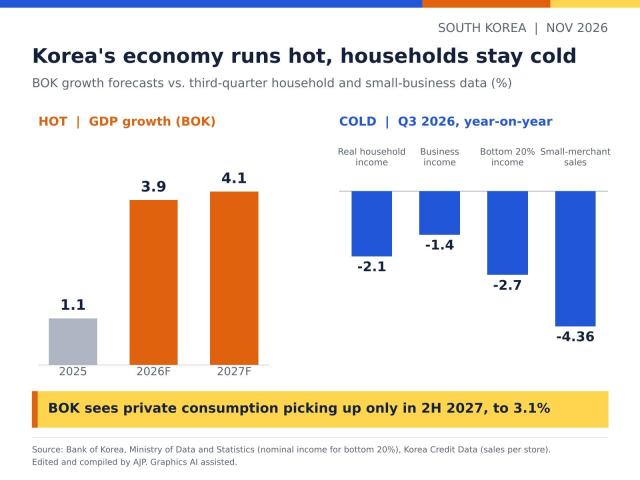
The Bank of Korea (BOK) raised its policy rate to 3.25 percent from 3.00 percent at its final policy meeting of the year, delivering its third hike alongside growth forecasts of 3.9 percent for 2026 and 4.1 percent for 2027. Next year's estimate was lifted sharply from 2.9 percent in August.
The unusually upbeat message from the typically cautious bank challenged expectations of slower growth and a winding-down of the tightening cycle.
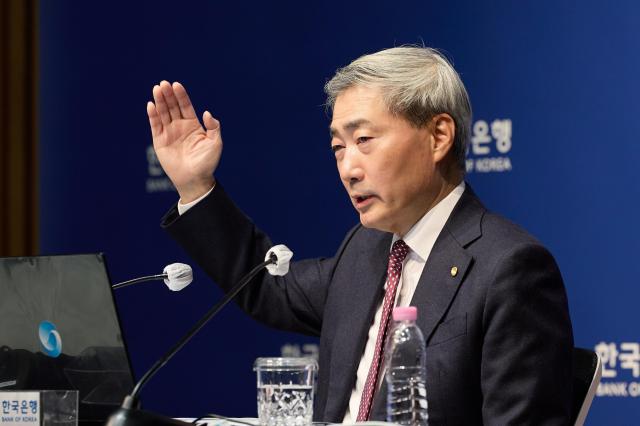
Governor Shin Hyun-song's argument was simple: staggering semiconductor profits would spread through corporate taxes, performance bonuses, dividends and investment, putting the expansion on a broader footing.
"The 700 trillion won ($521.3 billion) in operating profit does not disappear into a black hole. It flows into corporate taxes and performance bonuses," he said, referring to the estimated operating income of Samsung Electronics and SK hynix for 2026.
The figure is equivalent to roughly a fifth of national income, he said, estimating nominal gross domestic product swell well above 3,000 trillion won this year from about 2,600 trillion won last year.
"There are substantial grounds for next year's 4.1 percent forecast."
Shin said a BOK analysis due Dec. 15 shows cost pressures still dominate price gains, but demand is also clearly supporting inflation.
Asked why inflation forecasts rose only modestly despite the growth upgrade, Shin said: "It is because we assume monetary policy will be used appropriately."
That answer makes further tightening part of the bank's outlook. Inflation is expected to return to its 2 percent target only in 2028.
Board members' six-month rate projections had a median of 3.50 percent, with seven of the 21 dots at 3.75 percent and none below the newly raised policy rate.
Bond markets took the hint. The three-year Korean government bond yield rose 3.9 basis points to 3.622 percent, while the 10-year yield climbed 2.9 basis points to 3.790 percent.
The household scorecard told a different story.
Inflation-adjusted household income fell 2.1 percent from a year earlier in the third quarter, its first decline in 10 quarters and the steepest since the second quarter of 2023, according to data released Thursday by the Ministry of Data and Statistics.
Average monthly income rose just 0.8 percent in nominal terms to 5.48 million won, well below inflation of 2.9 percent.

Property income, including interest and dividends, dropped 11.1 percent, while transfer income fell 8.5 percent. Public transfers declined sharply from a year earlier, when nationwide consumption vouchers had boosted government support.
For mom-and-pop stores, the squeeze is already cutting into sales and margins.
Average sales per store fell 4.36 percent from a year earlier in the third quarter, the first decline in five quarters, according to small-business data provider Korea Credit Data. Average profit dropped 8.30 percent.
Overdue loans owed by individual business owners jumped 21.5 percent to 16.4 trillion won. The BOK said in September that the delinquency rate on self-employed loans stood at 1.99 percent at the end of June, above the long-term average of 1.60 percent.
The poorest households had the least cushion. Income among the bottom 20 percent fell 2.7 percent, making them the only income group to post a nominal decline. More than half — 56.6 percent — spent more than their disposable income.
The BOK's own forecasts acknowledge that stronger consumption will take time.
The bank cut this year's private consumption growth forecast to 1.8 percent from 2.1 percent, with Shin citing the stock market slump, which he said has tightened financial conditions.
Consumption growth is projected to slow to 1.1 percent in the second half of this year and reach only 1.6 percent in the first half of 2027 before accelerating to 3.1 percent in the second half. For next year as a whole, the bank expects consumption growth of 2.4 percent.
Much of the money is sitting in short-term markets, awaiting investment or dividend payments next year or the year after. Corporate taxes will reach households through next year's budget.
"It is only a matter of time."
But the channels carrying that money to households are uneven.
The BOK expects wage gains to be concentrated in IT-sector bonuses, with increases in non-IT industries such as construction remaining limited. Part of the dividend windfall will also flow to foreign shareholders.
Markets still need to see the projected growth materialize, Yoon Yeo-sam, a fixed-income analyst at Meritz Securities, told AJP.
Shin offered no detailed explanation of how tighter financial conditions from falling stocks and uncertainty over the chip industry would play out, Yoon said.
Shin argued that monetary policy must consider the economy as a whole.
"If you look at only one sector, you can misstep," he said.
That leaves vulnerable borrowers relying on fiscal support and debt restructuring, which Shin said are better suited than monetary policy to helping specific groups.
Their borrowing burden is already rising. Household interest payments increased 11 percent in the third quarter, and the average rate on new household loans topped 5 percent in October for the first time in nearly three years — before Thursday's hike.
Two of the seven board members, Hwang Kun-il and Lee Soo-hyung, voted to hold the rate at 3.00 percent. Details of the debate will be available in the minutes due in two weeks.
The dissents likely reflect concerns over growth concentrated in chips, the drag from falling stocks on consumption and uncertainty over the semiconductor outlook, Yoon said.
The BOK is setting rates for the economy it expects the chip windfall to create. Households are bearing the cost of tighter policy before that economy reaches them.

Kim Yeon-jae
Kim Yeon-jae is a journalist at AJU Press (AJP's English platform),
covering macroeconomics, international finance, and geopolitics.
He closely tracks central bank monetary policies, global energy supply chains,
and the Korean defense industry.
Copyright ⓒ Aju Press All rights reserved.