

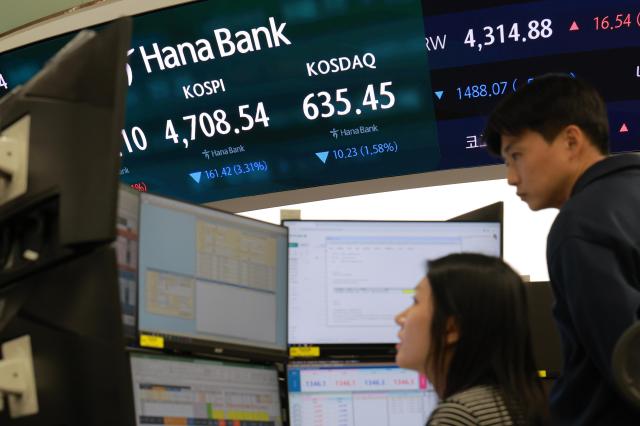
Both have lost more than half their value from their summer peaks. But in longer context - say two years - Samsung’s share price has more than tripled and SK hynix’s has risen almost sixfold.
The boom and bust expose the speculative element of the rush into chip stocks.
Investors who chased seemingly unstoppable gains are confronting risks that looked distant on the way up. The companies are still generating extraordinary profits, but confidence in what investors should pay for those profits has swung violently.
Are shareholders watching an excessive rally unwind, or a selloff that has pushed prices below what the companies can reasonably earn?
Even Bank of Korea Governor Shin Hyun-song weighed in Thursday.
“The combined market capitalization of semiconductor stocks is just over 2,000 trillion won ($1.5 trillion). That it amounts to only three times this year’s earnings (of 700 trillion won) is difficult to explain logically,” he said at a press conference following the bank’s rate-setting meeting.
His comparison used operating profit, rather than the net earnings used to calculate a conventional price-to-earnings ratio. But the disparity captures the question confronting investors: how much of today’s exceptional profit can last?
For those who bought near the top, the debate is painfully immediate.
“I bet my life on stocks and went all in,” wrote one user on Naver’s stock discussion board for SK hynix, identifying himself as an employee of a major corporation. “I drink two bottles of soju every day looking at my bank balance.”
The post captures the personal cost of turning confidence in a company into an all-or-nothing wager. Strong businesses can still be punishing investments when bought at prices that leave little room for disappointment.
A collapse inside a longer rally
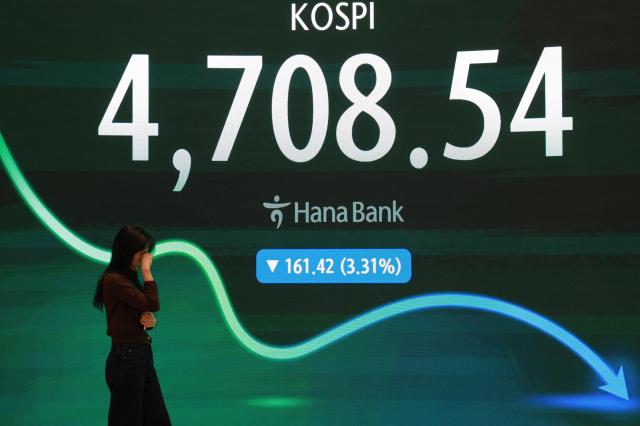
Samsung Electronics closed Wednesday at 170,700 won and SK hynix at 1.03 million won. Against their summer intraday peaks of 374,500 won and 2.987 million won, the declines amount to 54.4 percent and 65.5 percent, respectively.
The losses look different when measured from before the rally.
Samsung ended 2024 at 53,200 won and SK hynix at 173,900 won. Despite the collapse, they remained 221 percent and 492 percent above those levels on Wednesday, excluding dividends.
At their summer peaks, the shares had multiplied roughly sevenfold and 17-fold from end-2024.
That does not establish that the peaks were unjustified or that current prices are expensive. Earnings have also surged. It does show why the size of the fall alone cannot settle the valuation question.
Investors who bought before the boom and those who chased its final stretch are looking at the same prices from vastly different positions. For the latter, a belief in the long-term AI story offered little protection against the price paid to participate in it.
“There may have been some overshooting, but it was not unique to Korea,” an analyst at Mirae Asset Securities told AJP. “The rush into a handful of stocks was a global phenomenon.”
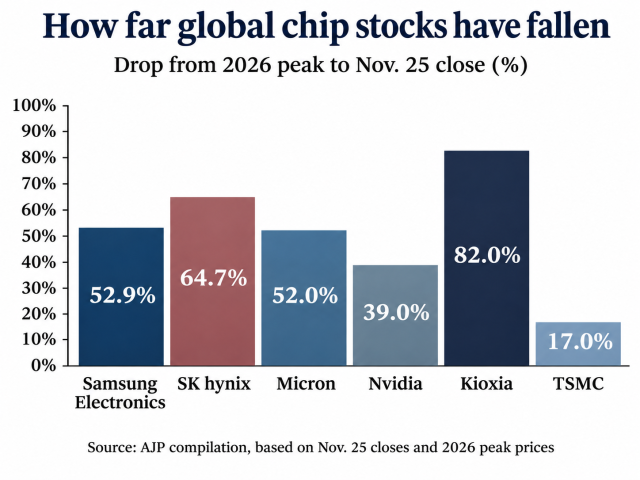
The reversal has also been global.
As of Wednesday’s close, Samsung and SK hynix were still up about 42 percent and 58 percent for the year. U.S. memory-chip maker Micron Technology and Japan’s NAND flash specialist Kioxia had gained about 111 percent and 98 percent, respectively.
Taiwan Semiconductor Manufacturing Co. (TSMC) was up about 39 percent and Germany’s Infineon Technologies 8.4 percent. Nvidia, by contrast, was down nearly 20 percent amid doubts about AI spending and the leadership turmoil surrounding co-founder Jensen Huang.
Measured against their peaks, the picture was considerably darker. Micron had lost about 52 percent from its high of $1,255. Nvidia closed Wednesday at $149.30, nearly 39 percent below its October peak of $243.37. TSMC had proved more resilient, falling about 17 percent from its October high.
Huang’s return as Nvidia CEO on Monday failed to sustain a recovery. The shares fell for two consecutive sessions afterward.
“Huang’s return did not resolve doubts over the returns on AI investment or the outlook for the memory market from 2028 onward,” an analyst at Yuanta Securities said.
Looking beyond the boom
The immediate earnings picture remains strong. South Korea’s semiconductor exports surged 294.4 percent from a year earlier to $38.5 billion in the first 20 days of November.
Investors, however, are increasingly focused on what follows the boom.
Tighter U.S. restrictions on China’s access to advanced chips, concerns about data center regulation and the prospect of higher interest rates have unsettled expectations for demand. Planned capacity additions raise a separate question about supply.
BNP Paribas added to those concerns by downgrading Micron from a buy-equivalent rating to neutral and cutting its price target to $775 from $1,700. The bank warned that memory production could catch up with demand as early as mid-2027, putting pressure on prices and profitability.
It also flagged the possibility of reduced high-bandwidth memory (HBM) content in Nvidia’s next-generation graphics processing units.
For memory manufacturers, even a relatively small change in the supply-demand balance can have an outsized effect on prices and margins. Record exports today therefore offer limited reassurance about profits two years from now.
Korea’s market concentration has amplified the adjustment.
Foreign investors sold a net 1.95 trillion won of KOSPI-listed shares on Wednesday, including about 1.01 trillion won of Samsung Electronics and 559.6 billion won of SK hynix. The two accounted for roughly 80 percent of foreign net selling.
With their combined KOSPI weighting at 44.85 percent, the broader market had little shelter. The index fell 6.16 percent, compared with declines of 4.8 percent in Taiwan’s TAIEX and 2.78 percent in Japan’s Nikkei 225.
“Korea’s market capitalization is far more concentrated in its two largest stocks than in overseas markets, making it more susceptible to volatility,” the Mirae Asset analyst said, pointing to heavy trading volumes and financial products tied to large-cap stocks.
Daol Investment & Securities attributed much of the recent weakness to persistent inflation, the prospect of higher interest rates and profit-taking.
“The unusually steep decline relative to the scale of foreign selling reaffirmed that share prices were being driven more by market flows than by earnings,” the Yuanta analyst said.
Cheap against which earnings?
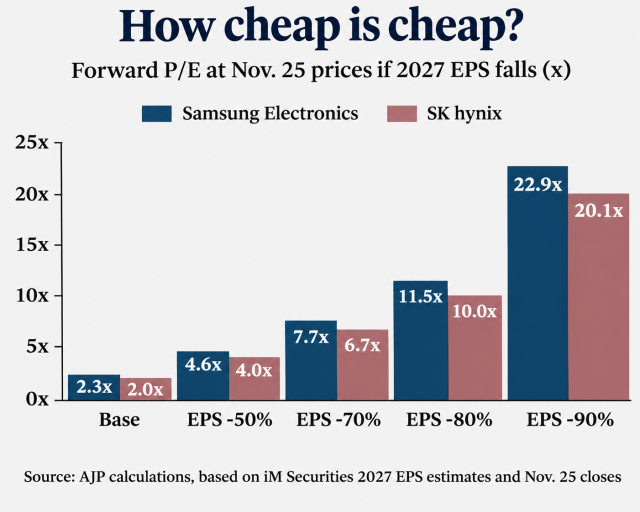
At Wednesday’s closing prices, Samsung and SK hynix traded at just 2.29 and 2.01 times iM Securities’ projected earnings for 2027, according to AJP calculations.
Those multiples offer a stronger argument for undervaluation than the distance from the summer peaks. But they depend on forecasts from one brokerage and on how representative next year’s earnings prove to be.
“The market’s inability to sustain a rebound despite low valuations reflects a lack of confidence in the durability of future earnings,” the Yuanta analyst said.
AJP tested how the multiples would change if earnings fell from iM Securities’ 2027 estimates of 74,427 won per share for Samsung and 513,110 won for SK hynix.
At unchanged share prices, a 50 percent earnings decline would raise their P/E ratios to 4.59 and 4.01. A 70 percent decline would lift them to 7.65 and 6.69.
The apparent discount becomes less striking under deeper declines. An 80 percent fall would put Samsung at about 11.5 times earnings and SK hynix at 10 times. A 90 percent collapse would lift both above 20 times. These are sensitivity calculations, not earnings or share-price forecasts.
The exercise shows that current prices leave room for a substantial profit decline. It does not establish a floor. A prolonged downturn, weaker cash generation after capital spending or further cuts to earnings forecasts could change the assessment.
“Current share prices are excessively reflecting the risks to future earnings,” the Mirae Asset analyst said. “Market flows and global uncertainties are still weighing heavily on share prices.”
How severe a downturn?
In a Nov. 24 report, iM Securities analyst Ko Eui-young projected that global DRAM supply would fall about 4 percent short of demand in 2028.
Under a stress scenario combining the loss of China-related indirect demand with the postponement of 12 gigawatts of data center construction until 2029, the balance would shift to a surplus of about 1 percent.
The surplus could reach about 5 percent if the HBM wafer capacity released by weaker demand were diverted to conventional DRAM. Ko considered that shift unlikely, citing demand from custom AI chip developers and long-term agreements covering volumes and prices.
That offers a counterweight to fears of a severe glut. It remains a model of future demand, capacity and customer behavior, rather than proof that profits will hold.
The two-year price history and the earnings forecasts can therefore support different conclusions without contradicting each other. The selloff is a sharp correction within an exceptional advance. It may also have created undervaluation if a substantial share of the earnings gains survives.
“The market could stage a rebound as conditions stabilize in early 2027, though volatility may persist through year-end,” the Mirae Asset analyst said.
For shareholders, the danger is repeating the same speculative leap in reverse: assuming that prices must recover because they have fallen so far, just as rising prices once seemed to promise further gains.
The summer peaks are a poor guide to fair value. Whether today’s prices offer a bargain depends on how much profit survives when the shortage eases — and how long investors must wait to find out.

Ryu Yuna
Yuna Ryu covers finance, capital markets and Southeast Asian affairs.
She is drawn to the questions that numbers raise and the stories that data alone cannot answer.
Prior to journalism, she worked at Hyundai Motor Company and the Singapore Chamber of Commerce, focusing on business strategy and international affairs. She has also hosted diplomatic receptions and international conferences as an MC.
Ryu holds a master's degree in Media and Communication from Korea University, where her research focused on neuroscience-based studies of media effects.
Copyright ⓒ Aju Press All rights reserved.
