

SEOUL, November 26 (AJP) - The cost of living has been cited as the primary cause of the Republicans’ landslide defeat in November’s midterm elections. Yet the return to the tariff playbook suggests the Trump administration has yet to learn its lesson, with proposed levies threatening to push up prices on everything from chips to garments made in Asia.
U.S. Trade Representative Jamieson Greer concluded that industrial policies in 14 economies, 12 of them in Asia, unfairly burden American commerce through excess production and government subsidies. The findings open the way for duties under Section 301 of the Trade Act of 1974.
For South Korean goods, Washington proposed tariffs of up to 15 percent, counting ordinary most-favored-nation duties and existing Section 301 tariffs toward that figure.
A product already facing 12.5 percent under the earlier forced-labor measure could therefore face another 2.5 percentage points. Washington left open a rate of up to 25 percent if consultations and existing commitments prove unsatisfactory.
The proposal revives the tariff threat through a different legal route. In February, the U.S. Supreme Court ruled that the emergency powers President Donald Trump invoked did not authorize his earlier duties. Section 301 allows Washington to impose tariffs after investigating a trading partner’s practices.
Greer said the proposal would “level the playing field for American workers.”
Across Asia, the question is whether it would curb subsidized overproduction or penalize investments that American customers also need.
Washington’s case against South Korea begins with two companies.
Samsung Electronics and SK hynix account for more than 70 percent of the global DRAM market and 51 percent of NAND flash, according to the U.S. trade office. They also supply roughly eight in 10 high-bandwidth memory chips used alongside AI processors in data centers.
The trade office cited preferential lending by state-owned banks and government support for power, water and permits, arguing that these measures cost American producers sales in South Korea and third-country markets. Its findings also cover automobiles and petrochemicals.
Seoul’s investment ambitions give Washington concrete projects to scrutinize.
In June, the government outlined plans for 800 trillion won in chip fabrication plants in the southwest. An August agreement among the government, Samsung Electronics, SK hynix and Korea Electric Power Corp. calls for about three gigawatts of initial power capacity in Honam. The energy ministry said the first plants could begin operating in 2029.
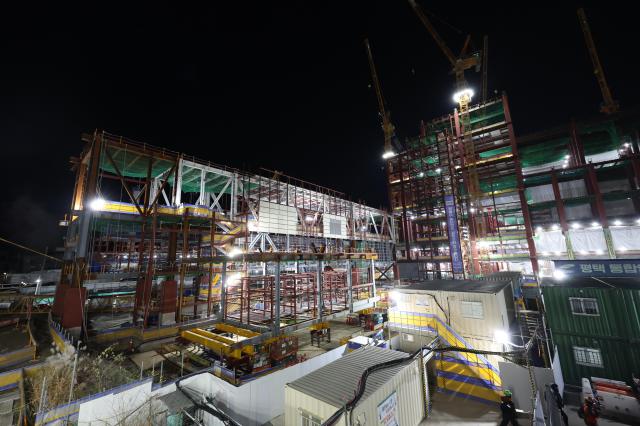
That provides a timetable for construction, but little certainty about demand when production begins.
“Taiwan’s own record is a warning. In the 2000s, new science parks were spread around the island partly as rewards to regional constituencies, and some, such as Erlin in Changhua, sat largely empty for years after the land had been acquired,” Jinn-yuh Hsu, a distinguished professor of geography at National Taiwan University, told AJP.
“What would persuade me is commitment rather than announcement: equipment orders placed with toolmakers, secured grid and water connections, hiring, board-approved budgets with dated wafer-start targets, and customer contracts. Even then, a glut is not the same thing as structural excess capacity,” Hsu said.
“Memory has always moved in boom-and-bust cycles. Capacity becomes structural only when it refuses to exit in a downturn, because subsidies, state-directed credit or political promises keep the lines running below cost,” he added.
Erlin illustrates the danger of treating plans as production. Approved in 2008 as an optoelectronics hub, including display panels, the project shifted in 2012 toward precision machinery and businesses using less water and producing fewer emissions.
“I don’t think it’s fair and reasonable to build in future capacity in existing arguments for structural excess capacity. After all, future capacity can be delayed and/or even undone,” said Henry Wai-chung Yeung, an economic geographer at the Chinese University of Hong Kong who studies Asian semiconductor supply chains.
U.S. investigators acknowledged that no single measure establishes excess capacity. They said they examined longer periods where appropriate to distinguish persistent government intervention from swings in demand.
The underlying question remains difficult: without state support, would a company build a smaller factory, build elsewhere or simply pay more to operate at the same site? Each outcome has a different effect on global supply.
Chipmakers also risk losing business if they wait for a shortage before investing.
“Firms that dare to expand production capacity even when the global market is sluggish will finally win the competition and expand market share. I think this is how the Korean IC manufacturers have grown into globally competitive firms,” said Tomoo Marukawa, a Japanese economist at the University of Tokyo.
He read Washington’s warning as a message that “you should leave room for our sales expansion.”
SK hynix said in October that 14 major customers, including cloud service providers, had signed long-term agreements covering more than half its production capacity for 2027 and 2028.
Those commitments offer evidence of demand, but both years precede Honam’s planned opening. The contracts’ strength also depends on how much risk buyers accept.
“For capacity reservations, I would distinguish forecasts or expressions of interest from binding purchase commitments,” said Louis Lehot, a technology and corporate lawyer and partner at Foley & Lardner LLP in Silicon Valley.
“Multi-year agreements with minimum purchases, take-or-pay provisions, deposits or similar economic exposure are stronger evidence of durable demand,” he said.
A buyer committed to paying for chips it no longer needs shares the investment risk. One free to cut orders when prices fall leaves more of that burden with the manufacturer.
Tariffs could alter financing assumptions, margins and contract terms, Lehot said. Their effect on investment in Honam would depend on the project.
Seoul also argues that Korean production is closely integrated into American supply chains — a relationship Washington itself has subsidized.
In December 2024, the U.S. Commerce Department awarded SK hynix up to $458 million for an advanced packaging and research facility in West Lafayette, Indiana. The plant is designed to package high-bandwidth memory for AI systems.
That creates a tension in Washington’s case: Korean memory production can compete with American suppliers while also feeding American manufacturing.
Who picks up the bill
The same interdependence runs through Malaysia, which accounted for 13 percent of global chip assembly, testing and packaging activity, according to its central bank’s 2024 economic review.
Moving that work requires suppliers that can meet technical specifications, pass customer checks and deliver at comparable cost.
“Semiconductor products packaged and tested in Malaysia may also embody substantial US-origin technology and intellectual property. Higher tariffs could therefore indirectly increase the cost of economic value previously created in the United States,” said Goh Lim Thye, an associate professor of economics at Universiti Malaya.
The U.S. proposal exempts several categories of integrated circuits from Malaysian duties.
For covered goods already facing a 10 percent Section 301 tariff, Goh calculated that raising the rate to 18 percent would add $80 million per $1 billion of imports, assuming unchanged import values. At 25 percent, the increase would be $150 million.
Importers pay at the border. How much they recover depends on negotiations with suppliers and customers.
Bangladesh’s garment industry has already experienced that bargaining pressure.
“Brands and buyers put pressure on exporters to cut down offer prices” when the earlier U.S. reciprocal tariffs took effect, said Mustafizur Rahman, a trade economist and distinguished fellow at the Centre for Policy Dialogue in Dhaka.
Buyers seeking to hold retail prices steady absorbed some costs and pushed others back onto suppliers. An unchanged price tag could conceal a loss on a garment maker’s books.
Washington is proposing tariffs of up to 18 percent for covered Bangladeshi goods, net of existing Section 301 duties. Its findings single out ready-made garments, citing export incentives and inadequate labor protections.
The notice also seeks comment on allowing a limited volume of textiles or apparel to enter at a lower rate. For factories negotiating orders, access to that allowance could matter as much as the headline tariff.
Goh said exemptions should be judged by the investment they unlock: equipment purchases, signed supply agreements and deferred projects brought forward because firms have greater tariff certainty. For workers, the test is whether investment raises wages and helps local firms undertake more sophisticated work.
“What matters is how much sustainable domestic value each economy creates,” he said.
The proposed rates give Asian governments powerful incentives to negotiate.
Japan and Taiwan join South Korea in the 15 percent group. Singapore faces up to 20 percent, with 10 percent possible after a satisfactory agreement or negotiations. Vietnam faces up to 35 percent, potentially reduced to 20 percent under a qualifying trade agreement. India could qualify for 17 percent, down from 25 percent.
China’s proposed treatment varies by product: up to 20 percent for goods outside two designated lists, net of the separate forced-labor Section 301 duty; up to 10 percent for one list; and exemptions for the other.
Taiwan’s cabinet said Thursday it was confident Washington would honor their agreed 15 percent terms. South Korea’s trade ministry said Washington had also assured Seoul that its bilateral deal would be respected when rates were finalized.
Seoul has pledged $350 billion in U.S. investment, including $150 billion for shipbuilding. Rep. Yoon Sang-hyun of the People Power Party said Washington’s discretion to raise tariffs to 25 percent gives it leverage over delivery.
“This means that even domestic industrial investment plans could become a subject of trade negotiations with the United States,” Yoon said.
He urged Seoul to demonstrate how Korean chip investment supports American supply chains and report to the National Assembly on progress toward its U.S. investment commitments.
Washington “unilaterally threatens to increase its tariffs to invite target countries to negotiate,” Taiji Furusawa, a University of Tokyo economics professor, told AJP.
He urged Seoul and Tokyo to accelerate promised U.S. investments or present concrete plans benefiting both sides, while reminding Washington that American consumers and manufacturers using imported inputs also pay higher prices.
Written comments are due Jan. 5, 2027, with public hearings scheduled to begin Jan. 25 in Washington.
Seoul will have to defend factories that have yet to produce a chip. Washington will have to explain how taxing their output serves American manufacturers — and voters already unhappy about prices.
Lee Jung-woo
I studied philosophy in college, and sociology and journalism in graduate school. I cover North Korea, South Korean politics, foreign affairs and films. I enjoy Nordic cinema, Indian cuisine and Japanese detective novels. I have a cat and like bright, acidic coffee.
Copyright ⓒ Aju Press All rights reserved.
