

SEOUL, November 26 (AJP) - Hacking has become an almost daily event in South Korea, threatening public and private organizations large and small — and creating an unlikely business boom for law firms.
“Personal information breaches have become so frequent that we are seeing an average of 3.3 incidents a day. There are so many cases that we can hardly handle them all,” Heo Seung Jin, an attorney at law firm Yulchon, told AJP on the sidelines of a cybersecurity seminar in Seoul on Thursday.
His estimate was based on a review of publicly reported incidents over roughly 45 days from October to mid-November.
The workload has prompted dark humor about hackers inadvertently creating jobs for lawyers.
“There is so much work related to these incidents that domestic law firms are recruiting more people for these practices,” Heo said.
For corporate clients, the question is increasingly not whether an attack will come, but how they will respond.
“These days, when companies suffer a cyberattack, they come to us with a sense that what they had been expecting has finally happened,” Heo said. “It has become impossible to prevent every attack, so we have no choice but to respond immediately.”
Tougher cybersecurity and data protection rules are adding to demand for legal advice. Companies must account for both their security precautions and their handling of a breach.
Amendments to the Personal Information Protection Act that took effect Sept. 11 allow punitive administrative fines of up to 10 percent of total revenue for qualifying serious or repeated violations. The rules also provide for reductions reflecting preventive investment and safeguards.
Changes to the Information and Communications Network Act, effective Oct. 1, allow authorities to investigate suspected cybersecurity incidents even without a report from the affected company, subject to a review committee’s determination that an investigation is warranted.
Service providers that suffer two or more incidents within five years because of intentional misconduct or gross negligence can face fines of up to 3 percent of revenue calculated under the law.
With the financial stakes rising, companies are seeking legal advice before an attack occurs.
Kim So Jung, another Yulchon attorney, said clients increasingly want to know how to demonstrate that they took reasonable precautions and limit potential penalties.
“It is impossible to prevent every attack. Companies need not only to take preventive measures but also to maintain records of those efforts so that they can submit them as evidence later,” Kim told AJP.
“To demonstrate that an attack was unavoidable and could not have been prevented with the technology available at the time, companies must first prove that they took adequate preventive measures.”
Kim said cybersecurity-related cases had increased noticeably from previous years.
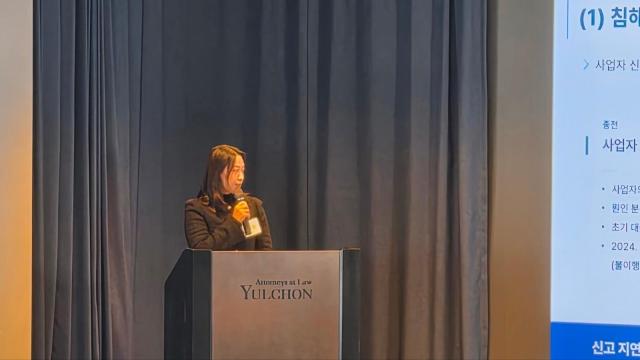
Telecommunications operators face additional exposure under the revised Telecommunications Business Act. Speaking at the seminar, Kim explained that operators could face liability for damages even without fault, making evidence that an attack was beyond their control increasingly important.
The law allows liability to be reduced or waived when damage results from force majeure or a user’s intentional conduct or negligence.
Companies must also work against tight reporting deadlines. Covered service providers generally must report cybersecurity incidents within 24 hours of becoming aware of them, while qualifying personal data breaches must be reported within 72 hours under data protection rules.
Both attorneys stressed that companies should report confirmed facts first and supplement them as investigations progress, rather than wait until the full extent of a breach is known.
For businesses, cybersecurity now demands two lines of defense: protecting systems against hackers and demonstrating to regulators that those protections were adequate. For law firms, both are bringing more work.

Candice Kim
Candice Kim is a dedicated business and technology reporter specializing in the intersection of high-tech innovation and fast-paced consumer trends. Her core beats span the semiconductor, IT, cosmetics, and retail sectors, where she provides in-depth coverage of industry titans including Samsung Electronics, SK hynix, and LG Electronics, alongside leading consumer brands like Olive Young and Musinsa. Whether analyzing complex silicon supply chains or tracking the latest shifts in beauty and fashion retail, Candice is committed to delivering sharp, accurate reporting that keeps readers informed on the forces shaping today's most dynamic markets.
Copyright ⓒ Aju Press All rights reserved.
